Dairy-Free Ice Cream for Toddlers: Which Plant Bases Actually Feed a Small Child
Published on September 19, 2026

An adult who goes dairy-free swaps out one food among hundreds. A two-year-old who goes dairy-free loses the single item quietly carrying a large share of their protein, calcium, iodine and calories, and has a stomach the size of a fist to make up the difference in. That asymmetry is why paediatric guidance on plant bases reads so much more cautiously than the advice aimed at grown-ups, and why “it is dairy-free, so it is fine” stops being a safe shortcut somewhere around the age of one.
Frozen desserts sit awkwardly in that picture. In a milk-allergic household the dairy-free pint often stops being an occasional treat and becomes the thing the child has instead, at parties, after nursery, at the end of most dinners. Once a dessert is routine, its base is part of the diet, and the base you picked for flavour is doing nutritional work it was never built for.
A Toddler Is Not a Small Adult
The reason milk looms so large in early childhood is arithmetic. Small children need far more energy and protein per kilogram of body weight than adults do, with very little appetite volume to deliver it in. Milk is unusually efficient at that job, so removing it leaves a gap that has to be filled deliberately rather than assumed away.
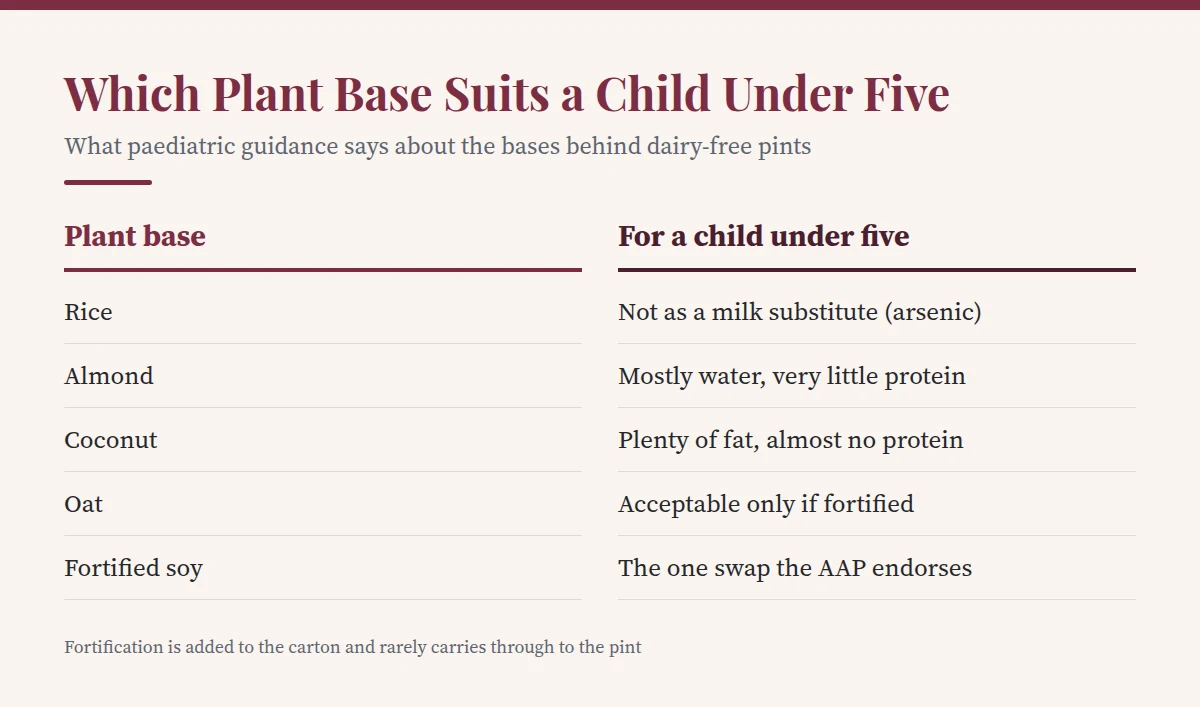
The American Academy of Pediatrics made the point in its committee review of lactose intolerance in children: it supports dairy as an important source of calcium for bone mineral health, and states that if dairy products are eliminated, other dietary sources of calcium or calcium supplements need to be provided. Note the structure of that sentence. Elimination is allowed. Elimination without replacement is not.
Timing matters too. Capra and colleagues, reviewing complementary feeding for Nutrients, call the introduction of solid foods one of the critical and sensitive periods in human life, with consequences reaching well past infancy, and are explicit that alternative approaches including plant-based weaning deserve professional support rather than improvisation. A parent building a dairy-free diet for a toddler is working inside that window, not after it. If you have not established what you are working around, start there: a lactose problem, an IgE milk allergy and a delayed non-IgE reaction lead to three different diets, and what each dairy test can and cannot tell you is worth settling first.
Plant Drink and Plant Formula Are Not the Same Product
This is the distinction that causes the most trouble and the one no packaging explains.
Brusati and colleagues, writing in Foods, split plant-based milk alternatives into two categories that differ in both manufacturing and regulation. Plant-based formulas are built to a compositional standard and can be used interchangeably with cow-origin formula. Plant-based drinks are a different class of product: nutritionally unlike cow’s milk, variable between brands and even within a brand, and meant to follow the use of formula rather than replace it.
The World Allergy Organization’s DRACMA guidance on nutritional management of cow’s milk allergy, led by Venter and colleagues, works from the same split. Its substitute formulas are soy formula, milk-based extensively hydrolysed formulas, rice-based extensive and partially hydrolysed formulas, and amino acid-based formulas. Plant beverages appear separately, and the wording matters: for toddlers who are eating well, for older children and for adults, a suitable plant-based beverage may be a suitable alternative to a specialised formula, following careful nutritional considerations. “Eating well” and “careful nutritional considerations” are doing real work there.
Every dairy-free ice cream on the market is built from a drink, never a formula. That does not make it a bad food. It makes it a food carrying no nutritional guarantee at all.
Rice Is the One Base With a Hard Age Rule
Most base advice for young children is a matter of degree. Rice is not.
The NHS is unambiguous: children under five should not be given rice drinks as a substitute for breast milk, infant formula or cows’ milk, because of the levels of arsenic in these products. Rice takes up more inorganic arsenic from soil and water than other grains do, and an exposure tolerable across an adult diet is not tolerable spread across a body that small.
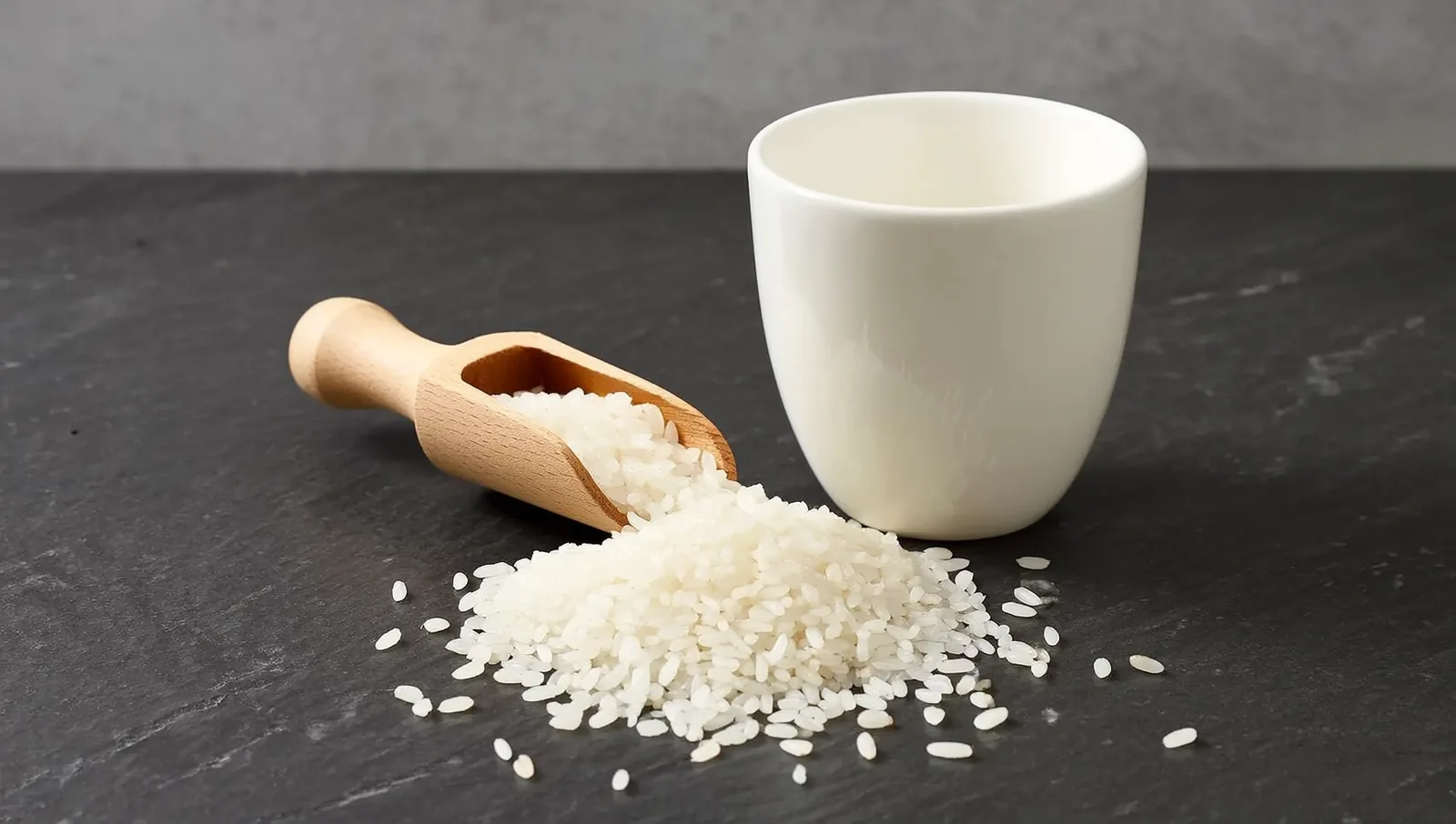
That is a rule about rice drinks standing in for milk rather than a blanket ban on rice, and the NHS says so directly for parents now worrying about what has already happened. But it travels to the freezer in one case: if a rice base is the household default, turning up in the cup and the dessert bowl and the pudding, the cumulative picture is exactly what the guidance is aimed at. The FDA monitors the same contaminant in rice and has set an action level for infant rice cereals. Neither body says a single rice-based sorbet will hurt a child. Both say rice should not be the base a small child lives on.
Almond and Coconut Are Thin Where It Counts
These are the two bases shoppers most often assume are the wholesome choice, and for a small child they are among the weakest.
The AAP’s guidance on drinks for children aged nought to five puts it flatly: most plant-based milks are not nutritionally equivalent to cow’s milk and may lack protein, vitamin D and calcium, and other than soy, plant-based milks are not recommended for children to drink in place of dairy milk. Almond is the clearest case. A plain almond drink is mostly water, and the nut content that gives it its name contributes very little protein per serving.
Coconut has the opposite problem. It brings plenty of fat, which is why it dominates the freezer case and churns so beautifully, but almost no protein. In a dessert eaten now and then that is irrelevant. In a base also standing in for milk, a fat delivery system with nothing behind it is not a swap, it is a subtraction. The trade-offs of each base are laid out in my guide to the plant milks behind dairy-free ice cream.
Fortified Soy Is the Base the Guidance Actually Endorses
Ask what paediatric bodies do recommend and the answer narrows quickly.
The AAP names soy directly as nutritionally equivalent to cow’s milk and an acceptable alternative. The NHS is broader, allowing unsweetened calcium-fortified milk alternatives such as soya, oat or almond drinks from the age of one as part of a healthy balanced diet, with the fortification and the balanced-diet qualifier both load-bearing. The two authorities diverge on how wide the door is, and the honest reading of that gap is that soy is the base both are comfortable with, while the others depend on what else the child is eating.
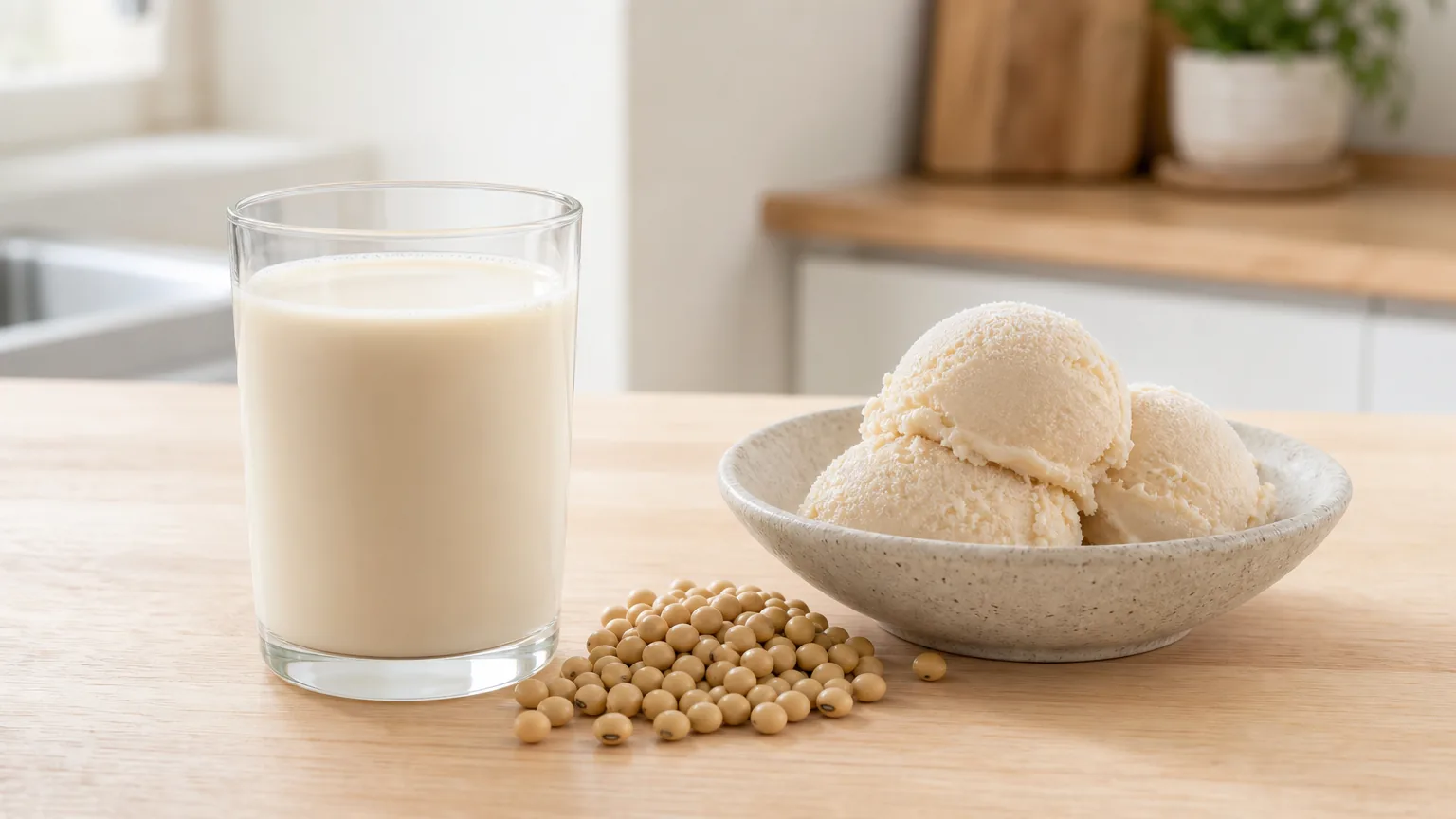
That is useful for frozen desserts, because soy is also the plant protein that performs best in a churned base. It builds body the way dairy protein does instead of leaning entirely on gums and fat, which is the case I make at length for the original dairy-free base. Pea protein behaves similarly and carries real protein per serving. If a dairy-free dessert is going to be a regular fixture, these are the two bases that give you something back. One caveat worth stating out loud: soy drink is not soy formula, and neither is a soy ice cream. DRACMA treats soy formula as a medical product with its own indications, and nothing in the freezer aisle substitutes for one.
The Fortification Gap Between the Carton and the Pint
Here is the part that catches out careful parents. The calcium, vitamin D and B12 in a carton of oat or soy drink are almost always added. They are not native to oats or soybeans in those amounts. Fortification is a deliberate manufacturing step, and it is the main reason a plant drink can stand in for milk at all.
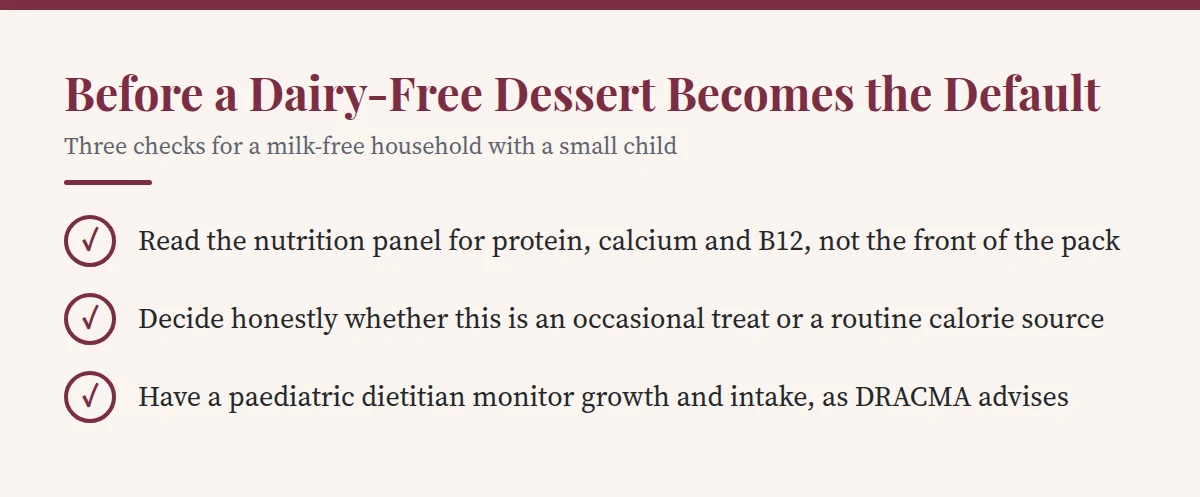
That step does not automatically survive the trip into a frozen dessert. Fortifying an ice cream is optional, it complicates the formulation, and most manufacturers do not bother. So a pint built on a fortified oat base frequently arrives with none of the fortification that made the base acceptable in the first place, and the only way to know is the nutrition panel rather than the front of the pack. A scoop showing nothing meaningful for protein, calcium or B12 is a treat rather than a contribution. That is the same discipline every claim on a dairy-free tub deserves, which I set out in how to read a dairy-free ice cream label.
Homemade Is the Riskiest Choice for a Small Child
For an adult home churner, blending your own cashew or oat milk is a virtue. It gives you control over sugar, gums and flavour, and it is the approach I generally recommend in my homemade dairy-free ice cream guide.
For a toddler it inverts. Home-blended plant milk has no added calcium, no added vitamin D, no added B12, and whatever protein the nut or grain carried, which is usually very little once it has been strained. Every advantage a commercial carton holds for a small child is precisely the industrial fortification a home blender cannot reproduce. Antunes and colleagues, comparing cow’s milk with plant-based alternatives, note that consumption of these products has been associated with the development of disease in infants and children, and unfortified preparations used as a milk substitute are the clearest route there. Make the dessert at home if you like. Do not let the milk the child drinks be homemade too.
When a Treat Becomes a Calorie Source
The quiet risk in a milk-allergic household is displacement rather than any single ingredient. A child who fills up on a sweet, low-protein, unfortified dessert most evenings has less appetite left for the foods meant to be closing the gap milk left behind. The dessert does not have to be harmful to do harm. It only has to be there instead of something denser.

DRACMA builds this into its definition of good management. Optimal elimination of cow’s milk includes label reading, information about safe and nutritious substitute foods, appropriate choice of formula or plant-based food, establishing tolerance to baked milk, and monitoring nutritional intake and growth. Monitoring is on the list, not appended to it. The guidance also advises against other mammalian milks such as goat or sheep, which cross-react with cow’s milk protein. That baked milk point matters more than it looks: many children with cow’s milk allergy tolerate milk baked into a matrix, and establishing that under clinical supervision can widen a diet considerably. It is a conversation for an allergist, not a kitchen experiment.
Away from home the provision is often thinner than parents expect. A BBC investigation into the school milk schemes in England and Wales found only cow, goat and sheep products are eligible, with alternatives left to each school’s discretion and typically supplied on request at extra cost. One parent was told her severely milk-allergic son’s options at milk time were cow’s milk or water. When school and nursery offer nothing, the load shifts back to the home diet and the dessert bowl carries more weight than anyone planned.
The Bottom Line
Start with the base, because it decides most of the rest. Fortified soy or pea gives you protein. Oat is acceptable if fortified and sits in the middle. Almond and coconut are flavour and texture rather than nutrition. Rice is the one to keep off the regular rotation for an under-five. Then turn the tub over and read the panel rather than the claim, looking for protein per serving and any calcium, vitamin D or B12 that survived the trip from the carton. If the household is managing more than one allergy the options narrow fast, and my multi-allergy family’s guide maps which bases stay open when soy or nuts are also out.
Above all, keep the frame straight. A dairy-free dessert is not a nutrition product and nothing in the freezer aisle claims to be one (the published evidence on how dairy-free pints actually compare on sugar, fat, protein and micronutrients is a useful corrective to the marketing). For a milk-allergic toddler the whole question should be running past a paediatric dietitian anyway, because monitoring growth and intake is part of the treatment rather than an optional extra. Treat the dessert as a dessert, and let something else do the feeding.
Further reading (sources)
- Brusati and colleagues in Foods on why plant drinks and plant formulas are different products
- Venter and colleagues for the WAO DRACMA guidance on feeding a child with cow’s milk allergy
- NHS with what young children should and should not drink, including the rice rule
- American Academy of Pediatrics on which drinks are recommended for children aged nought to five
- Heyman and the AAP Committee on Nutrition, in Pediatrics, for why eliminating dairy obliges you to replace the calcium
- Capra and colleagues in Nutrients on complementary feeding, plant-based weaning and where it goes wrong
- Antunes and colleagues comparing cow’s milk with plant-based alternatives nutrient by nutrient
- FDA for how inorganic arsenic is monitored in rice and infant foods
- BBC Wales reporting that milk-allergic pupils are often offered cow’s milk or water