Boozy Dairy-Free Sorbets: How Much Alcohol a Frozen Dessert Can Actually Take
Published on August 18, 2026
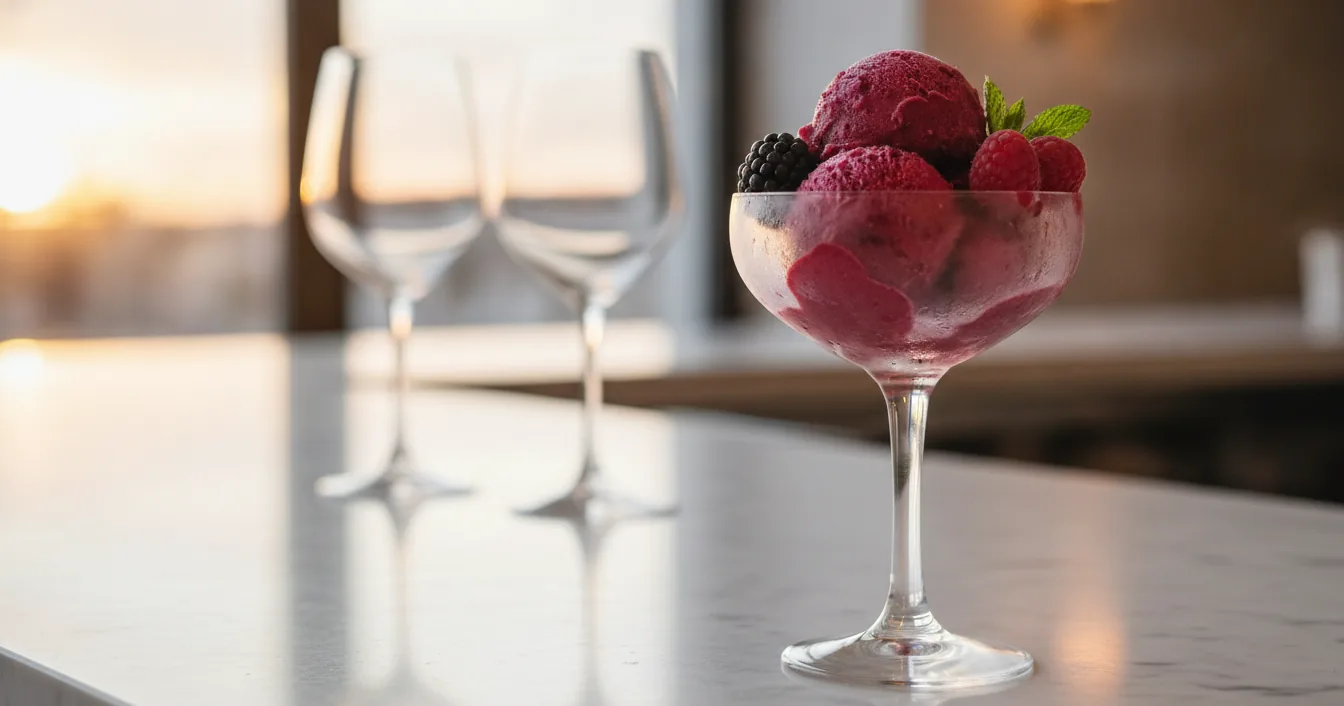
Jeni’s Sparkling Berry Punch made the point better than any recipe post could. It was blackcurrant, blackberry, and raspberry churned with Chandon California sparkling wine, a limited collaboration sold at twelve dollars a pint and meant to be eaten straight or as a scoop bobbing in a coupe of the same wine. The tasting notes that came back were telling: bold currant and black raspberry, a winey punchiness on the finish, and a texture reviewers called beautifully creamy right out of the freezer, with the wine itself credited for the softness.
That last detail is the whole technique lesson. There was no cream in that pint. The creaminess came from alcohol doing what alcohol does in a frozen dessert, which is the same thing that wrecks a batch when you pour with a heavy hand.
Why Alcohol Fights the Freezer
Ethanol does not freeze at any temperature your kitchen can produce. Pure alcohol stays liquid down to roughly 173 degrees below zero Fahrenheit, so in a sorbet base it never becomes ice. It just sits in the water phase and gets in the way of everything else trying to crystallize.
The mechanism is freezing point depression, the same job sugar does in every frozen dessert. Dissolved molecules lower the temperature at which water turns to ice, so at a normal freezer setting of about 0°F a smaller share of the water in the mix has actually frozen, and the unfrozen syrup left behind is what you experience as scoopability. How the various sweeteners play this role is covered in the reference on sugars and freezing point. Alcohol simply joins the same equation.
What makes it dangerous is potency. The effect runs on the number of dissolved molecules, not their weight, and an ethanol molecule is tiny next to a sucrose molecule. Gram for gram, ethanol pulls the freezing point down roughly seven times harder than table sugar, so a pour that looks modest in a measuring jug is doing an enormous amount of structural work in the wrong direction. Ethanol also lowers surface tension, which destabilizes the air bubbles a churn is trying to whip in, so an over-spiked base builds no volume and comes out soupy rather than light.
The Ceiling Is About Two Percent
The practical rule that formulators and experienced home churners converge on is to keep total ethanol under roughly 2 percent of the finished mix by weight. Below that, alcohol contributes smoothness and a softer set. Above it, the base stops freezing.
That single number translates very differently depending on what you are pouring, because proof varies enormously.
| What you are adding | Typical ABV | Ceiling per quart of base |
|---|---|---|
| Spirits (vodka, tequila, rum, whiskey, gin) | 40% | 2 to 3 tablespoons |
| Liqueurs (triple sec, amaretto, limoncello) | 20 to 30% | About 1/4 cup |
| Fortified wine (port, sherry, vermouth) | 17 to 20% | About 1/3 cup |
| Still or sparkling wine | 11 to 13% | About 3/4 cup |
| Beer, cider, hard seltzer | 4 to 6% | 1.5 to 2 cups, reduced first |
Every row lands in roughly the same place, between 1 and 2 percent ethanol by weight. Note how little room 3/4 cup of sparkling wine leaves in a quart of base. That is almost certainly the ballpark a commercial sorbet like the Chandon collaboration worked in, and it is why the wine registers as a finish note rather than a cocktail.
One thing that pour will not deliver is bubbles. Carbon dioxide comes out of solution the moment wine warms and gets agitated in a churn, so the word sparkling on a frozen dessert describes flavor, not fizz.
Sorbet Is the Hardest Case
Adding booze to a dairy custard is forgiving, because milk fat, milk proteins, and lactose are all holding structure. Adding it to a dairy-free sorbet is the hardest version of the problem, since sorbet is close to nothing but water, sugar, and fruit. There is no fat network and no protein scaffolding to fall back on when alcohol starts dissolving the ice. The wider differences between these formats are covered in the primer on gelato and sorbet.
You have to buy back structure somewhere else. Five things work.
Reduce the alcohol before it goes in. Simmer wine down by half and you get concentrated flavor with a fraction of the ethanol, which lets a whole bottle’s worth of taste into a base that still freezes. Nothing cooks off completely, though: USDA retention data puts a fifteen minute simmer at around 40 percent of the original alcohol still present.
Add it late. Stir the spirit in during the final minute of churning rather than at the start. The base gets most of its freezing cycle done before the alcohol shows up to interfere.
Pull the sugar back. Alcohol is now doing part of sugar’s structural job, so a base carrying a real pour needs about 10 to 15 percent less sugar than the same recipe without it. Skip this step and you have stacked two antifreezes on top of each other.
Use a stabilizer. A quarter teaspoon of locust bean gum or guar per quart binds free water that would otherwise turn to coarse ice. The rundown of gums and plant emulsifiers covers which one suits which base.
Give it more body. A few tablespoons of coconut cream push a sorbet toward sherbet texture and buy real tolerance for alcohol. If coconut is off the table, cashew cream does similar work, and the guide to coconut-free dairy-free options walks through the substitutions. Pectin-rich purées (apple, citrus, stone fruit) thicken the water phase for free.
If a batch still refuses to set, the diagnosis is nearly always the same. A base that stays slushy overnight, weeps a syrup layer, or never thickens in the machine has too much alcohol in it. More churn time will not fix that.
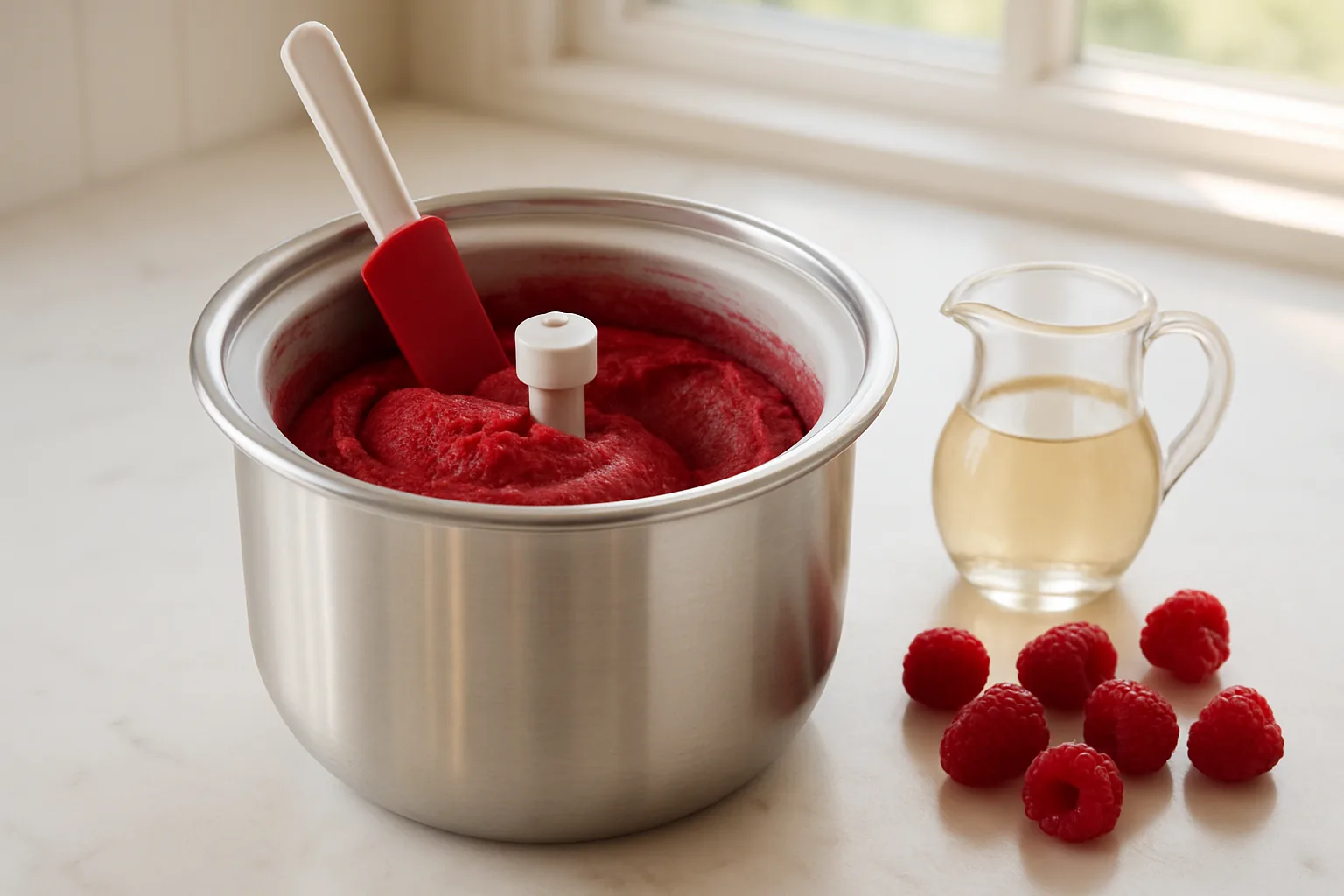
A Sparkling Berry Sorbet Worth Churning
This is a home version of the idea, sized for a standard quart machine.
Make a syrup from 3/4 cup sugar and 1/2 cup water, then cool it completely. Purée one pound of mixed blackberries and raspberries (blackcurrants too, if you can find them) and press the purée through a fine sieve to remove the seeds. Combine the purée and syrup with one tablespoon of lemon juice, a pinch of salt, and, if you want insurance, a quarter teaspoon of locust bean gum blended in thoroughly.
Chill the base overnight. This matters more than people expect. Then stir in 3/4 cup of dry sparkling wine straight from the fridge and churn immediately, about 20 to 25 minutes. It will look loose coming out of the machine, which is normal. Harden it flat in a shallow container for at least six hours, and give it eight if your freezer runs warm. Swap the wine for 1/4 cup of limoncello against a lemon purée, or 1/3 cup of tawny port against roasted plums, and the same architecture holds.
Boozy Paletas Skip the Hardest Part
Molded pops are the easier entry point, because you are not asking the mixture to stay soft and scoopable. It only has to hold a stick. No churning, no machine, and a base that tolerates a slightly heavier hand.
For eight margarita paletas, combine 1.5 cups water, 3/4 cup fresh lime juice, 3/4 cup sugar, and a pinch of salt, then add 2 tablespoons blanco tequila and 1 tablespoon orange liqueur. Fill the molds, leaving headroom for expansion, freeze for at least six hours, and dip the mold in warm water for a few seconds to release. A paloma version swaps grapefruit juice for half the water; a sangria version uses red wine, orange juice, and diced fruit.
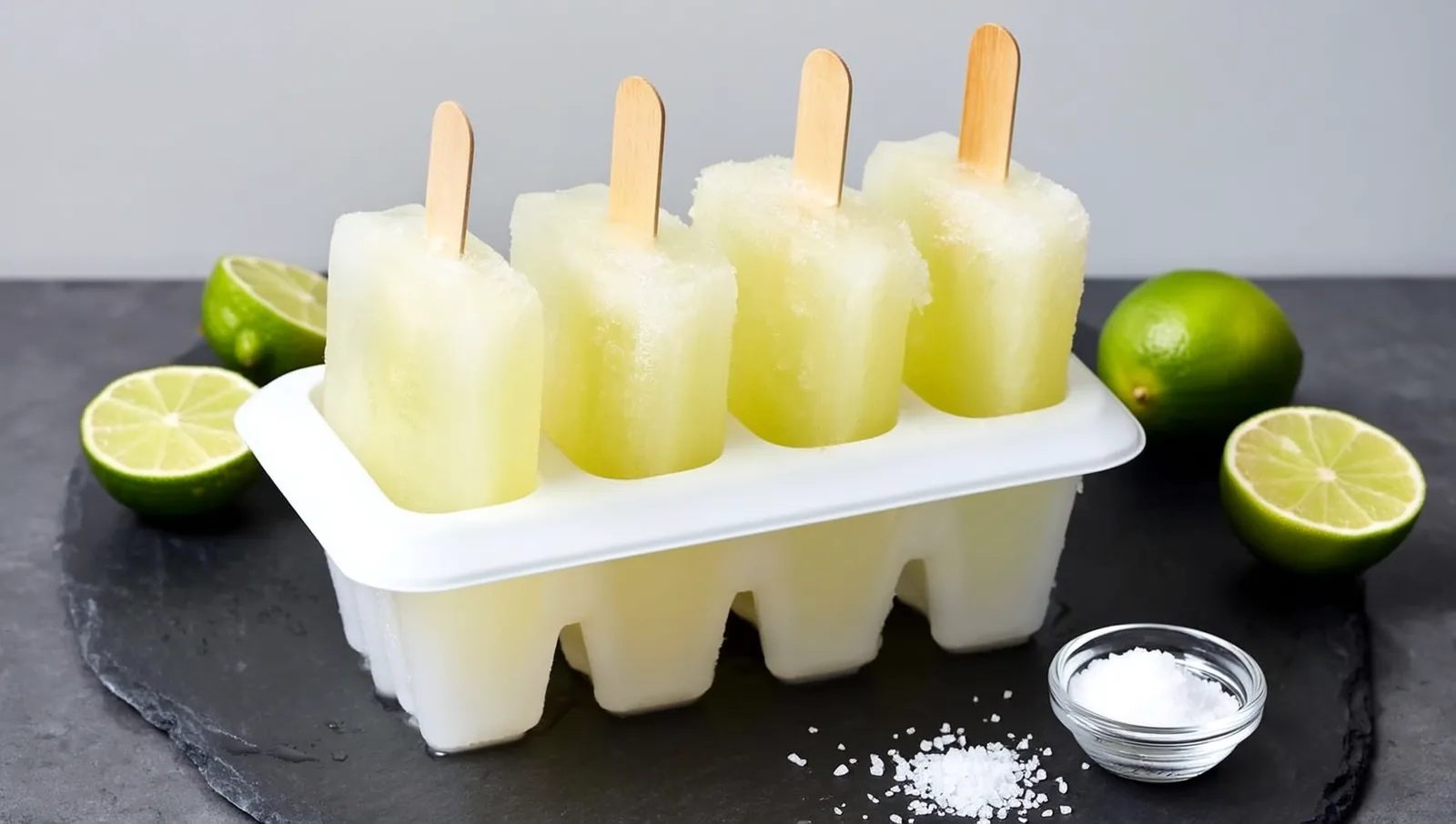
Push much past about 2 percent ethanol, though, and the pop never sets hard enough to grip the stick, so it slides out of the mold in pieces. A chest freezer set colder than a fridge-freezer makes a real difference. The rest of the mold technique, including how to suspend fruit pieces so they do not all float, is in the dairy-free paleta and frozen dessert table guide.
The Dairy Trap in the Liquor Cabinet
Here is where a boozy dessert stops being a technique question and becomes a dairy-free one.
Cream liqueurs are dairy. Irish cream, RumChata, most horchata liqueurs, and anything sold as a cream liqueur contain real milk or cream. They are not a gray area and there is no reading of the label that saves them.
Crème liqueurs usually are not. Crème de cacao, crème de menthe, and crème de cassis take that word from their sugar density, not from dairy. Most are milk-free, though the safe habit is still to check, and the label-reading method applies to a bottle as much as to a pint.
Wine can be fined with casein. This is the one almost nobody knows. Winemakers clarify wine with fining agents, and the traditional ones include casein (a milk protein), egg albumin, and isinglass from fish. Most of the agent is filtered back out, but EU labeling rules require milk and egg to be declared above a residue threshold, precisely because trace protein can remain. For a preference-level dairy-free diet this is a non-issue. For a diagnosed milk allergy it is worth a check, and vegan wine directories track fining agents bottle by bottle.
Buying It Instead of Making It
Ready-made boozy frozen desserts come in three shapes: alcohol-infused sorbetto pops sold in the liquor aisle, boozy pint brands keeping a sorbet or two alongside their cream flavors, and short-run collaborations like the Jeni’s and Chandon pint. All three are harder to shop than a normal freezer case, because products above a trace ABV are regulated as alcoholic beverages. That means age-gated retail, state-by-state distribution, and fast rotation. Do not assume anything you read about is still in production, including that Chandon sorbet.
The dairy-free check is its own step. A brand making both boozy ice cream and boozy sorbet runs them through the same equipment, so the sorbet needs the same allergen statement scrutiny you would give any pint. Sorbet is a style, not a dairy-free guarantee.
Serving It
Alcohol does not evaporate in a freezer, and cold mutes the burn, which makes a boozy dessert easy to underestimate. Label it clearly at a party and keep it off the table children are grazing.
The float one national pint brand suggested is still the best way to serve one: a scoop of berry sorbet dropped into a coupe of the same dry sparkling wine, eaten with a spoon while the edges melt into the glass. It costs nothing, it looks like effort, and the bottle you opened for the sorbet is already right there.
Further reading (sources)
- Drinkhacker on tasting the Jeni’s sparkling berry punch sorbet made with Chandon
- Ice Cream Science for how dissolved solids set the freezing curve and scoopability
- USDA Agricultural Research Service on the nutrient retention factors behind alcohol cook-off rates
- Barnivore for the community directory of which wines are fined with animal products
- U.S. Food and Drug Administration with how major food allergens including milk must be declared
- TTB on how alcohol beverages are labeled, and the proposed allergen disclosures