Stones in the Pint: How to Check Your Freezer for the So Delicious Recall
Published on September 27, 2026

If a pint of So Delicious Salted Caramel Cluster is sitting in your freezer, check it before you open it. On September 15, 2026, Danone USA recalled the flavor’s pints with best-by dates on or before April 3, 2028, because the cashew pieces mixed through them may contain small stones and other hard objects. Consumer complaints brought the problem to light, according to the company’s announcement on the FDA’s recall page, and Canada’s food inspection agency posted a matching recall of the 500 mL pint sold there a week later.
This is the second recall of the same flavor for the same reason in nine months, and the new one reaches later dates than the first, so a pint you checked and kept last winter may be covered now. Here is how to match your pint, how the refund works, why stones end up in nut pieces at all, how the FDA weighs a hazard like this, and what the recall does not tell you about the brand’s allergen handling.
Which Pints Are Covered
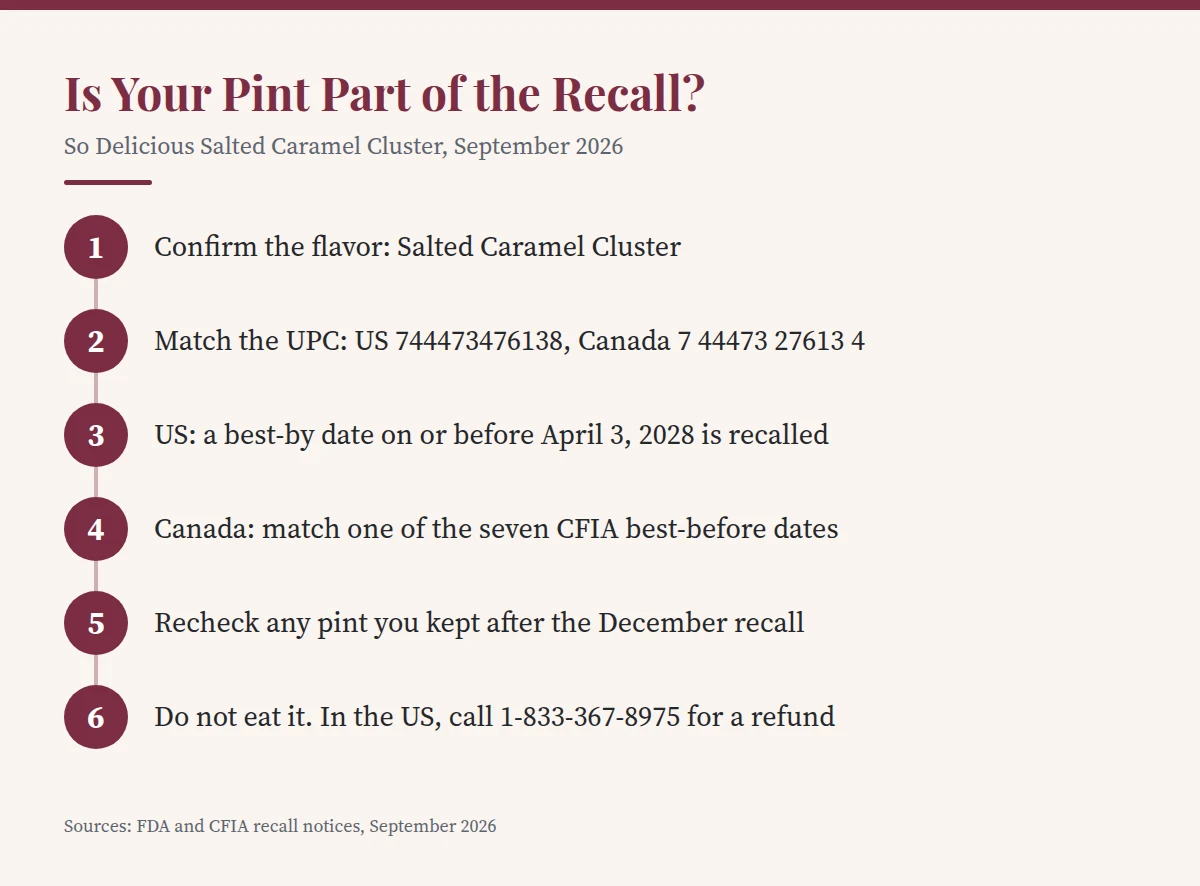
The recall is narrow: one flavor, one size. The notice says no other So Delicious Dairy Free codes, flavors or products are affected. In the United States it covers:
- Product: So Delicious Dairy Free Salted Caramel Cluster Non-Dairy Frozen Dessert, in pint containers
- UPC: 744473476138, printed under the barcode (usually spaced as 7 44473 47613 8)
- Best-by dates: on or before April 3, 2028
- SKU: 136603, in case a store or the care line asks for it
- Where sold: retail stores across the United States
Anything dated after April 3, 2028 falls outside the recall. The company says unaffected pints are still on shelves and product shipped from now on is not affected, so seeing the flavor in a store does not mean the store missed the recall. The date on the carton is what decides it.
In Canada, the Canadian Food Inspection Agency’s notice covers the 500 mL pint, UPC 7 44473 27613 4, with seven specific best-before dates: September 8, October 15 and October 16, 2027, and February 3, February 25, March 30 and March 31, 2028. The Canadian notice describes the material as plastic-like and gravel-like fragments, and the agency has already rated the recall Class 2, the middle of its three risk tiers.
How to Check the Pint in Your Freezer
Take the pint out and work through it in this order.
- Confirm the flavor, but not by the artwork. Danone’s December notice said the carton design changed in February 2025 while the UPC stayed the same, so an older-looking pint is still in play. Match numbers, not pictures.
- Match the barcode number. In the US it is 744473476138. In Canada it is 7 44473 27613 4 on the 500 mL pint.
- Find the best-by date. Check the base and the lid. In the US, any date on or before April 3, 2028 means the pint is recalled. In Canada, compare it against the seven dates above.
- Note the code line printed with the date. The FDA’s record of the December recall decodes one example, S05-33 25218 20:05: S05-33 is the plant, 25 the year, 218 the day of the year, and 20:05 the time the pint was filled. You do not need it to know whether your pint is covered, but it ties the pint to a single fill, which is exactly what a complaint needs.
- Recheck anything you cleared in December. That recall stopped at best-by dates before August 8, 2027. A pint dated October 2027, which was fine to keep then, is inside this one.
Getting Your Refund
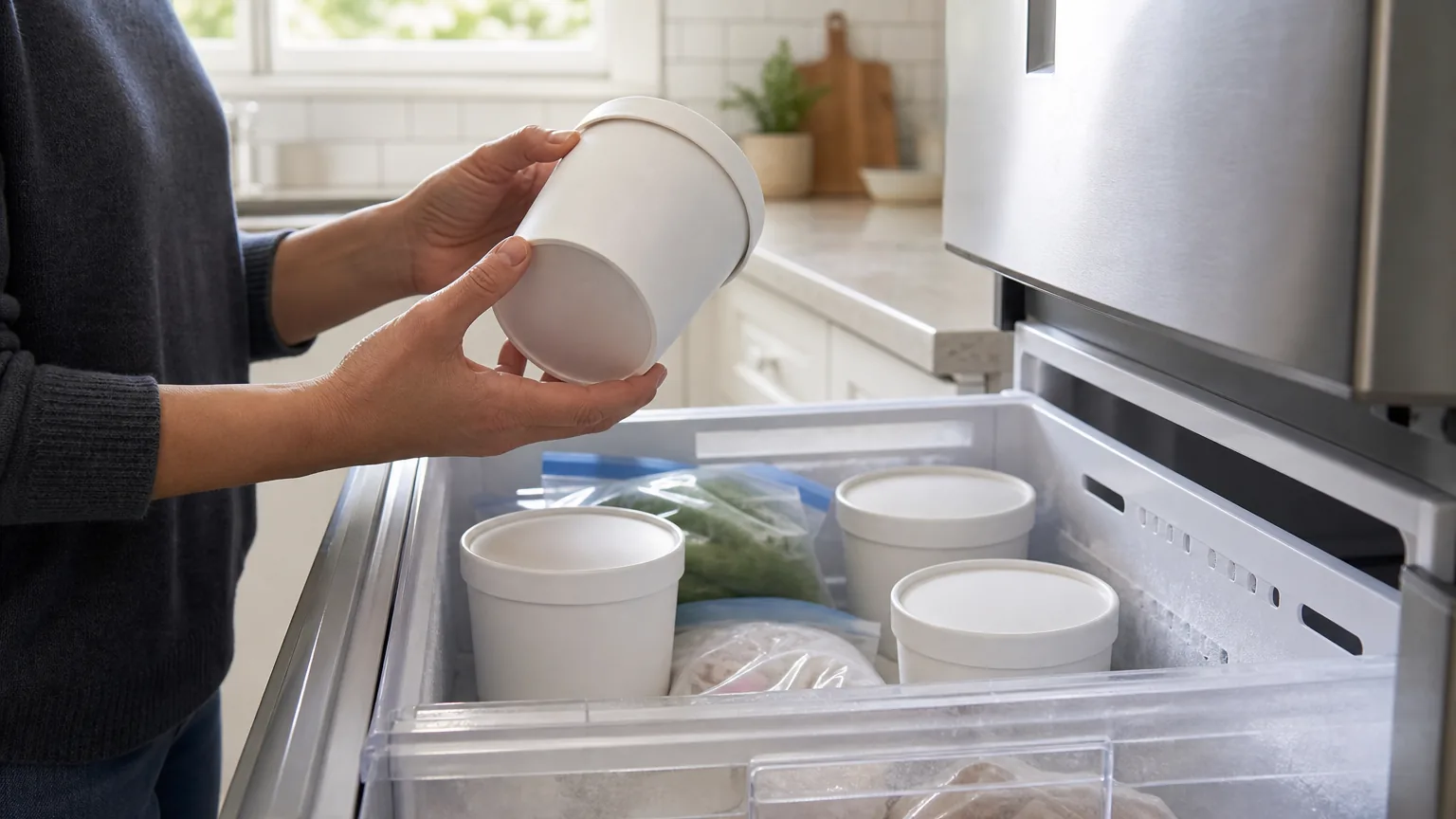
The notice routes refunds through the company’s care line. Call the So Delicious Dairy Free Consumer Care Line at 1-833-367-8975, Monday to Friday from 9 a.m. to 6 p.m. Eastern, or use the web form linked from the FDA notice, and ask for a refund or a replacement coupon. Keep the pint until you have called, in case they ask for the code line, but seal it in a bag and mark it so nobody in the house mistakes it for dessert. Do not eat any of it, including the base around the clusters.
The Canadian notice is addressed to retailers and lists no company refund line, so in Canada start with the store where you bought the pint.
If Someone Already Ate Some
A recall for the potential presence of foreign material means some pints may hold a hard piece, not that every pint does. If you ate from a recalled pint, noticed nothing out of the ordinary and feel fine, there is nothing more to do than claim the refund.
If you bit on something unexpectedly hard or gritty, take it seriously. Hard or sharp objects in food can damage teeth and gums, and in worse cases cut or perforate the mouth, throat, stomach or intestine, according to the FDA’s compliance policy on these hazards. If a tooth hurts or feels rough after a mouthful, see a dentist. For throat or stomach pain, trouble swallowing, or any symptom that worries you, see a doctor and say what you ate. The FDA’s review of past cases found that objects under 7 millimeters rarely cause serious injury except in infants, surgery patients and the elderly, so be quicker to call if a small child or an older relative was the one eating it.
Then report it, because complaints are how this recall started. In the US, food problems go to the FDA through its Safety Reporting Portal or by phone at 1-888-INFO-FDA. In Canada, the CFIA notice links to a page for reporting a health or safety concern.
Why Stones Turn Up in Nut Pieces
The US notice is specific about where the problem sits: within the cashew inclusions, the nut pieces mixed through the pint.
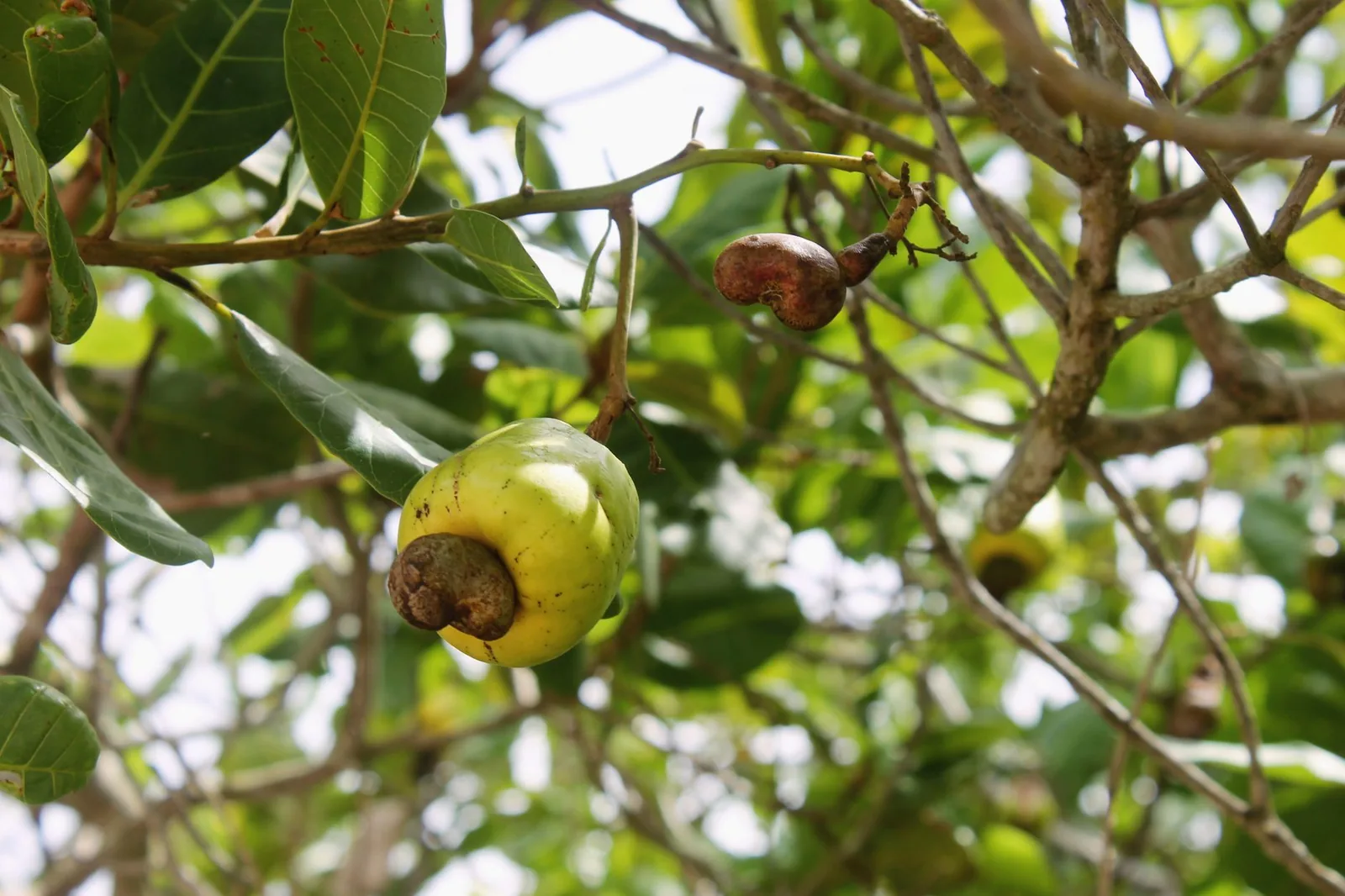
Stones are a farm hazard. In their 2023 review of foreign material in food, Payne and colleagues list stones alongside soil, grit, insects and bits of harvesting equipment as things that come into a plant with harvested crops. The FDA’s preventive controls rule names stones, with glass and metal fragments, as examples of the physical hazards a food plant’s hazard analysis must consider. A cashew is a crop before it is an ingredient.
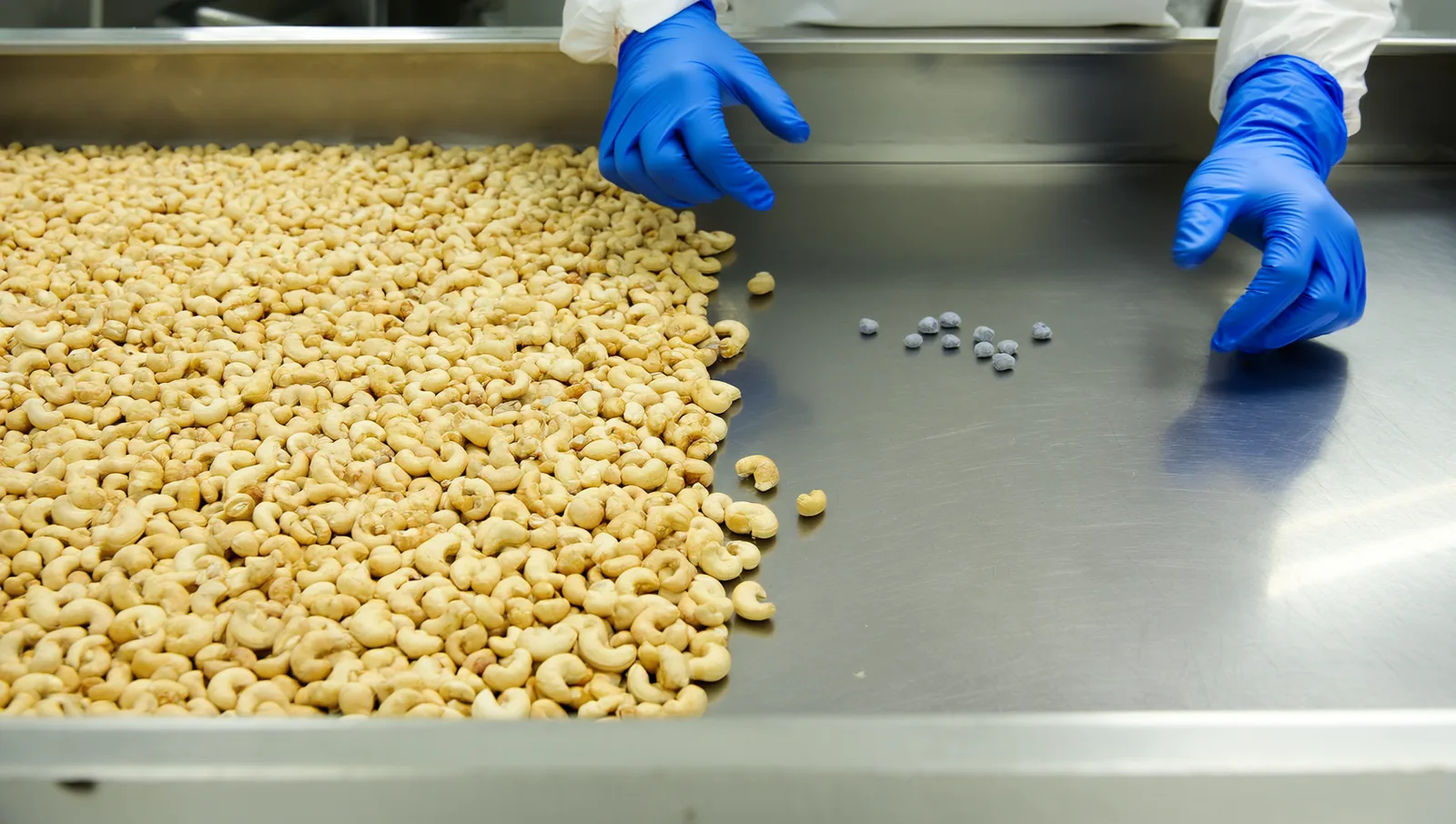
Plants catch stones with cleaning and sorting steps: optical sorters that reject pieces by color and shape, and X-ray systems that can see dense objects like stone and glass. The usual last check before packaging, the metal detector, is not built to find stone, because it only reacts to objects that conduct electricity or are magnetic (Payne and colleagues). Neither notice says which step failed here, and guessing would not help anyone checking a freezer.
Stones also make this recall unusual for its category. A search of the FDA’s enforcement records for ice cream and other frozen desserts since 2012 turns up about 30 recalls over foreign material. The ones that name the material mostly name metal shavings and fragments or plastic, the sort of thing equipment and packaging can shed (Payne’s review lists conveyor and freezer belts among the sources). Stones almost never come up. Across all foods, Payne and colleagues put foreign material behind roughly one recall in ten over the past 20 years, with plastic fragments the most common complaint.
How the FDA Sizes Up a Recall Like This
The announcement you read on the FDA’s site is the company’s. The agency posts it as a public service and notes that it does not endorse either the product or the company. Its own verdict, the recall class, comes later, after it has weighed the hazard, and appears in its weekly Enforcement Report. The classes are set in federal regulation:
- Class I: a reasonable probability the product will cause serious adverse health consequences or death.
- Class II: it may cause temporary or medically reversible harm, or the probability of serious harm is remote.
- Class III: it is not likely to cause adverse health consequences.
For hard objects, the FDA’s compliance policy supplies the yardstick. A hard or sharp foreign object measuring 7 to 25 millimeters in a ready-to-eat food makes that food adulterated. Smaller objects can count too when infants or other special-risk groups are among the intended eaters, as can larger ones over 25 millimeters, once the agency’s reviewers confirm a health hazard. The same policy handles a fragment of shell in a nut product separately, as a natural part of the food that eaters expect.
In practice, foreign-material recalls of frozen desserts almost always land in Class II. Of the ice cream and frozen dessert cases in the FDA’s enforcement data since 2012, all but one were Class II; the exception was a Class III for pieces of wood, and none were Class I. The December So Delicious recall followed the pattern. It was classified Class II on January 14, 2026, a month after it began, and closed on January 29, after covering about 4.67 million units in the US and 665,000 in Canada. Expect the September recall’s US class to follow on a similar timeline.
A recall is also the system doing its job: complaints came in, the company traced them to an ingredient, and stock came off shelves. A second recall of the same flavor for the same hazard nine months later is worth noticing too, and neither notice explains it. Both things are true.
What a Stone Recall Says About Allergens: Nothing
A recall anywhere in a brand’s lineup can feel like a verdict on all of it, and readers managing a milk allergy understandably ask what this one means for them. The honest answer is nothing, either way. The FDA’s preventive controls rule has a food plant assess physical hazards, stones among them, separately from chemical hazards, a group that includes food allergens. It also makes allergen control its own category of preventive control, covering cross-contact and correct labeling. A stone in a nut piece tells you about hard objects in one ingredient. It does not show that a plant keeps milk out of its dairy-free lines badly, or well.
The evidence that bears on allergens is the allergen statement on the pack and any recall for undeclared allergens, the kind of failure I walked through in the vegan ice cream recall for undeclared milk. Reading a dairy-free ice cream label covers where that statement sits and what a “may contain” line does and does not promise. Keep reading it on every purchase, because recipes and suppliers change.
One allergen point does apply to this pint, and it is declared, not hidden. The FDA’s enforcement record describes it as a cashew milk frozen dessert, and the clusters are cashew too, so it was never an option for anyone with a tree nut allergy. My multi-allergy guide maps which dairy-free pints avoid tree nuts. And if you are picking a replacement, the base can matter more than the recall: cashew and almond bases carry oxalate, which is worth knowing if you manage kidney stones or kidney disease, a different kind of stone entirely.
The Bottom Line
Pull out any So Delicious Salted Caramel Cluster pint, match the UPC, and read the date. On or before April 3, 2028 in the US, or one of the seven listed dates in Canada, means it goes back for a refund, not into a bowl, and that includes pints you cleared in December. If someone bit on something unexpectedly hard, get the tooth or throat looked at and report it. And keep the two questions apart: this recall is about hard objects in an ingredient, not about whether a dairy-free pint is safe for a milk allergy, which only the allergen statement can tell you.
Further reading (sources)
- U.S. Food and Drug Administration posting Danone’s September 2026 recall notice for Salted Caramel Cluster pints
- Canadian Food Inspection Agency on the matching Canadian recall of the 500 mL pint
- openFDA for the enforcement record of the December 2025 recall, with its class and code key
- U.S. Food and Drug Administration with its compliance policy on hard or sharp foreign objects in food
- 21 CFR 7.3, defining the three FDA recall classes
- 21 CFR 117.130 on stones, glass and metal as physical hazards a food plant must assess
- 21 CFR 117.135 for food allergen controls as a separate preventive control
- Payne and colleagues reviewing where foreign material in food comes from and how plants detect it