Adding a Dairy-Free Line to Your Scoop Shop: Bases, Equipment, Cross-Contact, and Margins
Published on September 8, 2026
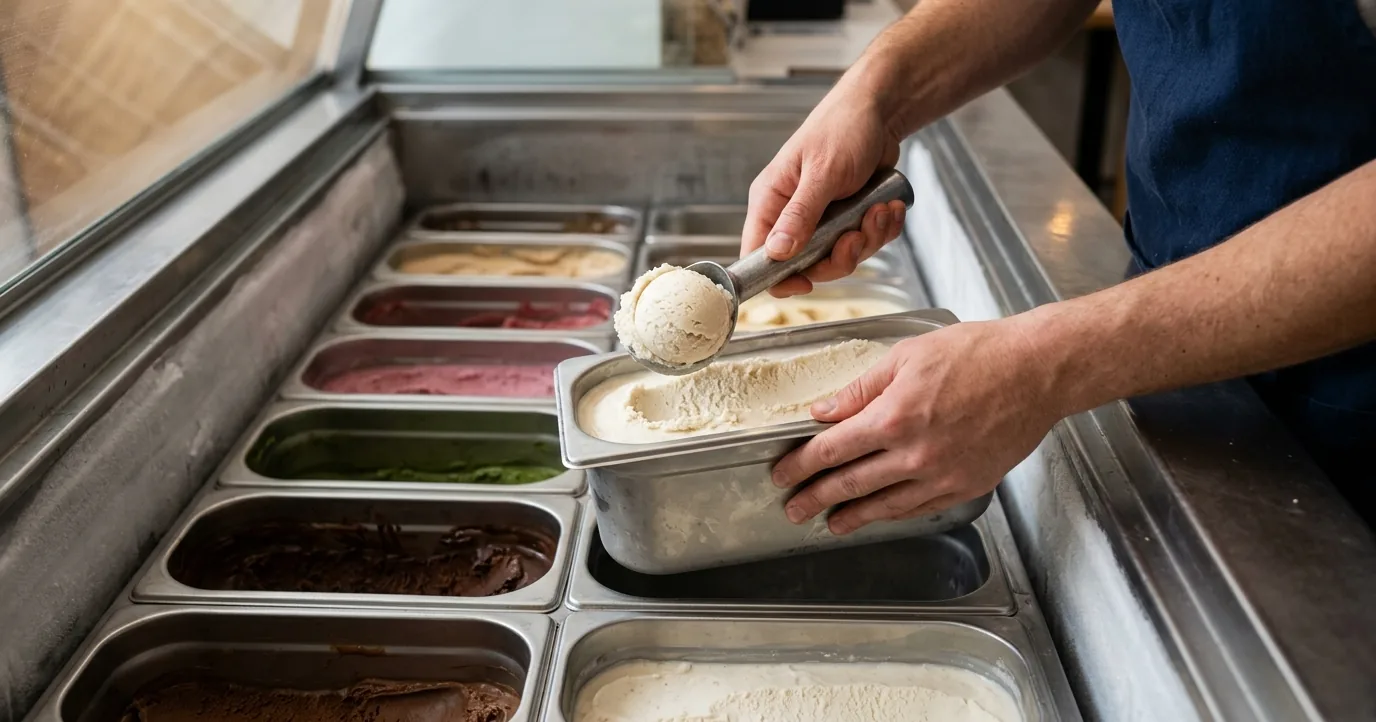
The demand question is settled. A national franchise chain put oat milk scoops into 175-plus stores this summer. A downtown DC counter opened with an ice cream program that runs entirely on cashew cream and coconut milk. Toronto is in the middle of a shop-opening wave, and the city roundups coming out of Philadelphia and Winnipeg now read like inventory sheets: five dairy-free flavours at this shop, a vegan version of the house strawberry banana at that one. If you run a shop and still have nothing in the case, you are not being conservative. You are just later than the people down the street.
What almost nobody writes about is the part that lands on you. What a dairy-free line does to your production schedule, your dipping cabinet, your staff, and your food cost is a completely different article from the ones written for customers. This is that article.
Pick the Base for the Case, Not for the Spoon
Every base tastes fine straight off the dasher. The question that matters in a shop is how it behaves after six hours in a dipping cabinet, under a scoop that has been in and out of it forty times.
Coconut is the workhorse, and it is why most shops start there. Its fat is largely saturated and sets hard, so the scoop holds an edge on the plate and does not slump under the lights. Weckerly’s in Philadelphia builds on coconut cream plus cocoa butter, which is that same logic pushed one step further: a second hard fat and a cleaner melt. Cost is the trade. Refined coconut cream in foodservice quantities lands well above a dairy cream line item, and you are buying a flavor you may not want anywhere near a vanilla.
Cashew is the texture winner and the margin loser. It gives you body without leaning on gums, and the fat stays pliable at counter temperature. It also costs more than anything else on this list and puts a tree nut permanently into your building, which changes your allergen conversation forever. That DC counter runs a house cashew and coconut base and has already said a nut-free version is coming, which tells you they hit the same wall.
Oat is the operational answer. Neutral, cheap next to the nut bases, and it dodges the two allergens foodservice fears most. Its dissolved sugars, a byproduct of the enzyme step that breaks oat starch down, depress the freezing point and keep the base scoopable instead of icy. That is why chain rollouts keep landing on it. It is also why an oat base can go soft in the case if you do not manage the total sugar load, since you are stacking those native sugars on top of the sucrose you added yourself.
Soy is cheap and protein-rich, which buys you real structure, and it is out of fashion for reasons that have more to do with marketing than with performance.
Whichever you pick, budget for a stabilizer blend you would never need on the dairy side. Plant bases have no casein, so nothing is holding water the way milk protein does, and the difference shows up as ice crystals on day three rather than day one. Locust bean and guar with a trace of tara is a common shop blend, and I walk through what each gum actually does in the stabilizer and emulsifier reference. Pick your base with the whole lineup in view, then test it on vanilla first, because vanilla is where every base off-note surfaces with no cocoa or fruit to hide behind. The full base-by-base comparison lives in my guide to plant milk bases.
The Equipment Question Is Smaller Than You Think
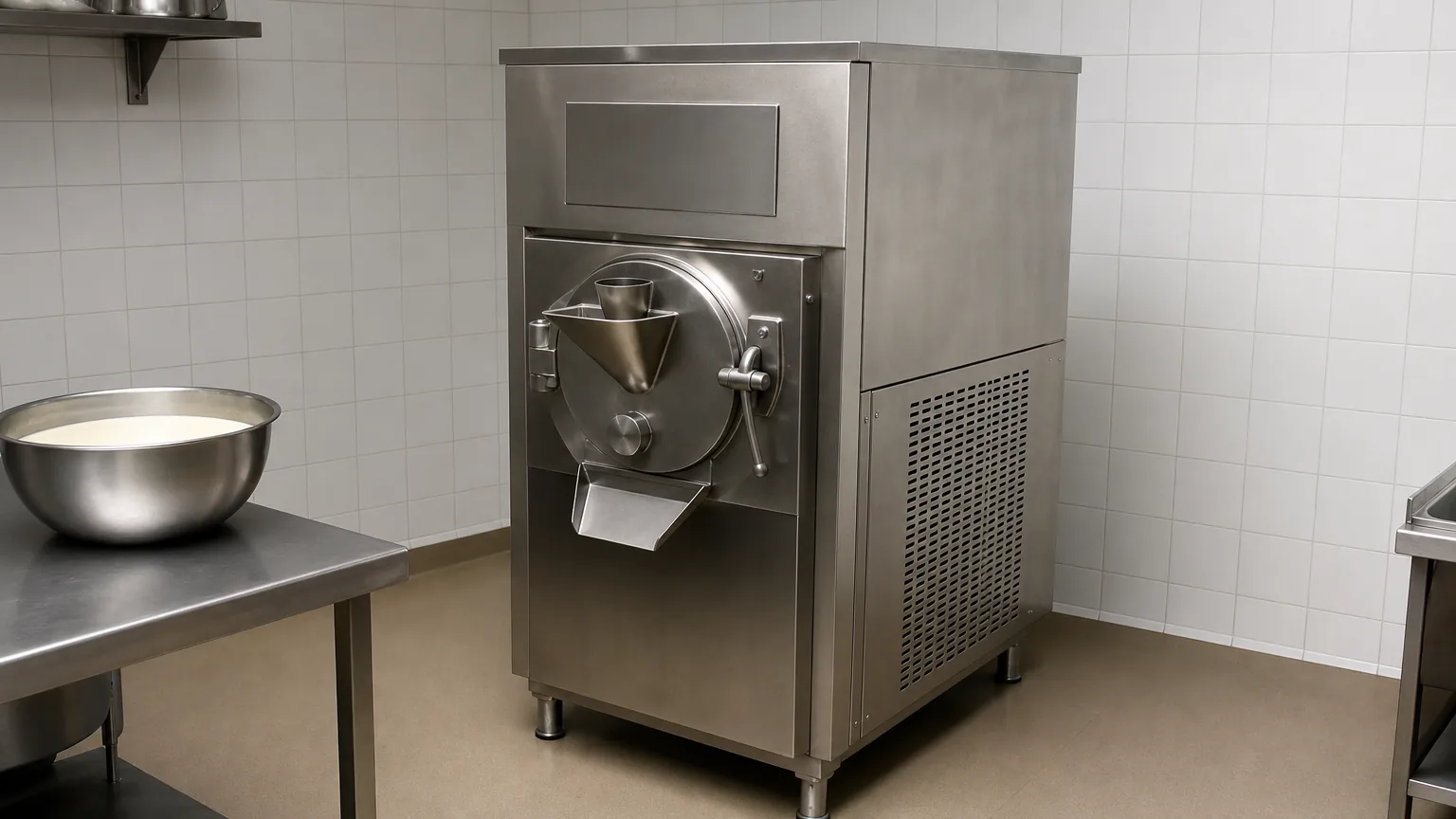
Good news first: you almost certainly do not need a second batch freezer. Plant bases run in a standard machine alongside dairy, and the controls matter far more than the badge on the front. A batch freezer lets you set beater speed and freezing time, which is how you land premium overrun in the 20 to 40 percent range, and better units let you dial overrun batch by batch. That control is worth more on a plant base than on dairy, because plant proteins whip less reliably and a mix that would come out dense on default settings needs the help.
The dipping cabinet is where the real difference lives. Hard-pack scoops best somewhere in the range of 6°F to 10°F, and the exact number moves with the fat and sugar in the recipe. A high-coconut base sets harder than dairy at the same temperature and will fight your staff at the cold end of that band. A high-sugar oat base does the opposite and goes slack at the warm end. You are running one cabinet at one setpoint, so the practical move is to formulate toward the cabinet rather than fight it: pull sugar back on the oat recipe, and park the coconut tubs in the warmest section of the well.
Soft serve is the genuine capital question. A dedicated plant-based machine is a real line item, and a shared barrel is not a plant-based program, it is a plant-based product with an asterisk. If soft serve is the plan, price the second unit honestly at the start, because swapping equipment mid-build costs roughly double what specifying it correctly the first time does.
The same DC counter took a third route worth knowing about. Its program runs on a Little Jem machine imported from New Zealand that blends frozen fruit into the house base to order, so no finished product sits in a case at all. Blend-to-order sidesteps hold-up entirely and moves your problem to throughput.
Cross-Contact Is a Process Problem
This is the part operators get wrong most often, and the part your customers quietly judge you on.
The product in the tub is not the risk. The scoop is. A dipper well keeps a scoop from gumming up between servings, and it sanitizes nothing. Water sitting at ambient temperature after a shift of dairy scoops is not a cleaning step, and moving a scoop from dairy vanilla into a plant-based tub transfers milk protein no matter how good the rinse looks.
The protocol that actually works is short:
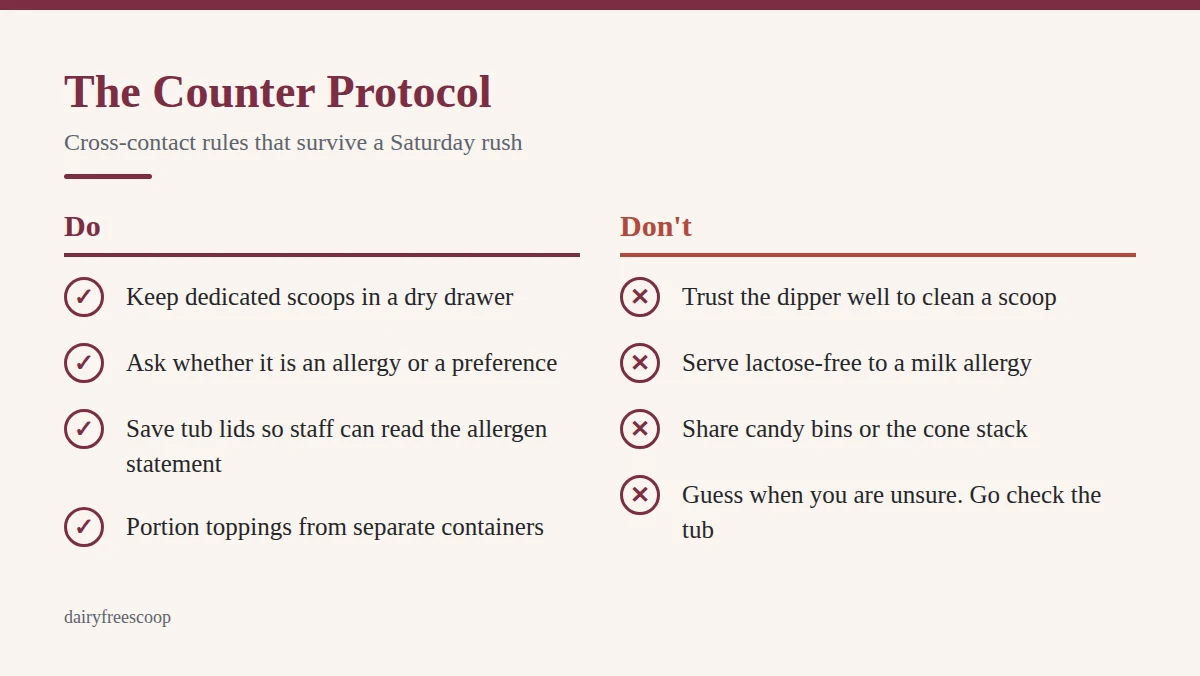
- Dedicated scoops and spades, stored dry and separately. A drawer of clean scoops behind the counter, not a second well.
- Plant-based tubs at the end of the run, or in their own section if your cabinet is divided. Physical separation beats a rule anyone can forget on a Saturday.
- Separate portioning for toppings. A shared candy bin and a shared cone stack undo everything you did upstream.
- Keep the tub lids and cases. The allergen statement your customer wants is printed on packaging sitting in your back freezer.
None of this is optional politeness. The 2022 FDA Food Code requires the person in charge to demonstrate knowledge of the major allergens and the symptoms of a reaction, and to make sure staff are trained in allergy awareness as it applies to their jobs. States have gone further at different speeds. Massachusetts requires a certified food protection manager with allergen training, plus posted notices and a line on the menu. Maryland and Rhode Island mandate poster display. Michigan and Virginia fold allergen training into manager certification. California’s SB 68 requires written allergen notification in menu descriptions for operators with 20 or more locations. Check your own state before you draft a protocol, because some of it may already be written for you.
Train Two Sentences
Most of the service problem disappears if your staff own two lines.
The first: “Do you have an allergy, or a preference?” Those are two different service paths. An allergy triggers the clean scoop from the drawer and the tub check. A preference does not need to slow the line down at all.
The second is the distinction your counter staff will get wrong forever unless you teach it: dairy-free, lactose-free, and vegan are three separate claims. Lactose-free product is real dairy with the sugar broken down, so the casein and whey are fully intact and it is dangerous for a milk allergy. Vegan means no animal ingredients, which is a recipe claim and says nothing about your scoops. Dairy-free is what your milk-allergic customer is actually asking about. Anyone who hands a lactose-free cup to a guest who said “dairy allergy” has made a serious error, and that distinction deserves a page in your training binder.
Then give staff explicit permission to say “let me check the tub.” A pause is not a failure. A confident wrong answer is.
Batch Sizing and the Flavor That Dies in the Case
The most common failure of a new dairy-free line is not a safety incident. It is a tub of plant-based pistachio that sat for nine days, iced over, and convinced the owner the whole category does not sell.
Start with three flavors, not eight. The standard shop advice to pick a few things and execute them perfectly applies double here, because your plant-based turns will be slower than your dairy turns until the category builds its own regulars. Three tubs turning in five days beats eight tubs turning in fifteen.
Choose them to cover the field rather than to be interesting: one chocolate, one vanilla or something vanilla-adjacent, and one fruit sorbet. The sorbet does double duty as the nut-free, soy-free, coconut-free fallback, and it is the cheapest thing in the case. Milk Jawn in Philadelphia runs the same flavor on both sides of the counter, mint stracciatella in dairy and in vegan, which is a smart merchandising move: it reads as a real menu item instead of an accommodation parked at the end of the board.
Cut your batches smaller than the dairy ones for the first two months and let the numbers tell you when to scale. Chaeban in Winnipeg carries five dairy-free flavours and Van Leeuwen runs coconut, cashew, and oat bases across a wide vegan menu, but both got there on volume they had already proven.
The Margin Math
Run the line against the same prime cost framework you use for everything else. A common target for a scoop shop is 25 percent food cost, 25 percent labor, and 25 percent occupancy, with the last quarter covering debt service, repairs, and profit. If a category pushes any one bucket past its number, you have a structural problem rather than a bad week.
Four things change on the plant side:
Ingredient cost goes up, sometimes sharply. Coconut cream and cashews both cost more per unit of fat than dairy cream. Oat sits closest to parity. That pressure lands squarely in the food cost bucket.
Overrun is a lever, not a given. Ice cream margin is substantially an air story, and a base that whips badly costs you twice: worse texture and less finished yield per gallon of mix. This is exactly where a batch freezer’s overrun control earns back its price.
Waste is the cost nobody forecasts. Nine slow days on an expensive tub can erase the premium you charged for it. Batch sizing is a margin decision, not a housekeeping one.
You can usually price it. Most shops take a modest upcharge and customers absorb it, because the alternative for a dairy-free guest is buying nothing. Against a roughly $9 average ticket for the category, a small surcharge on a slower-turning tub closes most of the gap.
What the ledger will not show you is the party effect. A group of five does not split up because one of them cannot eat dairy. They go where everyone can order. The Philadelphia and Winnipeg roundups exist because publications now expect a shop to have an answer, and the shops without one quietly fall off those lists. Sassy Cow Creamery grew from fifty cows into a destination scoop shop over years of exactly that kind of accumulation, and the categories you add early are the ones that compound.
Your customers are already doing this homework from the other side of the counter. Reading what they check before they order is the fastest way to find out whether your protocol survives a real question at 9pm on a Saturday.
Start with three flavors, one base, dedicated scoops, and two trained sentences. Everything after that is refinement.
Further reading (sources)
- PoPville on a DC counter blending its ice cream to order from a house cashew base
- Billy Penn with which Philadelphia shops keep a vegan lineup and what bases they run
- Winnipeg Free Press surveying a city’s frozen dessert shops and their dairy-free counts
- blogTO noting a sudden wave of new ice cream and gelato openings
- Dairy Herd on how a fifty-cow creamery grew into a destination ice cream shop
- FARE covering what the Food Code and state laws require of food service on allergens
- Chefs’ Deal explaining how batch freezer controls set overrun
- WebstaurantStore for where a dipping cabinet has to sit to stay scoopable
- Wilson K Lee breaking down the prime cost framework behind a scoop shop