Dairy-Free Gelato: Why the Format Flatters Plant Bases, What to Buy, and How to Make It
Published on September 14, 2026
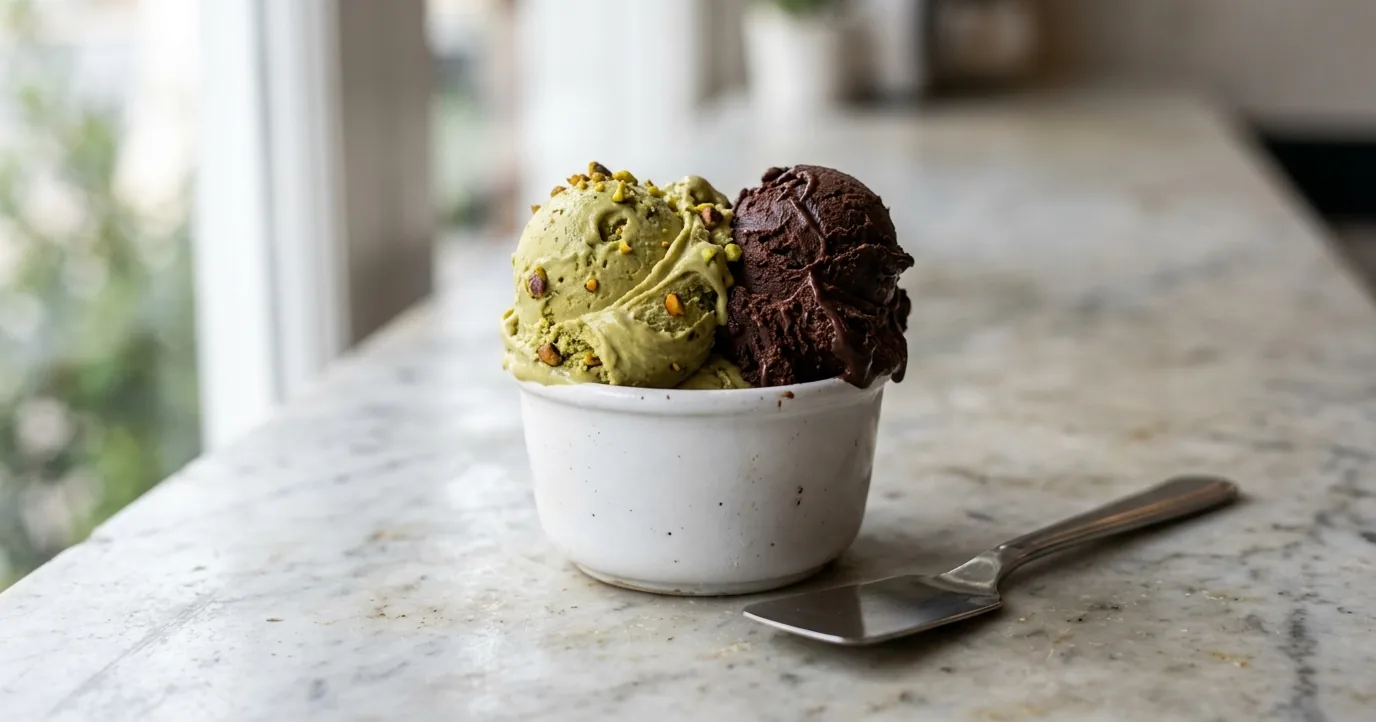
If you have made a dairy-free sorbet and found it thin, then made a dairy-free ice cream and found it waxy, gelato is the format sitting between them that nobody thinks to suggest. It usually gets treated as a definition question, gelato versus ice cream, Italian versus American, and the site already has that head-to-head with sorbet. The more useful framing for a dairy-free kitchen is this: the three traits that make gelato gelato, less fat, less air, and a warmer serving temperature, happen to be the three things a plant base most wants. A coconut or cashew mix that fights you as ice cream often behaves the moment you churn it as gelato instead.
Why the Format Suits a Plant Base
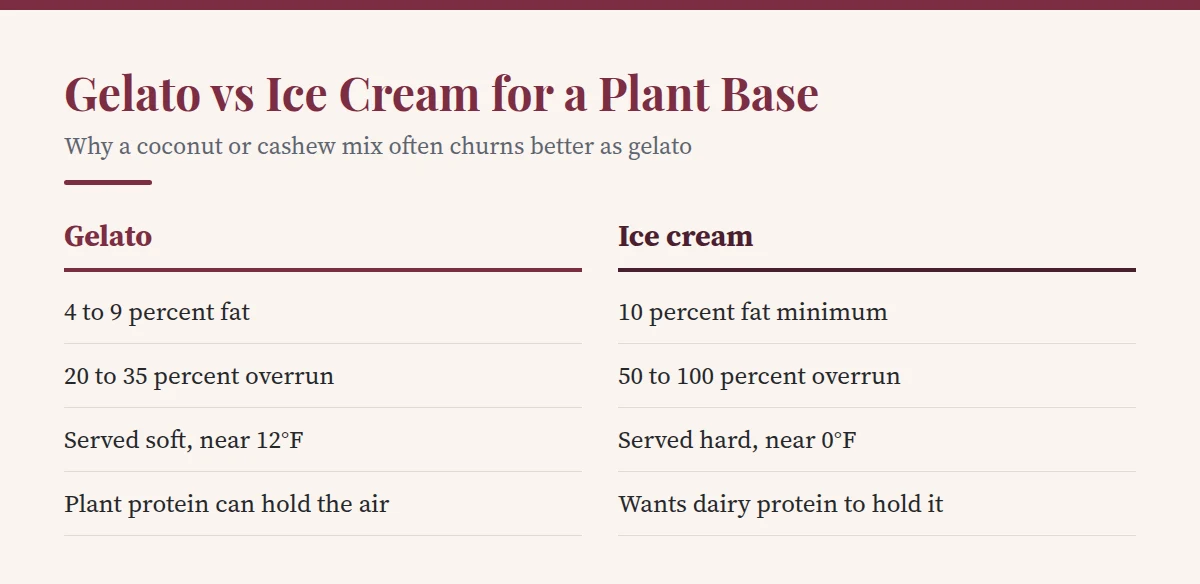
Take the three traits one at a time.
Less fat. Gelato runs roughly 4 to 9 percent fat, against the 10 percent minimum US law sets for anything sold as ice cream. Dairy cream is forgiving in quantity. Plant fats are not. Coconut fat is highly saturated and sets hard at freezer temperatures, and pushing a coconut base up to ice cream fat levels is exactly how you get that greasy film across the roof of your mouth. Gelato asks for less of it. Cashew cream sits around 10 to 14 percent fat and oat milk in the low single digits, which makes both awkward as ice cream and well suited here.
Less air. Overrun is the percentage a base expands as air whips into it. Ice cream can run 50 to 100 percent; gelato sits around 20 to 35. That gap matters more for plant bases than most people realise, because dairy protein is unusually good at holding air cells in place and plant proteins are not. Ask a coconut or oat base to carry 80 percent overrun and it collapses into something coarse and foamy. Ask it to carry 25 and it can do that honestly. Home machines rarely whip in much air anyway, which is why a homemade batch so often eats denser than a store pint. You were making gelato and did not know it.
A warmer serving temperature. Gelato is served around 10°F to 14°F, against roughly 0°F for hard-packed ice cream. That sounds like a serving detail and is actually a structural one, because the harder a fat sets, the more a few degrees change. Every dairy-free eater knows the pint that needs ten minutes on the counter before a spoon will go in. Gelato’s warmer service is that counter rest built into the format instead of improvised at the table.
The Machinery Behind the Modern Product
Modern gelato is a twentieth-century product at least as much as a Renaissance one. The hand-cranked bucket gave way to the powered batch freezer (the first automatic one was American, built by Emery Thompson in 1904), and the vertical batch freezer that defines artisan gelato today came out of Italian workshops in the 1940s, Carpigiani in Bologna chief among them. The BBC traced the modern Italian product back to an unlikely pair of origins: a humble Tuscan dairy shop and a couple of abandoned American World War Two freezers.
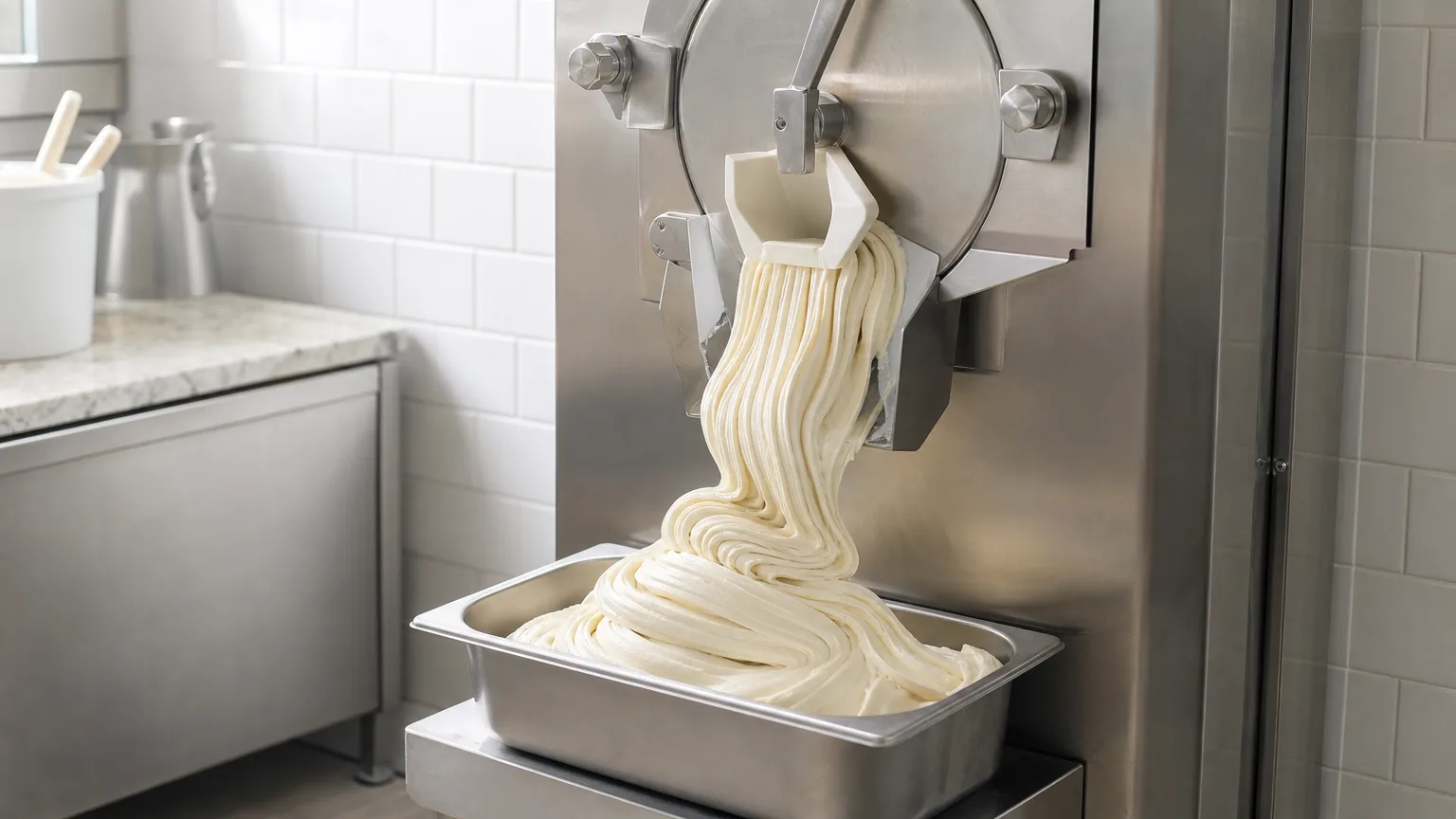
Three machines shape what lands in the cup, and each has a home equivalent.
- The batch freezer churns and freezes at once, working the mix at roughly -6°C to -9°C with a slow vertical dasher and pulling overrun to about 25 to 35 percent. Slow is the entire point.
- The blast freezer then drops the core to -30°C or colder, racing the mix through the band where ice crystals grow. This step matters more for a plant base, which has less protein and fat tying up free water.
- The display. An open glass case (a vitrina, the one with gelato mounded into peaks) holds around -12°C to -14°C. Pozzetti, the round lidded wells, sit slightly warmer and hold flavor better because the surface is never exposed to air and case lights.
At home your freezer-bowl or compressor machine is the batch freezer, the back of your freezer is a poor but workable blast freezer, and you supply the display step yourself by tempering on the counter. The machine buyer’s guide covers which models hold their bowl temperature long enough to matter on a thick coconut base.
What to Look For in a Pint
Start from this: “gelato” is not a regulated term in the US the way “ice cream” is. A tub can say gelato because it is dense and Italian-styled, not because it meets a compositional standard. The front of the package tells you about texture ambition. The ingredient panel does the rest of the work.
Two traps come up constantly.
Dairy-free gelato is frequently not vegan. Talenti’s dairy-free gelato line is built on oat milk and cashew butter, and every flavor in it is churned with egg yolks and egg whites for richness. Dairy-free, yes. Vegan, no. Their sorbetto line splits along the same seam: all of it is dairy-free, but Cold Brew Coffee and Dark Chocolate contain egg while the fruit flavors (Roman Raspberry, Alphonso Mango, Zesty Lemon and the rest) do not. If you are avoiding milk for an allergy, the egg is beside the point. If you are vegan, it is the whole question, which is the practical reason those two labels are not interchangeable.
Shared production lines are the norm. Talenti states plainly that it does not run separate lines for flavors containing its major allergens. A dairy-free pint from a company that also makes dairy pints is a claim about the recipe, not a promise about the factory. US law forces milk onto the label when it is an ingredient, but precautionary “may contain” wording is voluntary, so its absence proves nothing. This is standard label reading for dairy-free frozen desserts, and gelato gives you no special exemption from it.
What to look for on the good side: a real fat listed early (coconut cream, cashew, or an oat base with added oil rather than plain oat milk), a short stabilizer list, and for imported artisan pints, a production date rather than just a distant best-by. Anything sold as creamy gelato on a fat-free oat base is going to eat like a firm ice pop.
Ordering at a Gelateria Counter
One word does most of the damage here. Senza lattosio is not senza latte. Lactose-free gelato is ordinary dairy gelato with the lactose enzyme-split, so it still carries casein and whey and is unsafe for a milk allergy. The words you want on an Italian flavor card are vegano or senza latte. The difference between lactose-free and dairy-free is the single most useful thing to know before you order anywhere in Europe.
Fruit sorbetto is the usual dairy-free default, and in Italy the allergen list has to be posted on the premises, which makes checking easier than it is in most countries. Two cautions anyway: Sicilian-style and “crema” sorbetti are not always water-based, and shops that batch their own cones often use butter or milk powder in them.

Worth asking at the counter, in this order:
- Which flavors are made without milk, not which are without lactose.
- Is the spade rinsed between flavors, or does one spade work the whole case? A shared spade through a mounded vitrina is the main cross-contact risk.
- Where do the dairy-free tubs sit? In an open case, a tub positioned under a dairy flavor catches drips.
- What is in the cone?
Pozzetti shops hide their gelato under lids, so you cannot judge by eye and the flavor card plus the staff answer is all you get. The broader playbook for shared counters is in the guide to eating dairy-free ice cream away from home, and for a city where plant-based gelato counters have multiplied fast, the Canadian scoop shop guide covers the Toronto wave.
Making Dairy-Free Gelato at Home
You do not need a gelato machine. A standard freezer-bowl or compressor ice cream maker produces better gelato than it produces ice cream, because its weakness (it cannot whip in much air) is the format’s requirement.
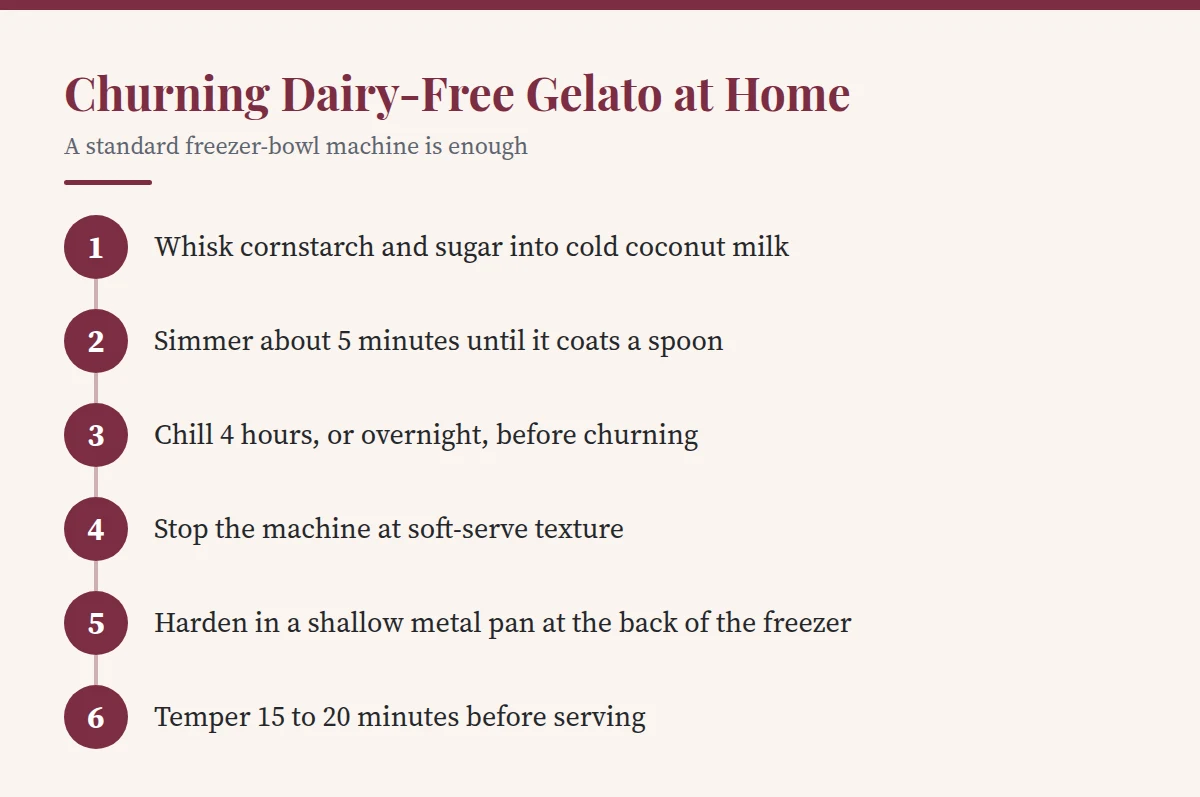
Build the base. Roughly 3 cups full-fat coconut milk (look for 60 percent or more coconut extract), 3/4 cup sugar, and 2 tablespoons cornstarch. For a cleaner, less coconut-forward result, swap in 2 cups oat milk plus 1 cup soy cream. For cashew, soak raw cashews in hot water for an hour and blend to a thick cream; boxed cashew milk is far too thin.
Cook it. Whisk the sugar and cornstarch into the cold liquid before any heat goes under it, or the starch clumps. Bring to a boil over medium-high heat while stirring, then simmer about 5 minutes until it coats a spoon. The starch is doing the job milk solids do in dairy gelato: binding free water so it cannot gather into crystals.
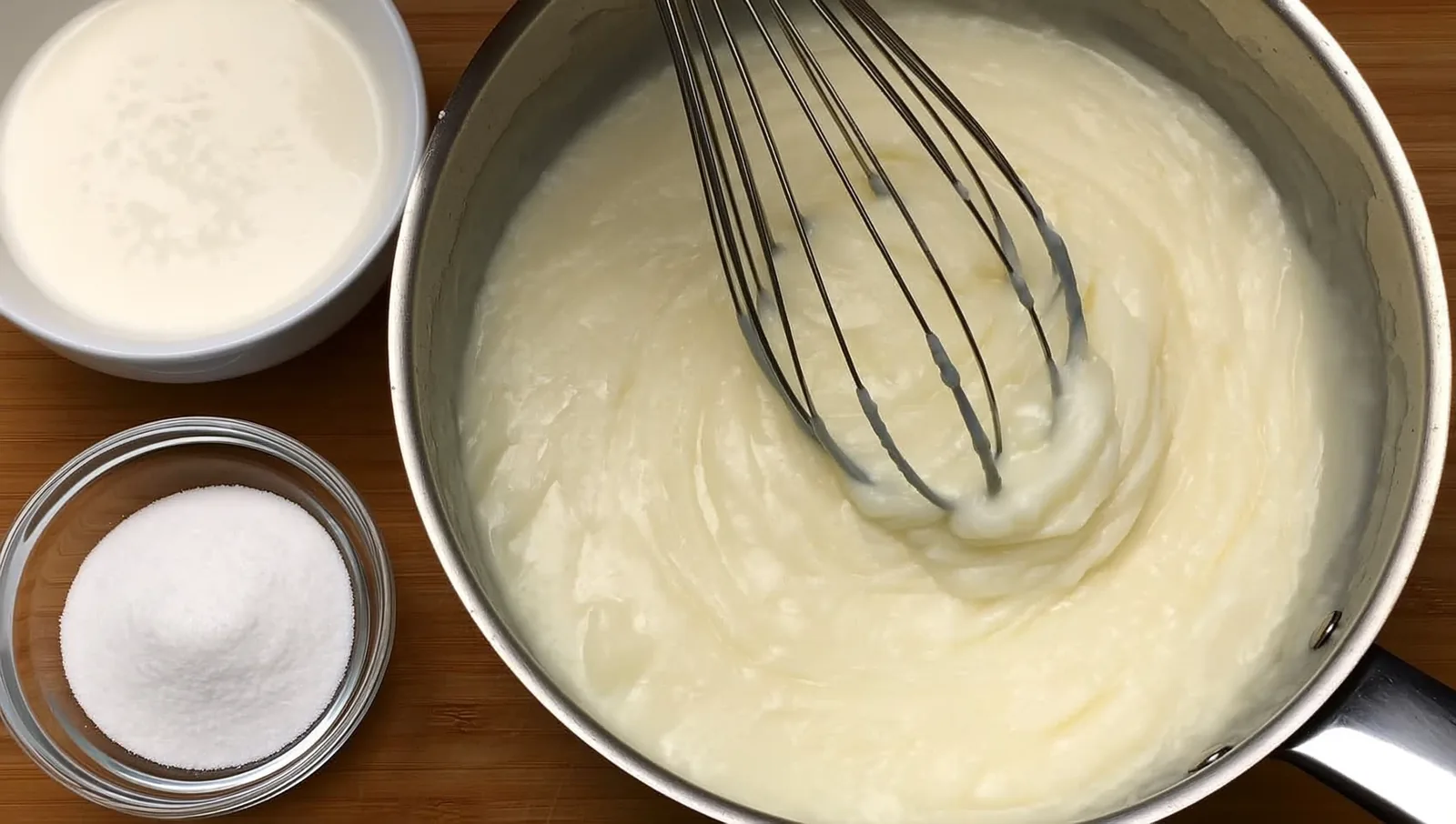
Age it. Cool to room temperature, then refrigerate 4 hours minimum, overnight if you can. Skipping this is the most common reason a home base churns grainy. A cold base in a cold bowl means a short churn, and a short churn means small crystals.
Churn short. Stop when it looks like soft serve. Chasing stiffness in the machine whips in the air you are specifically trying to avoid, and the friction warms the mix.
Harden fast. Scrape into a shallow metal pan rather than a deep tub, press wrap directly onto the surface, and put it at the back of the freezer, never in the door. Shallow plus metal is your improvised blast freezer.
Serve it soft. Pull a coconut-based gelato out 15 to 20 minutes before serving. Coconut fat sets harder than dairy cream, so tempering is not a nicety. It is the format working as designed.
Three failures and their causes: icy and crunchy usually means too little sugar or a base that never aged, since sugar is the antifreeze as much as the sweetener. Gummy and stretchy means too much gum or starch, which the stabilizer reference covers dose by dose. A waxy film means too much coconut fat, fixed by cutting it with oat or cashew per the plant milk base guide. If you want the full arc from first batch to advanced, the homemade master guide is the place to start.
The Short Version
Gelato tends to get sold to dairy-free eaters as a consolation, the Italian thing you are allowed to have provided you stick to the fruit flavors. It deserves better than that. The format’s own rules, less fat, less air, served soft, are close to the rules a plant base would write for itself if it could. Read the panel anyway, because the word gelato tells you nothing about milk. Ask at the counter, because senza lattosio is not senza latte. Then go churn a batch and stop the machine early.
Further reading (sources)
- BBC Travel on how American war-surplus freezers shaped modern Italian gelato
- Go Dairy Free for what is actually in Talenti’s dairy-free gelato line
- Go Dairy Free with the sorbetto flavors that do and do not contain egg
- Food Nouveau on a coconut milk gelato base you can churn in a standard machine
- Amrichi for the numbers behind gelato overrun and serving temperature
- Carpigiani Gelato Museum on how batch freezer design changed the craft
- From Home to Rome with how to find vegan rather than lactose-free gelato in Italy
- V Gelato on choosing a plant base for a gelateria-style texture