Can You Trust a 'Sugar-Free' Ice Cream Label? What the Golda Lawsuit Reveals
Published on September 15, 2026

In August 2026 an Israeli court certified a class action against Anita Ice Cream, which runs the Golda chain, over scoops sold under a “sugar-free” label. The claim is worth NIS 350 million, though the court was explicit that the figure is what the plaintiff is asking for and not what anyone has been ordered to pay. What makes the case worth reading is the lab work behind it. A shopper who had been avoiding sugar bought a sugar-free scoop, felt like she had eaten sugar, and took a sample to an accredited laboratory. The tested flavors came back at roughly 6.6 grams of sugar per 100 grams of product, against a regulatory ceiling of 0.5 grams per 100 grams for anything calling itself sugar-free. That is more than thirteen times the limit (Jerusalem Post, 2026).
The Chain’s Defense Is the Part Worth Your Attention
Golda did not argue the number was wrong. It argued the number did not matter, because a reasonable person knows milk-based ice cream naturally contains lactose, so “sugar-free” in that context must mean no sugar was added. The court rejected that reading. Judge Iris Rabinovich-Baron found it a reasonable interpretation that the labeling could mislead the public, and certified causes of action including consumer deception, negligence, breach of statutory duty, and unjust enrichment. The ruling also noted something sharp: because most of Golda’s products are plainly not sugar-free, the sugar-free tag carried extra weight with shoppers precisely because it was the exception on the menu.
There was a second finding, and for anyone shopping dairy-free it is the more useful one. The lab also detected polyol sugar substitutes that had not been clearly disclosed at the point of purchase. So the product was not simply mislabeled on sugar. It contained a class of sweetener the buyer had no way of knowing was there, which matters a great deal if your gut reacts to it.
If you eat dairy-free, the lactose half of this story is not your problem. Plant bases have no lactose in them at all, which is a real and underrated advantage, and I cover why the two categories keep getting confused in lactose-free versus dairy-free ice cream. But the structural failure in the Golda case travels perfectly into the plant-based freezer case: a company made a sugar claim its formula could not support, then defended it by redefining the claim after the fact.
Two Claims That Sound Identical and Are Not
American rules draw a hard line here, and it is the single most useful thing to carry to the store.
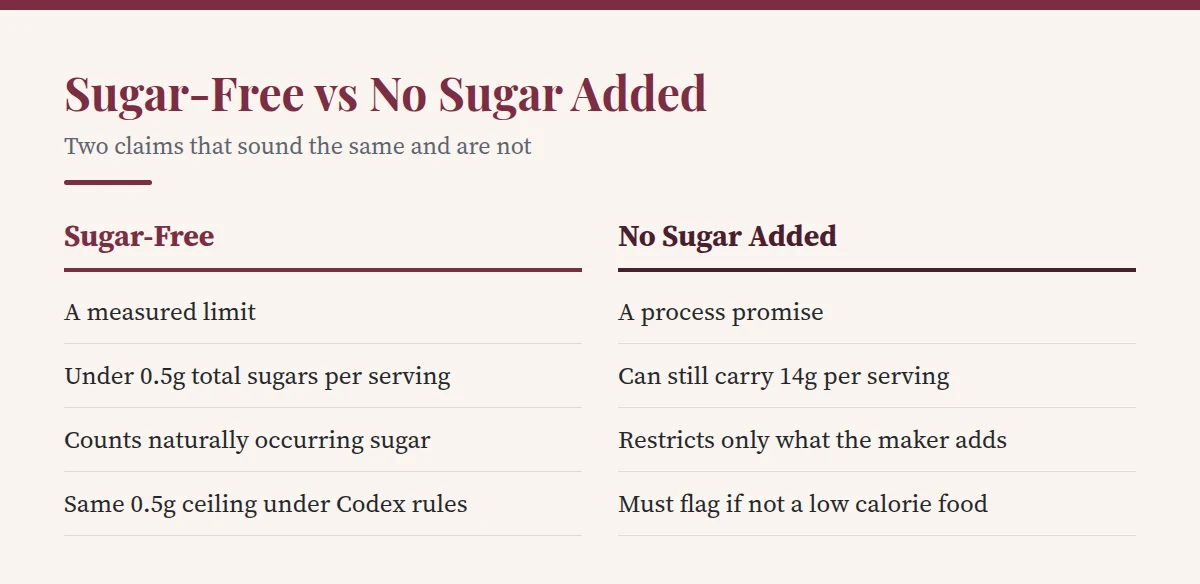
Sugar-free is a numerical claim. Under FDA regulations, a food can only be labeled sugar-free, sugarless, no sugar, or zero sugar if it contains less than 0.5 grams of total sugars per serving and per reference amount. It is a measurement of what is in the finished food, no matter where the sugar came from. Naturally occurring sugar counts. This is the same 0.5 gram threshold used internationally under the Codex guidelines, and it is the ceiling the Golda samples blew through.
No sugar added is a process claim. It says nothing whatsoever about how much sugar the product contains. It means no sugars were added during processing, no ingredient carrying added sugars (jam, jelly, concentrated fruit juice) went in, and the sugar level was not raised by other means such as enzymes. A no-sugar-added pint can legitimately carry 14 grams of sugar per serving. The rule also requires that if the food is not low-calorie or reduced-calorie, the label must say so next to the claim, which is why you sometimes see the oddly defensive line “not a reduced calorie food” in small type.
The gap between those two is where most of the confusion in this category lives. One is a test result. The other is a description of the recipe. A shopper scanning a freezer door at speed reads both as “this will not spike my blood sugar,” and only one of them is making that promise.

Where the Sugar Hides in a Dairy-Free Pint
Plant bases create sugar problems that dairy bases do not have, and they are easy to miss.
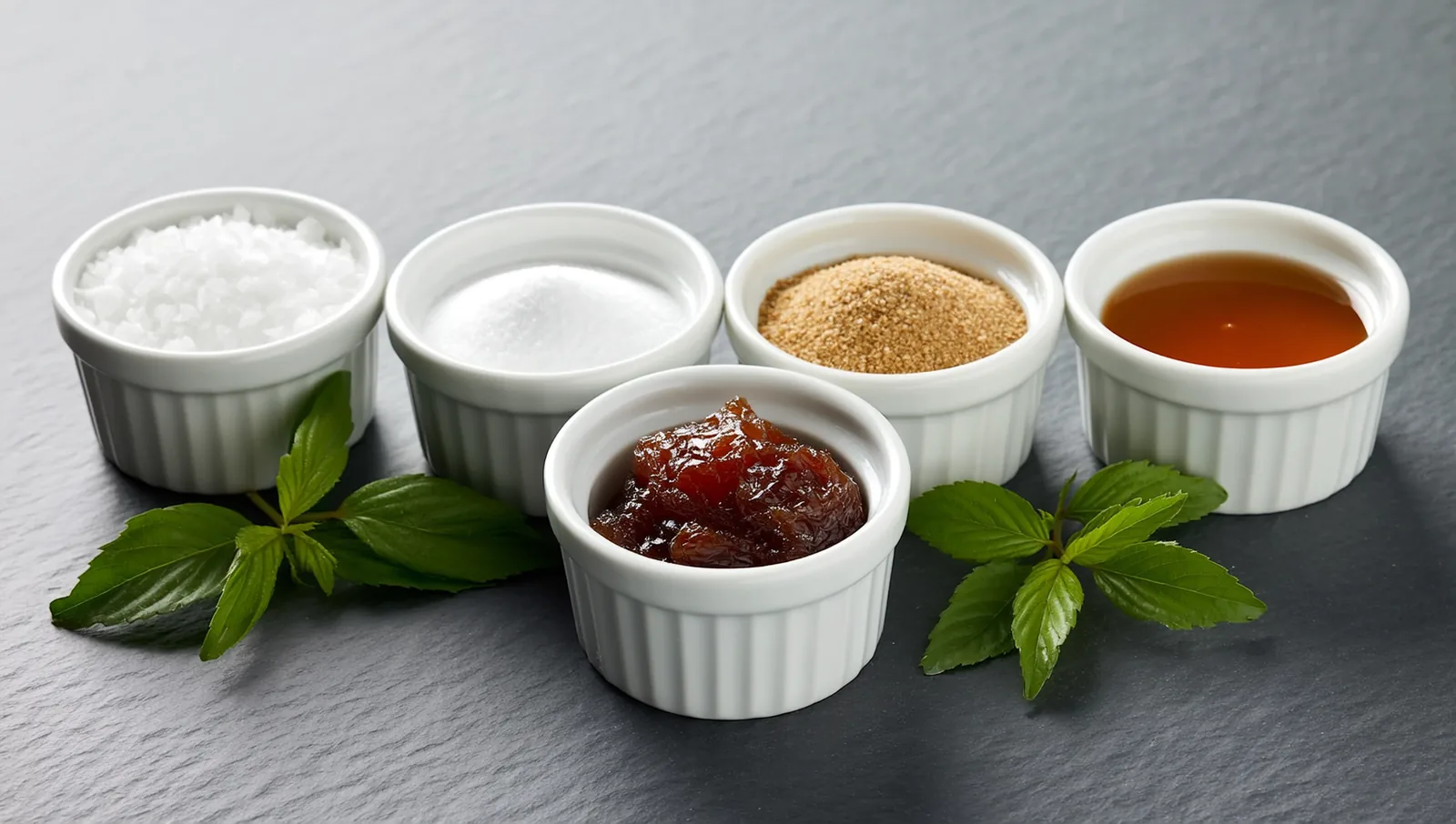
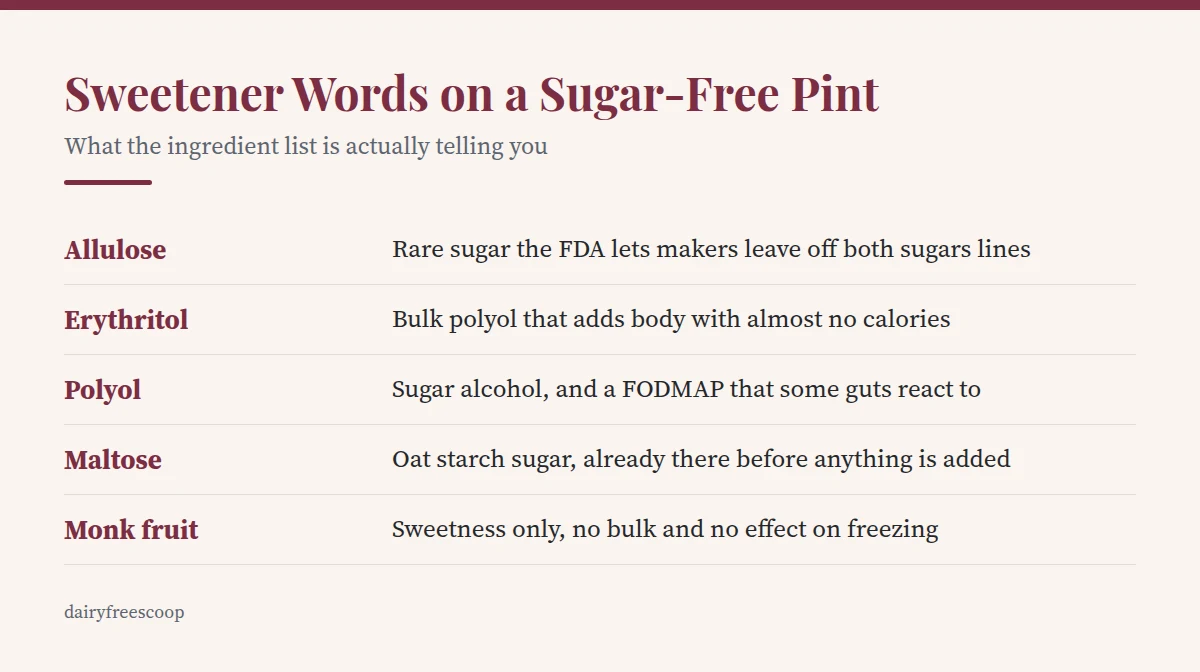
Oat bases make their own sugar. Oat milk is sweet because enzymes break the oat starch down into maltose during manufacturing. That sugar is already in the ingredient when the ice cream maker buys it, so a brand can add nothing at all, label the pint no sugar added in full compliance, and still print a total sugars figure that surprises you. This is a property of the base rather than a trick, and it is one of the trade-offs I walk through in the guide to plant milk bases.
Fruit-derived sweeteners are still sugar. Date paste, apple juice concentrate, brown rice syrup, and agave all read as wholesome on an ingredient list and all land in the total sugars line. Juice concentrates used to sweeten are counted as added sugars by the FDA, so they will show up on the added sugars line as well.
Sugar alcohols are not counted as sugars but are not nothing. Erythritol, maltitol, sorbitol, and xylitol are polyols. They sit outside the sugars line on the Nutrition Facts panel while still contributing carbohydrate and, for some people, a very real digestive response.
That last point is where the undisclosed polyols in the Golda product stop being a paperwork issue. Polyols are FODMAPs, the group of fermentable carbohydrates that drive bloating, gas, cramping, and diarrhea in people with irritable bowel syndrome. A review in Nutrients on lactose intolerance makes the connection directly: lactose intolerance is often one part of a broader intolerance to fermentable oligosaccharides, disaccharides, monosaccharides and polyols, and roughly half of IBS patients need to restrict the whole FODMAP group rather than lactose alone. A dairy-free shopper avoiding dairy for gut reasons can walk into exactly the symptoms they were trying to dodge, via a sweetener they were never told about.
US rules do address this, in a way that is easy to appreciate once you know it: declaring sugar alcohols on the Nutrition Facts panel is voluntary, but it becomes mandatory the moment the label makes a claim about sugar. In other words, a pint that says sugar-free has already forfeited the right to stay quiet about its polyols.
What Actually Replaces Sugar in These Pints
Sugar in a frozen dessert is not just sweetness. It depresses the freezing point, which is the entire reason ice cream scoops instead of shattering. Pull the sugar out and something has to do that job, which is why sugar-free formulas are usually a blend rather than a single ingredient.
The workhorses are allulose, a rare sugar the FDA permits makers to exclude from both the total and added sugars lines and count at 0.4 calories per gram, and erythritol, which brings bulk with almost no calories. Both lower the freezing point, allulose strongly, which is why a sugar-free pint built on it stays surprisingly soft. High-intensity sweeteners such as stevia and monk fruit supply sweetness but no bulk and no freezing-point effect, so they nearly always appear alongside one of the bulk agents. I break down what each one does to texture, sweetness, and glycemic load in the complete sweetener reference.
Scoop shop counters are the weak spot in all of this, because a dipping case has no Nutrition Facts panel at all. You are trusting a chalkboard. That was true at Golda, and it is true at the gelato counter as well, where the format’s lower fat already invites better-for-you positioning. Ask what sweetener the base uses and whether sugar alcohols are in it, and treat a shrug as an answer.
The Claim Is Worth Money, Which Is Why It Gets Stretched
None of this is an accident of sloppy design. One market analysis puts the sugar-free ice cream category on a compound annual growth rate of about 9.2 percent, and industry estimates for a niche like this vary, but the direction is not in dispute.
Research backs up why the words themselves are so valuable. In a study in the Journal of Dairy Science surveying more than a thousand frozen dessert consumers, sweetener type was among the most important attributes driving purchase in the better-for-you category, and sweetener-related claims (naturally sweetened, reduced sugar, no added sugar) ranked among the strongest signals that made shoppers perceive a dessert as better for them at all. The claim on the front of the tub does commercial work before anyone tastes anything. That is exactly the dynamic the Israeli court identified when it held that the sugar-free label carried more value than the chain was willing to admit.
A Ninety-Second Check at the Freezer Door
Turn the tub around and work the panel, not the front.
- Read the total sugars line, not the claim. Sugar-free means under 0.5 grams. If total sugars reads 6 grams, the pint is not sugar-free whatever the lid says.
- Separate total from added. No sugar added constrains only the added sugars line. Total sugars can still be substantial, especially on oat.
- Look for the sugar alcohol line. If a sugar claim appears on the package, polyols must be declared. A sugar claim with no polyol line and no obvious sweetener in the ingredients deserves a second look.
- Scan the ingredient list for fruit sweeteners. Date paste, juice concentrate, agave, and rice syrup are sugar wearing a health halo.
- Check whether the panel is per serving or per pint. Half a cup is the serving. Most people eat more than that, and the numbers scale.
The habits are the same ones that keep hidden dairy out of your cart, and I set out the full method in how to read a dairy-free ice cream label. The Golda case is a useful reminder of what it is protecting you from. A company put a testable claim on a product, the product failed the test, and the defense was that nobody should have taken the claim literally in the first place. The Nutrition Facts panel is the part of the package that cannot argue back. Read that one.
Further reading (sources)
- Jerusalem Post on the class action certified against the Golda chain over sugar-free marketing
- Jerusalem Post for the lab results behind the NIS 350 million claim
- Code of Federal Regulations with the rules governing sugar-free and no-sugar-added claims
- U.S. Food and Drug Administration on why allulose is excluded from total and added sugars
- Nutrients on lactose intolerance, polyols, and the wider FODMAP picture
- Journal of Dairy Science documenting which claims make shoppers read a frozen dessert as better-for-you
- Market.us for a growth estimate on the sugar-free ice cream category