Celiac Disease and Dairy-Free Ice Cream: Secondary Lactose Intolerance, Gluten Mix-Ins, and Oat Bases
Published on October 5, 2026

A celiac diagnosis comes with one clear instruction, no gluten for life, and often a second problem nobody mentioned: dairy stops agreeing with you as well. That is rarely a new allergy. The intestinal damage behind celiac disease also cuts the enzyme that digests milk sugar, so a scoop with no gluten in it can still cost you an evening. Dairy-free ice cream looks like the obvious answer, and for the lactose half of the problem it is one. But a dairy-free pint is not automatically gluten-free, an oat base raises its own question, and the two label claims you now have to read follow completely different rules. Here is how to find a frozen dessert that is safe on both counts.
Why Celiac Disease Makes Dairy Hard, and for How Long
Lactase, the enzyme that splits lactose, is made in the lining of the small intestine. In celiac disease, gluten triggers antibodies that attack and damage that same lining, as FDA’s gluten-free labeling page explains. NIDDK names celiac disease among the injuries that leave the small intestine making less lactase, and calls the result secondary lactose intolerance, to separate it from the genetic decline after infancy that is the most common cause of low lactase. The difference matters because the secondary kind can lift. If the cause of the injury is treated, NIDDK says, you may be able to tolerate lactose again, and for celiac disease the treatment is a strict gluten-free diet.
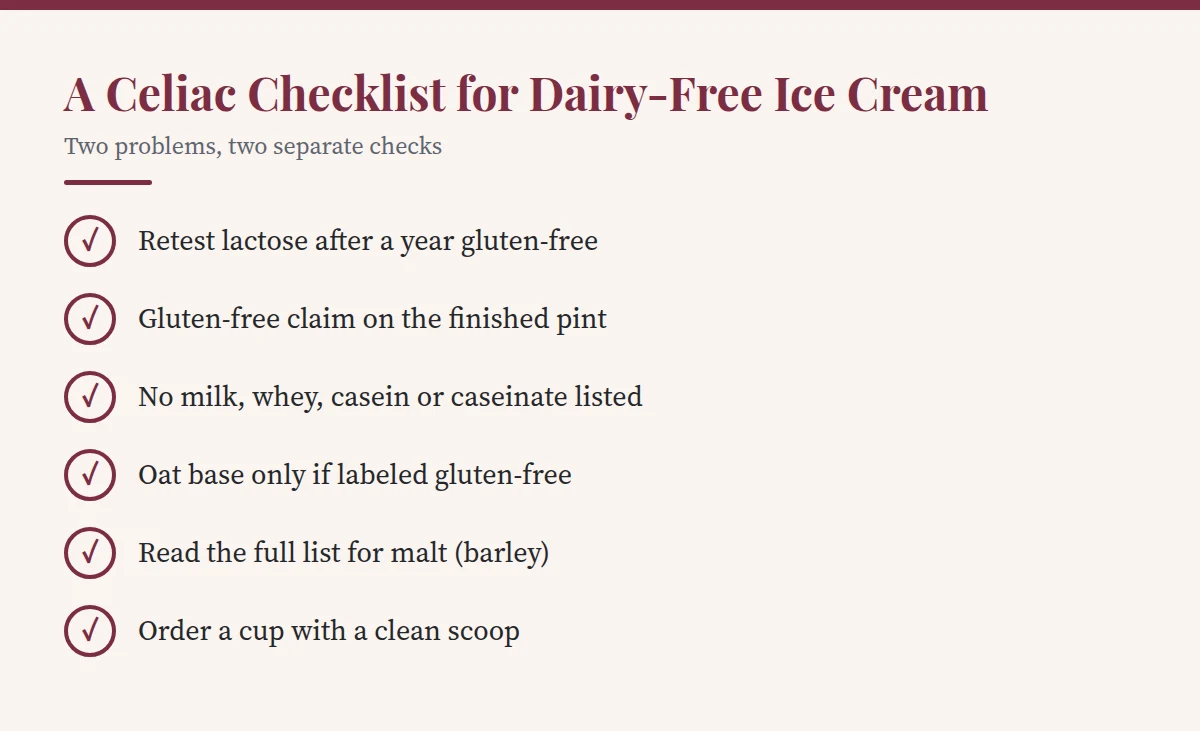
How long that takes is the part people underestimate. Ojetti and colleagues followed 15 adults with celiac disease whose breath tests showed they were not absorbing lactose, and started them all on a gluten-free diet. At six months, one had a normal lactose test. At twelve months, 9 of the remaining 14 did. It was a small study, but the authors suggested the recovery tracks the intestinal lining returning to normal, and in their patients that took the better part of a year. Their advice was to repeat the lactose breath test after a year on the diet, rather than stay lactose-free indefinitely on the strength of a test taken while the gut was still damaged.
The link can run the other way, too. The same group screened 54 patients in southern Italy who had been referred with bloating and diarrhea after milk and a positive lactose breath test. Celiac antibodies turned up in 24 percent of them, against 2 percent of matched blood donors, and biopsies confirmed the damage. For those patients, trouble with lactose seemed to be the only sign of celiac disease. If you have been told you are lactose intolerant and cutting dairy has not settled things, ask about celiac testing, and ask before you give up gluten, because NIDDK warns that avoiding gluten beforehand can make the results inaccurate.
Not everyone gets full tolerance back. Secondary intolerance sits on top of whatever lactase your genes were already going to leave you with, and healing the gut only returns you to that baseline, which may still be low. I cover who tends to keep lactase, and who loses it, in who becomes lactose intolerant, and when.
Lactose-Free, Dairy-Free, or Neither
If lactose is the only thing your gut is struggling with, you do not have to give up dairy, only the milk sugar in it. Lactose-free ice cream is real dairy with the lactase enzyme added, so the sugar is split before it reaches you. That makes it a fair choice while you heal, and the wrong one for a milk allergy, because every milk protein is still in the tub. I set out that difference in lactose-free vs dairy-free ice cream. Dairy-free is the right call if you also react to milk protein, if you eat vegan, or if you simply prefer it.
Portion size still counts. MedlinePlus notes that most people with low lactase can drink up to half a cup of milk at a sitting without symptoms, so a small serving may sit fine when a sundae does not.
There is also a reason not to drop dairy carelessly. FDA lists osteoporosis among the health risks that come with celiac damage, and MedlinePlus warns that cutting out milk products can leave you short of calcium, vitamin D, riboflavin and protein. If dairy goes, replace what it supplied through fortified foods or a supplement your doctor recommends, and check the calcium line on the panel rather than assuming a plant pint covers it.
Where Gluten Hides in a Dairy-Free Pint
When symptoms hang on after diagnosis, hidden gluten is the usual reason. Stasi and colleagues checked 321 people with celiac disease who had been gluten-free for at least a year and found that 70, about one in five, still had symptoms. In patients whose diagnosis held up, gluten still getting into the diet was the main cause. Lactose intolerance did turn up, but less often: of 15 patients whose biopsies looked normal, 3 were lactose intolerant and 9 had irritable bowel syndrome. So before you blame the base of a frozen dessert, look at what is folded into it.
The bases themselves are rarely the problem. Coconut, almond, cashew, soy, pea and rice contain no gluten, and oat is a special case covered below. NIDDK lists ice cream among the processed foods where gluten can turn up, because flavorings, starches and thickeners can be made from gluten grains, and the inclusions are an even more direct route. The usual carriers:
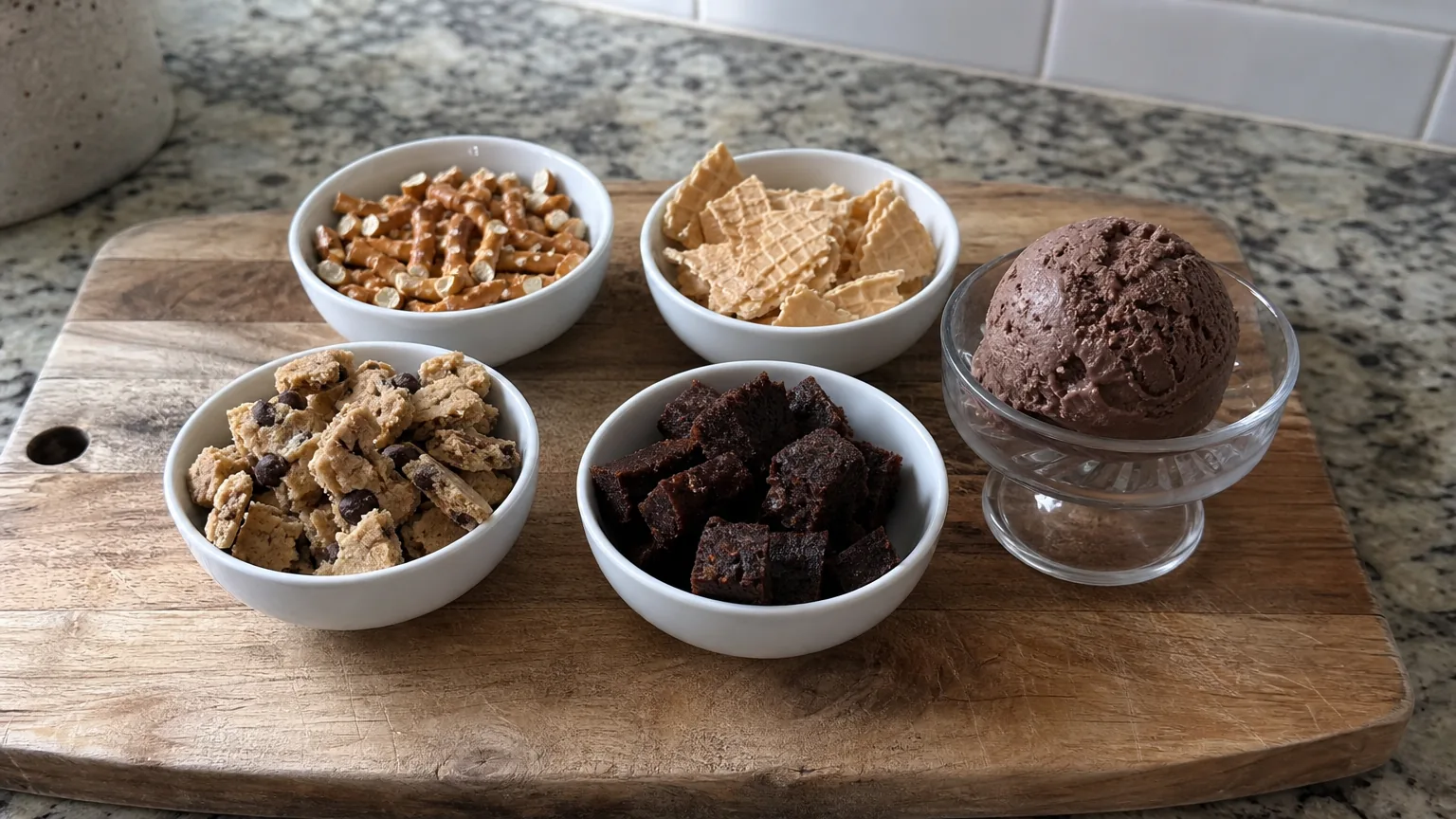
- Cookie, brownie and cake pieces, plus cookie dough, pretzels and graham crumbs, which are wheat unless the label says otherwise.
- Cones. Standard waffle, sugar and cake cones are made with wheat flour.
- Malt. NIDDK points out that malt and malt extract can carry barley. Malt balls, malted flavors and malt syrup all bring it in, and malted milk powder is typically made with wheat and milk as well.
- Crisped rice and cereal pieces. The rice is safe, but the recipe often includes malt flavoring.
Wheat is the easy one to catch. It is one of the nine major food allergens, so any wheat ingredient, even one tucked inside a flavoring, has to be named as wheat on the package. Barley and rye are not on that list, and Congress, not FDA, decides what is. FDA’s own 2026 request for information spells out the result: an ingredient such as malt extract or malt syrup can come from barley without saying so, and barley never has to appear in the “Contains” line. The agency adds that many products with malt ingredients do name the barley in the ingredient list, so the fix is simple. Read the whole list, not just the allergen statement.
A dairy-free claim also describes the base, not the flavor. When a chain launched oat milk scoops this summer, the oat drink was certified gluten-free and one flavor still carried wheat brownie pieces.
The Oat Base Question
Oats are not one of the gluten grains. FDA’s gluten-free rule defines those as wheat, rye, barley and their crossbreeds, and treats oats like rice or buckwheat: allowed under a gluten-free claim as long as any gluten picked up from other grains stays under 20 parts per million. Oats carry their own storage protein, avenin, and most people with celiac disease tolerate it.
The strongest evidence is a 2017 meta-analysis by Pinto-Sánchez and colleagues, which pooled 28 studies, including eight controlled trials with 661 patients. Eating oats for 12 months did not change symptoms, intestinal biopsies or antibody tests. Two caveats come attached: every randomized trial used pure, uncontaminated oats, and the authors rated the overall quality of the evidence as low. Most also does not mean all. In a Norwegian trial led by Lundin, 19 adults with celiac disease ate 50 grams of oats a day for 12 weeks. Most tolerated them, but one developed intestinal damage and a rash, recovered on an oat-free diet, and relapsed more severely when challenged a second time. NIDDK’s advice is to decide with your doctor or dietitian whether to eat oats and how much, and to choose only gluten-free ones.
The bigger risk is what oats pick up on the way to you. They can share fields, harvesters, trucks, silos and mills with wheat and barley. When Health Canada scientists led by Koerner tested 133 samples of regular commercial oats in 2011, about 88 percent carried more than 20 parts per million of gluten from other grains, while the one gluten-free oat variety in the study tested clean every time. That is the whole case for buying an oat pint only when it carries a gluten-free claim of its own, and for starting from oats labeled gluten-free if you make an oat base at home.
The claim has to be on the finished dessert. A gluten-free oat drink inside the pint says nothing about the cookie pieces, the swirl, or the line the pint ran on. Know what the claim does not promise, too. FDA does not require oats to be certified, or the manufacturer to test the food at all, only that it comes in under 20 ppm. Third-party certification programs add their own checks, and some set tighter limits such as 10 ppm, though FDA does not endorse any of them. The same scrutiny will apply to newer bases. Food scientists are developing blended grain bases to improve plant protein, and as I noted in what the labs are working on next, a blend made with wheat or barley would bring gluten with it.
Two Claims, Two Different Rulebooks
The labels you now have to read were never designed to work together.
- “Gluten-free” has a legal definition. The claim is voluntary, but a packaged food that uses it, or “no gluten,” “free of gluten” or “without gluten,” must contain no gluten grain, nothing made from one unless it was processed to remove the gluten, and less than 20 ppm gluten overall (21 CFR 101.91). Barley malt extract is not allowed under the claim at all.
- “Dairy-free” has no federal definition and no threshold. It is only as good as the ingredient list underneath it.
- “Non-dairy” is older and stranger. A food called nondairy can still contain caseinate, a milk protein, as long as the ingredient list follows it with a note such as “a milk derivative” (21 CFR 101.4(d)).
- The “Contains” statement must name milk and wheat. It does not have to name barley, rye or oats.
- “May contain” and “made in a facility” warnings are voluntary. FDA allows one on the same package as a gluten-free claim if it is truthful, and the 20 ppm standard still applies.
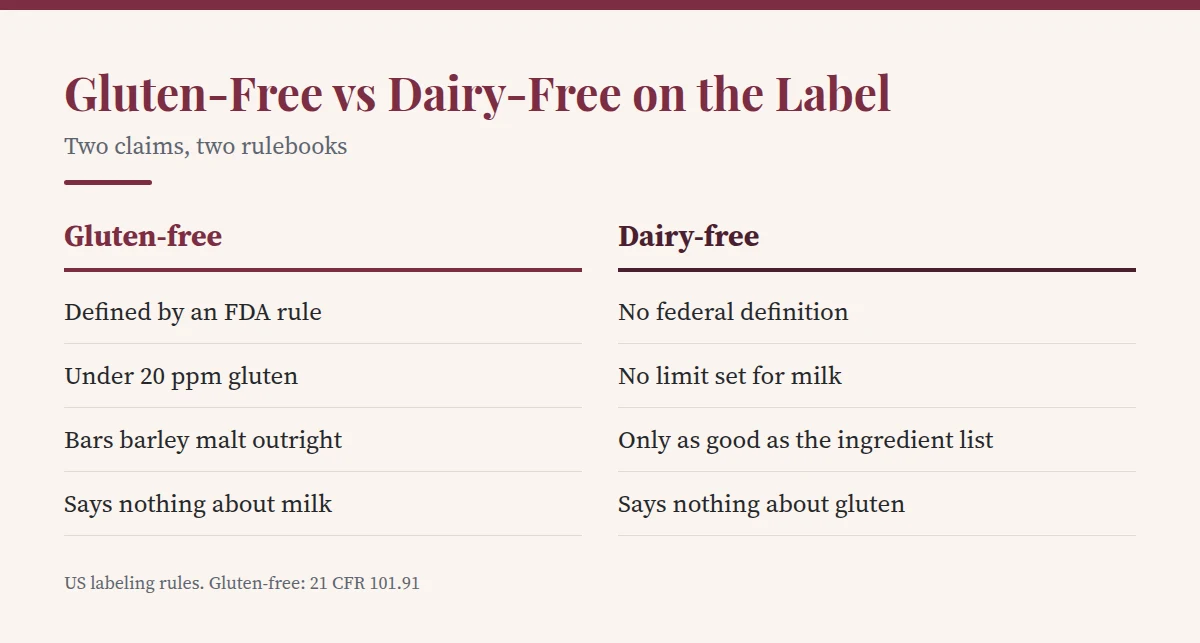
So every tub needs two separate checks: a gluten-free claim on the finished pint (or an ingredient list you have read line by line), and an ingredient list with no milk, whey, casein or caseinate. A vegan logo helps with the second check and says nothing about the first.
These gaps are now on FDA’s desk. In January 2026 the agency asked for public comment on a citizen petition that wants every gluten source named in ingredient lists, gluten brought into FDA’s allergen cross-contact policy, and oats treated as a gluten grain because they are so often contaminated. Comments closed in April. As of this writing no rule has been proposed, so for now the label works the way it is described here.
Ordering at the Counter
A scoop shop is where both risks meet, and the federal definition does not follow you there. FDA’s gluten-free rule is written for packaged food, and the agency says it shares complaints about restaurant food with state and local partners. Counter labels can also miss. Analyzing crowd-sourced readings from a portable gluten sensor, Lerner and colleagues found detectable gluten in 32 percent of restaurant foods labeled gluten-free, although the device picks up traces below 20 ppm, so a positive is not proof of a harmful dose.
The scoop shop risks are easy to picture: a scoop that moves from a cookie dough tub to the sorbet, a shared rinse well, crumbs around the cone station, an open toppings bar, and a blender that just mixed cookies into someone else’s shake. Ask for a cup instead of a cone, a clean scoop from an untouched tub, no toppings from the open bins, and nothing from the blender. A sorbet or a plain dairy-free flavor with no mix-ins is the simplest order on both counts. NIDDK’s advice for eating out holds here too: tell the staff you have celiac disease and ask how the food is prepared. I go through the full set of counter questions, soft serve included, in eating dairy-free ice cream away from home.

The Bottom Line
If you have celiac disease and dairy has turned on you, start with lactose. It is the well-documented explanation, and the trouble may be temporary. Lactose-free dairy and dairy-free pints both work while you heal, and a repeat breath test after about a year tells you whether you still need either. The gluten risk lives in the mix-ins, the cone and the counter rather than the base, so look for a gluten-free claim on the finished pint, read past the Contains line for malt, buy oat pints only when they say gluten-free, and order a cup. Recipes and suppliers change, so read the label on every tub, even the one you bought last week.
Further reading (sources)
- NIDDK on secondary lactose intolerance, and why it can lift once the cause is treated
- NIDDK for the celiac diet, including oats, malt, eating out and testing before going gluten-free
- MedlinePlus Medical Encyclopedia with lactose intolerance causes, tolerable servings and the nutrients dairy supplies
- Ojetti and colleagues on lactose malabsorption easing after a year on a gluten-free diet
- Ojetti and colleagues found celiac disease in a quarter of patients with positive lactose breath tests
- Stasi and colleagues on why symptoms persist in celiac patients on a long-term gluten-free diet
- Pinto-Sánchez and colleagues, with a meta-analysis of adding oats to a gluten-free diet
- Lundin and colleagues for an oat challenge in which one celiac patient developed intestinal damage
- Koerner and colleagues at Health Canada, testing gluten contamination in the commercial oat supply
- Lerner and colleagues on gluten detected in restaurant food labeled gluten-free
- U.S. Food and Drug Administration answering questions on the gluten-free labeling rule, from oats to barley malt
- U.S. Food and Drug Administration on gluten-free labeling and the health risks of celiac disease
- Federal Register for FDA’s request for information on gluten labeling and cross-contact
- Code of Federal Regulations defining “gluten-free” at 21 CFR 101.91
- Code of Federal Regulations on the “milk derivative” note required for nondairy foods with caseinate