Who Becomes Lactose Intolerant, and When: Ancestry, Age, and the Rare Congenital Form
Published on September 25, 2026

You ate ice cream all through childhood without a second thought. Then, somewhere in your twenties or thirties, a bowl after dinner started costing you an evening of cramps and bloating. It is natural to read that as something breaking. For most people on the planet it is the reverse: a gene that was always going to wind down, doing so on its own schedule. Whether and when that happens follows family ancestry closely, and in a very small number of babies the problem is there from the first feed. Here is who loses the ability to digest milk sugar, roughly when, and why most people who lose it never lose all of it.
Losing Lactase Is the Human Default
Lactose is the sugar in milk, and the body cannot absorb it until lactase, an enzyme made by the cells lining the small intestine, has split it in two. Babies born at term make plenty, because breast milk is full of lactose. After weaning, people part ways. For most humans, the LCT gene that carries the recipe for lactase grows gradually quieter once infancy is over, and the enzyme tapers off with it. That is lactase nonpersistence, which NIDDK also calls primary lactase deficiency and names as the most common reason anyone runs low on lactase.
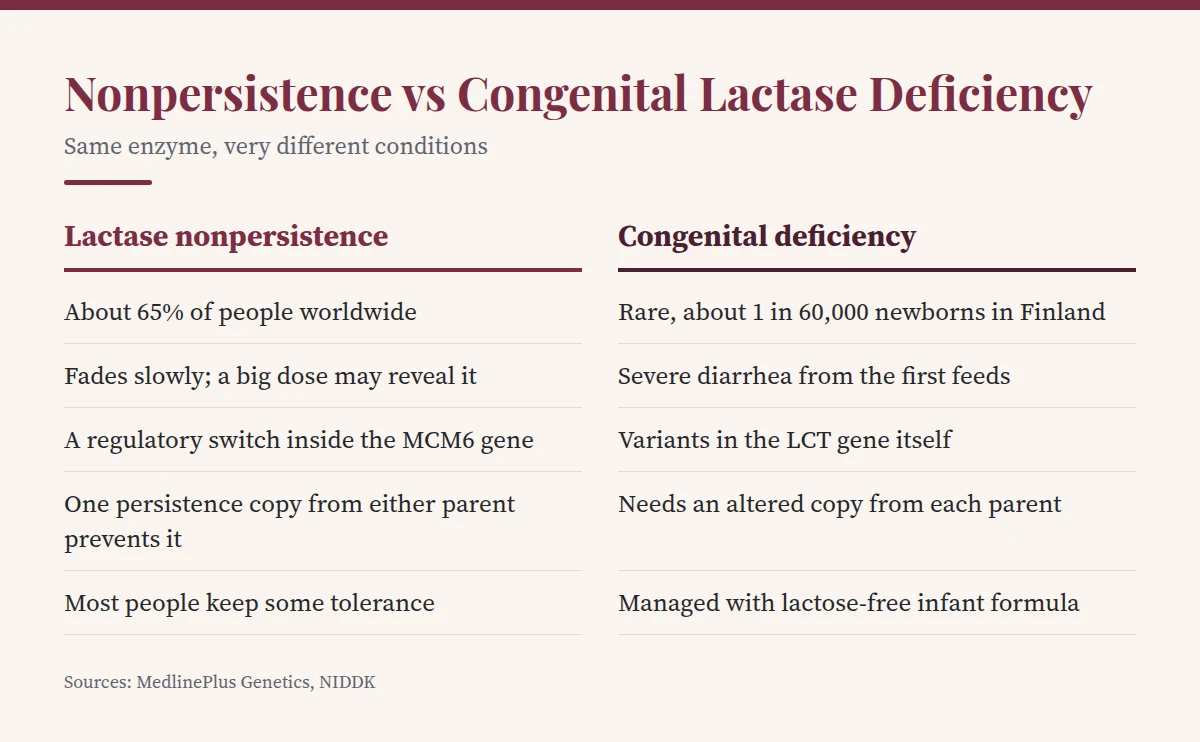
The volume knob for that gene is not in the gene itself. MedlinePlus Genetics explains that LCT is controlled by a stretch of DNA inside a neighboring gene, MCM6. Some people inherited a change there that keeps lactase running for life. The change is dominant, so one copy from one parent is enough, and anyone who inherited it from neither parent will make less lactase as they grow up.
So the variation is really the ability to keep digesting milk, not the loss of it. Ségurel and Bon frame lactase persistence as an adaptation to the domestication of dairy animals and to drinking their milk. Symptoms are a separate question from the enzyme: lactose that escapes digestion moves on to the colon, where bacteria ferment it into fluid and gas, and only some people notice (NIDDK). I untangle deficiency, malabsorption and intolerance in what each dairy test can actually tell you.
How Common It Is Depends on Where Your Family Comes From
Around 65 percent of the world’s people lose some of their ability to digest lactose after infancy, according to MedlinePlus Genetics, and that average hides an enormous spread. Among people of East Asian descent, 70 to 100 percent are nonpersistent. It is also very common in people of West African, Arab, Jewish, Greek and Italian descent, while only about 5 percent of people of Northern European descent are affected. Nonpersistence is rarest where fresh, unfermented milk was a staple food for many generations. The MedlinePlus medical encyclopedia names Asian, African and Native American heritage as backgrounds where it is very common in adults, and northern or western European roots as ones where it is less common, though it still occurs.
You will often see a more precise-sounding 68 percent instead, including on NIDDK’s pages. That figure comes from a 2017 meta-analysis that The Lancet Gastroenterology & Hepatology retracted in January 2025, after an expression of concern the year before. The MedlinePlus figure predates that paper: it was already on the page’s earlier incarnation, Genetics Home Reference, by 2015. The headline is the same either way: most adults make far less lactase than they did as babies.

Ancestry matters because persistence spread wherever keeping dairy animals gave people an edge, and it arose more than once. In Europeans it mostly traces to one variant, C/T-13910. Tishkoff and colleagues, studying 470 people in Tanzania, Kenya and Sudan, found three different variants doing the same job, each of separate origin, one carrying the signature of strong selection over roughly the past 7,000 years. Ségurel and Bon count five known variants and note loose ends, such as herding peoples in Central Asia with low persistence. Two practical points follow. A gene test built around the European variant is a blunter tool for anyone with other ancestry. And because one copy is enough, a parent can digest milk comfortably and still pass on only the nonpersistent version, which is how siblings can end up on opposite sides of the scoop counter.
When It Starts, and Why Your Twenties Can Be the Turning Point
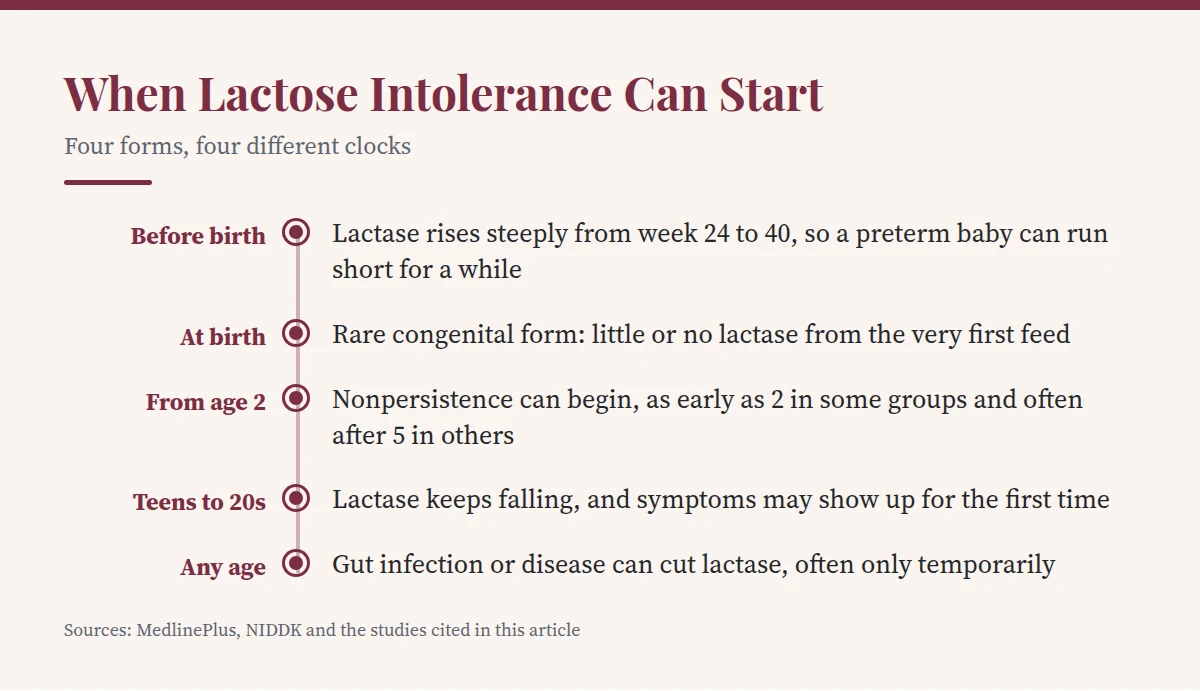
Children born at full term often show no sign of lactose intolerance before age 3, according to the MedlinePlus encyclopedia. After that, timing depends on background: it can appear as early as age 2 in African American children, while in white children it more often develops after age 5. NIDDK adds the part that surprises most adults. Lactase keeps falling with age, and symptoms can hold off until late childhood, the teenage years or even early adulthood. MedlinePlus counts about 30 million American adults with some degree of it by their twentieth birthday.

The lag between a falling enzyme and the first bad evening comes down to dose. Symptoms scale with how much lactose you have (NIDDK), so a slowly declining enzyme can go years without meeting a serving it cannot handle, and the first real reaction may arrive with a big one: a milkshake, a double scoop, a pint straight from the tub. The colon matters too. He and colleagues argue that the balance between how fast gut bacteria turn lactose into by-products that draw water into the bowel, and how fast the colon clears them, is a key factor in whether symptoms appear. That helps explain why two people with similar lactase levels can react so differently.
Not every new case in adulthood is nonpersistence, though. Infections, celiac disease, Crohn’s disease, and some treatments for other conditions (medicines, surgery, radiation) can injure the small intestine and cut lactase. NIDDK calls this secondary lactose intolerance, and tolerance can return once the cause is treated; after a passing diarrheal illness, MedlinePlus says lactase usually recovers within weeks. If dairy has never troubled your family and suddenly troubles you, or new symptoms come with it, raise it with a doctor rather than just switching pints.
The Two Infant Forms Are Something Else Entirely
Congenital lactase deficiency, or congenital alactasia, is the rare form. A baby born with it makes little or no lactase and cannot digest the lactose in breast milk or formula, so severe diarrhea starts with the first feeds, and without a lactose-free infant formula, dangerous dehydration and weight loss follow (MedlinePlus Genetics). The fault sits in the LCT gene itself, in variants thought to disrupt how the enzyme is built and how it works, not in the regulatory switch behind nonpersistence. It is recessive: an affected baby inherited an altered copy from each parent, and the parents usually have no symptoms. Its true incidence is unknown, but it is most common in Finland, at an estimated 1 in 60,000 newborns, and when Torniainen and colleagues first reported the mutations in patients living outside Finland, they concluded it seems more common than previously believed.
Developmental lactase deficiency belongs to premature babies. Lactase is a late bloomer in the womb: Mobassaleh and colleagues describe its activity climbing steeply between 24 and 40 weeks of gestation, while its neighbors on the intestinal lining, the enzymes that split table sugar and malt sugar, are usually fully working in a preterm baby. A baby born early can make too little lactase for a while. NIDDK notes that production usually rises as the baby grows, and Mobassaleh’s group observed that obvious intolerance is uncommon even so, because the gut adapts after birth and colonic bacteria salvage much of the sugar that escapes digestion.
The American Academy of Pediatrics (Heyman and the Committee on Nutrition) sorts children’s lactase problems into these same four types, primary, secondary, congenital and developmental, which start at different ages and last for different lengths of time. MedlinePlus advises seeing a clinician when a child under 2 or 3 has symptoms, and NIDDK notes that milk allergy usually shows up in the first year of life while lactose intolerance comes later, so a baby who reacts to milk needs a diagnosis, not a guess. If a young child does end up on plant bases, not every base can feed a toddler.
Why Most People Keep Some Tolerance
Nonpersistence is a dimmer, not a switch. Most people with it still make some lactase and can handle a certain amount of lactose comfortably (MedlinePlus Genetics). How much varies. The MedlinePlus encyclopedia says most people with low lactase can drink up to half a cup of milk at a sitting, with servings over a cup more likely to cause problems, while NIDDK cites research suggesting many can manage 12 grams of lactose, about a cup of milk’s worth, with mild symptoms or none. NIDDK’s advice is small amounts, with meals, added back a little at a time. Fermented dairy is easier because the cultures in yogurt and aged cheese break down much of the lactose first.

The colon may also learn. Hertzler and Savaiano gave adults who malabsorb lactose a daily dose for ten days; afterward, gas following a lactose test dose was half what it had been after ten days on glucose, and breath hydrogen fell sharply. A Paris trial by Briet and colleagues saw the same bacterial adaptation, but symptoms eased just as much in a comparison group given ordinary table sugar, which the authors suggest may be a placebo effect. Treat regular small doses as something that might widen your margin, not a cure.
This dependence on dose is what separates lactose intolerance from a milk allergy, where a trace of protein can matter, and it is why lactose-free and dairy-free ice cream answer different questions.
What It Means at the Freezer Case
Regular ice cream is made from milk and cream that are never fermented, so its lactose arrives intact, and portion and timing are your main levers: a small scoop after dinner is a very different dose from a pint on an empty stomach. Beyond that, the options sort by what they actually do.
- Lactose-free dairy ice cream is real milk with lactase added to predigest the sugar. It was built for nonpersistence, and NIDDK rates lactose-free milk products as just as healthy as regular ones. It still carries all the casein and whey, so it is no help with a milk allergy.
- Lactase tablets and drops help some people manage regular ice cream (NIDDK).
- Dairy-free and vegan pints contain no milk, so there is no lactose to digest. Vegan also rules out every other animal ingredient, but for lactose the two do the same job.
- Toppings and mix-ins are where lactose hides. NIDDK lists cookies, cakes, nondairy whipped toppings and nondairy creamers among the products that can contain it, and its ingredient words to watch are milk, lactose, whey, curds, milk by-products, dry milk solids and nonfat dry milk powder. So read the ingredient list, not the front of the pack.
If you drop dairy altogether, NIDDK warns you may run short on calcium and vitamin D, and plant-based pints are rarely fortified enough to help. I compare them nutrient by nutrient in whether dairy-free ice cream is actually healthier.
The Bottom Line
If ice cream started disagreeing with you as an adult, the likeliest explanation is the ordinary one: you inherited the human default, and your lactase has been winding down since childhood. Ancestry largely predicts how likely that was, age mostly decides when you noticed, and your remaining enzyme and your colon set how much you can still get away with. The congenital and premature forms run on a different clock, and a sudden change in adulthood deserves a look for other causes. For everyone else, the question at the freezer case is not whether you can have ice cream, but which one, and how much.
Further reading (sources)
- MedlinePlus Genetics on lactase nonpersistence by ancestry, and the congenital form
- MedlinePlus Medical Encyclopedia for the ages lactose intolerance tends to appear, and its secondary causes
- NIDDK with the causes of low lactase, from nonpersistence to premature birth
- NIDDK on how much lactose most people handle, and where it hides
- Ségurel and Bon, reviewing how lactase persistence evolved in humans
- Tishkoff and colleagues on persistence variants that arose separately in East Africa and Europe
- He and colleagues with the colon’s role in whether lactose causes symptoms
- Torniainen and colleagues for congenital lactase deficiency mutations found beyond Finland
- Mobassaleh and colleagues on how lactase matures before birth
- Heyman and the AAP Committee on Nutrition for the four types of lactase deficiency in children
- Hertzler and Savaiano on colonic adaptation to a daily lactose dose
- Briet and colleagues with a controlled test of whether that adaptation eases symptoms
- The Lancet Gastroenterology & Hepatology for its retraction of the 2017 lactose malabsorption meta-analysis