What the Labs Are Working On Next for Plant-Based Ice Cream: Oleosomes, Fermented Bases, and Multi-Grain Blends
Published on October 2, 2026
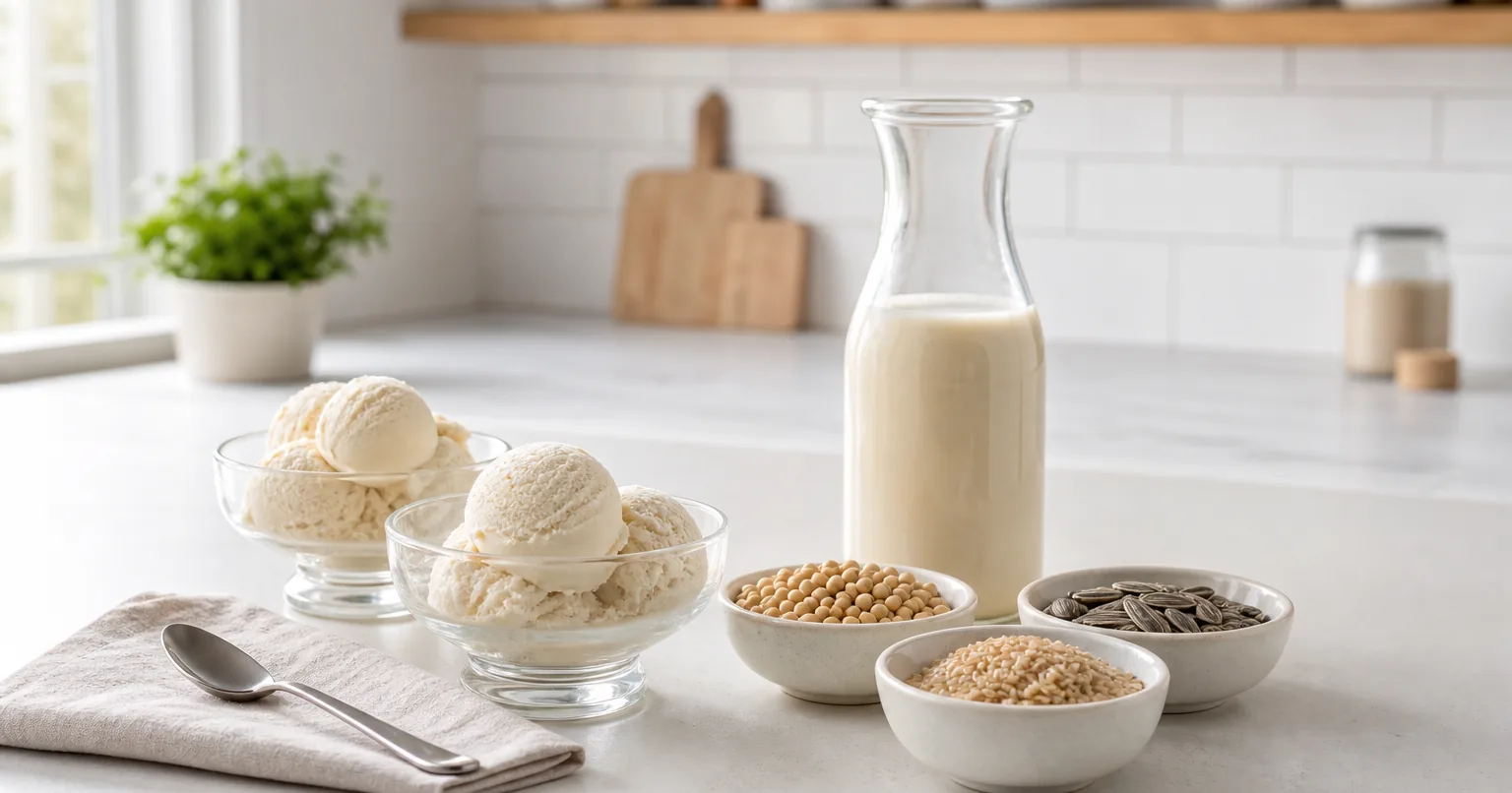
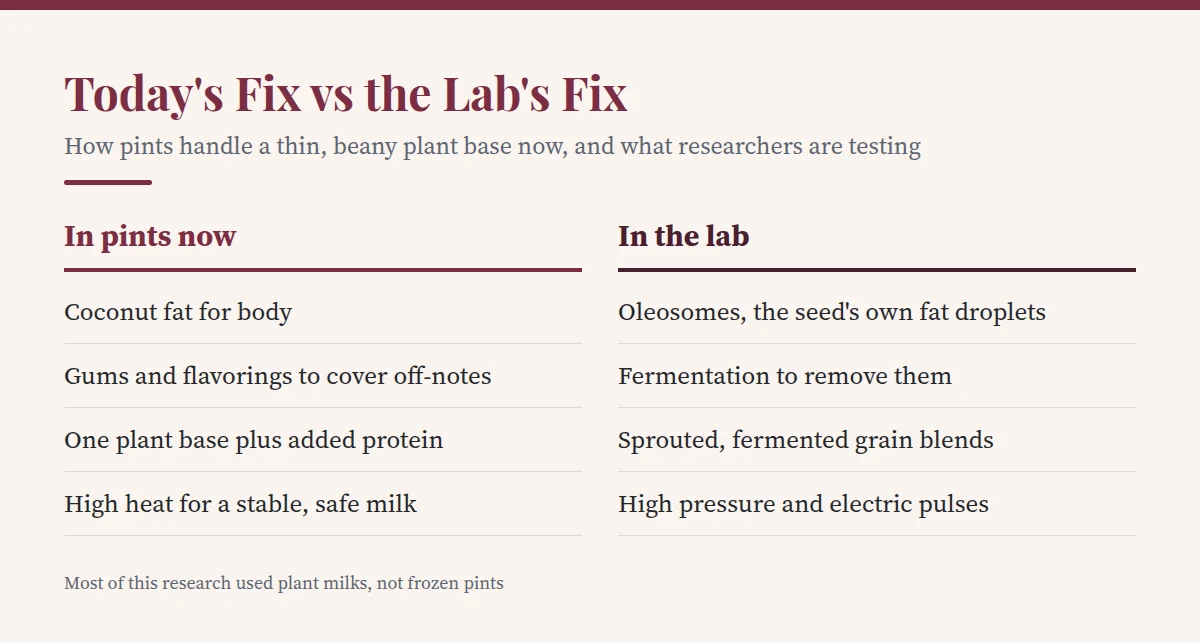
Most dairy-free pints fix a plant base the same way. The base is thinner than cream and often tastes of the bean, nut or grain it came from, so the recipe adds things: coconut fat for body, gums to smooth it out, and sugar and flavorings to cover what is left. It works well enough that the plant milk bases on the market today make good ice cream. But it is compensation, and food scientists have been working on the alternative, which is to change the base itself so there is less to cover up.
This is a tour of that research for readers who already know what guar gum and coconut oil are doing in a pint. Four lines of work stand out: oleosomes for creaminess, fermentation for flavor, sprouted and fermented grain blends for protein quality, and gentler processing. One caution before we start. Most of these studies were done on plant milks, not frozen desserts. A pint is built on that milk, so what improves the milk is a candidate for the pint, but freezing a base and whipping air into it is a separate test, and I will say so where a study has actually been churned.
Why Plant Bases Need So Much Help
Two broad reviews map the problem. Paul and colleagues name a difficult production process and a poor sensory profile as the main limits on how widely plant milks are accepted, especially milks made from legumes. Tangyu and colleagues break the sensory problem down. The beany, earthy smell comes mostly from n-hexanal and n-hexanol, compounds formed when the plant’s own fats oxidize. Phenols, tannins and saponins bring bitterness and astringency, and insoluble particles leave the mouthfeel chalky or thin. The nutrition gaps are just as specific: plant proteins tend to run short on lysine, methionine, cysteine and tryptophan, phytates tie up minerals, and the sugars raffinose and stachyose cause gas.
The standard answer, as Tangyu and colleagues describe it, is to add sweeteners, flavorings, protein, vitamins and minerals, along with pre-treatments such as soaking, dehulling and blanching. Blanching is the trick behind a clean-tasting soy base, since heat stops the enzymes that create the beany note. Silva and colleagues add that homogenizing and heat treatment are indispensable for a stable, safe plant milk. Each idea below tries to go a step further.
Oleosomes: Fat That Arrives Already Wrapped
Seeds store their oil as tiny droplets called oleosomes, or oil bodies, which make up 20 to 50 percent of a seed’s weight. Each one is a core of oil inside a skin of phospholipids and proteins, a structure that, as a review by Nikiforidis explains, evolved to keep the oil stable until the seed sprouts. Fat added to a base as an oil, coconut oil being the familiar example, has to be emulsified with help from lecithin or protein. An oleosome is an emulsion the seed has already made.
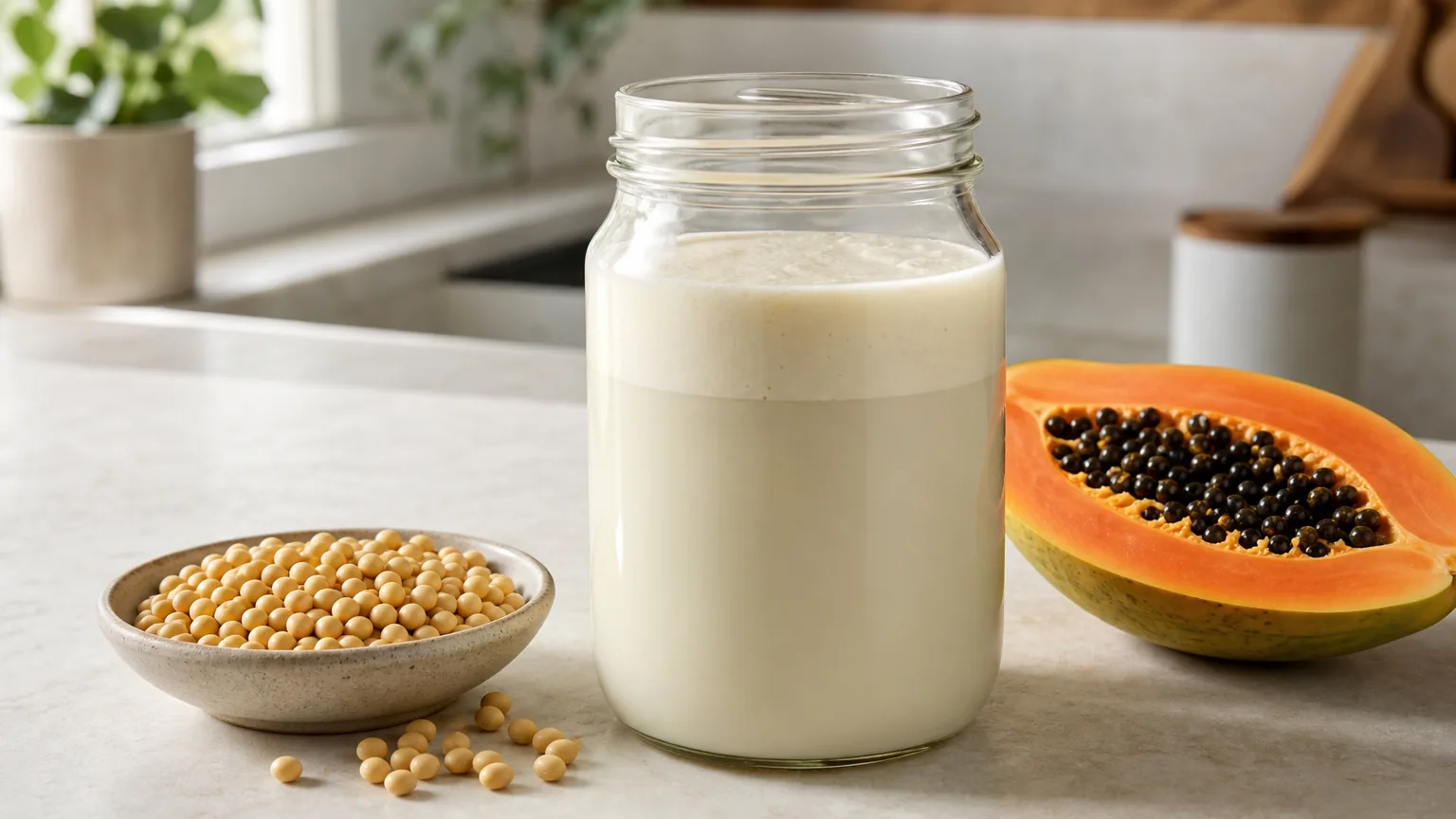
Li and colleagues set out to use that structure for creaminess. They separated an oleosome cream from soybeans and treated it with papain, an enzyme from papaya, which trimmed protein off the droplet surfaces and left more phospholipid exposed. With saliva present, the friction coefficient fell from 0.15 to 0.03. Part of what the mouth reads as cream is lubrication, how easily the tongue slides against the palate, and the team’s tests suggest the treated droplets hydrate into the mucin film that saliva leaves behind. Blended into raw soy milk, the treated cream gave a plant milk that the authors report matched full-fat dairy milk on nutrition, lubrication and creaminess.
That study stopped at milk, but oleosomes themselves have been churned. Zaaboul and colleagues used peanut oil bodies in place of the fat in an ice cream, and they pitch the approach as a platform for plant-based ice cream. Roasted oil bodies took in air more easily than fresh ones, giving more overrun and a slower melt, and the heat cut beany compounds such as hexanal. A sunflower oleosome ice cream covered in my stabilizers reference gained stability and melt resistance as its oleosome share rose. And a 2026 study by Aliyari and colleagues, comparing oleosomes with milk fat globules at the surface of air bubbles (stabilizing those bubbles is critical in ice cream), counted a scientist from a major ice cream maker’s lab among its authors.
The catch is allergens. An oleosome ingredient is the seed’s oil with its protein skin still on, and the main skin proteins, called oleosins, are allergens in peanut, sunflower seed and soy. Majsiak and colleagues note that oleosins survive heat and digestion and dissolve poorly in water, so the standard extracts used in allergy tests can miss them. Trimming the skin with papain has not been shown to change that, so treat any oleosome as its seed. Soy and peanut are major allergens and must be named on the label. Sunflower is not one of the nine, so it appears only in the ingredient list with no Contains line to flag it, the same gap the multi-allergy guide flags for seed-based swaps.
Fermentation: What Bacteria Can Do That a Gum Cannot
This is the old kind of fermentation, bacteria or yeast fed on the plant base itself, as with yogurt. It is not the precision fermentation that brews milk proteins in a tank, which puts real whey or casein in the pint and is covered in my piece on animal-free dairy.
A gum binds water and thickens. It can make a thin base feel richer, but it does little about what the base smells of. Kaur, Gray and Barringer tested exactly that. Added on their own to pea protein, xanthan gum, pectin and oil barely moved the off-odor compounds. A two-stage fermentation, a lactic acid bacterium for 12 hours followed by a yogurt culture for 8, cut total off-odor volatiles by more than 98 percent across eight plant proteins, including soy, pea, chickpea, hemp and rice. In pea protein, hexanal fell from 9,184 to 42 parts per billion, down where it is barely perceptible. The bacteria, the authors explain, convert aldehydes such as hexanal into less volatile alcohols and acids, and use up the oxygen that would form more. In a sniff test, 42 consumers preferred the fermented pea and soy samples.
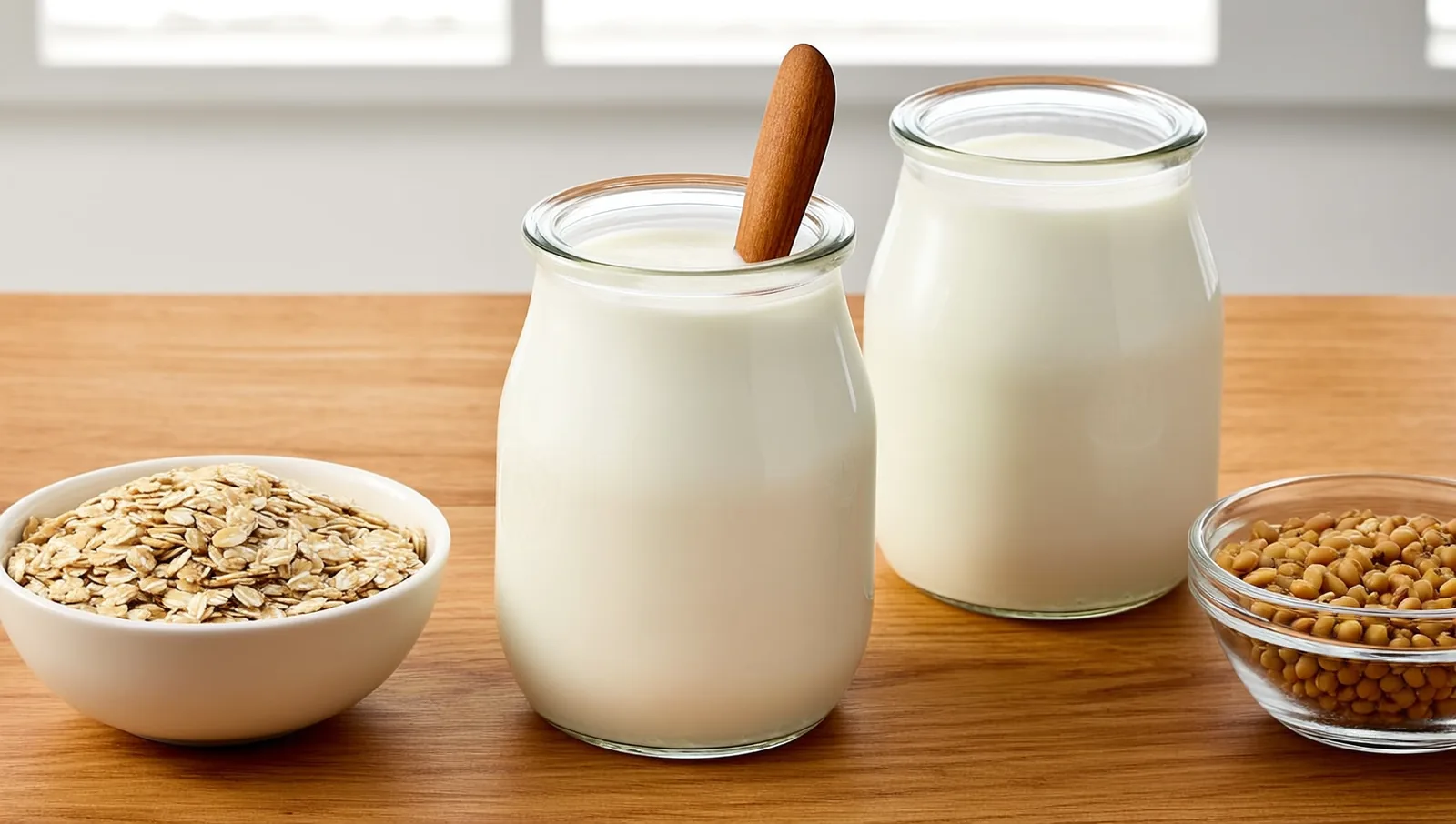
The review by Tangyu and colleagues adds nutrition to flavor. Lactic acid bacteria make phytases, and one mixed culture cut phytic acid in soy by 80 percent and saponins by 30 percent. Mixed cultures generally broke down more raffinose and stachyose than single strains, a blend of Lactobacillus strains raised riboflavin, thiamine and niacin in cowpea milk, and two yogurt bacteria together made peanut milk less beany while leaving it whiter, thicker and smoother. A stabilizer does none of this.
Two cautions. Results depend heavily on the strain. Zipori and colleagues found that one lactic acid bacterium on its own actually raised hexanal in pea protein, and it took a yeast to bring it down. Tangyu and colleagues, two of whom work in a large food company’s research division, describe choosing strain combinations as still largely trial and error. The second caution is acid. The two-stage ferment ended near pH 4.5, which is yogurt sourness. That suits a fruit pint or a frozen yogurt style, and it is harder to hide in vanilla.
Multi-Grain Blends: Better Protein, Not More of It
Most plant milks start from a single plant, and each plant’s protein has its weak spots. Wang and colleagues combined two. They sprouted soybeans for 18 hours, fermented brown and white rice for 48 hours with a rice starter, then ground, homogenized and sterilized the mix with no additives. They compared it with plain soy milk made the same way from unsprouted beans, and with commercial cow’s milk, in a standard lab model of the stomach and gut.
The blend was the better protein. Essential amino acids made up 36.5 percent of its protein, against 29.9 percent for the soy milk and 38.5 percent for cow’s milk. Its weakest amino acids, the sulfur ones, scored 0.60 against soy’s 0.54. By the end of simulated digestion it had broken down more protein than cow’s milk, though not significantly more than the soy milk, and it formed no curd in the simulated stomach, where cow’s milk did.
Read the fine print, though. The blend held 3.0 percent protein against the soy milk’s 5.9, so quality went up while quantity went down. It was a lab digestion model, not people, the lead author’s listed affiliation is a dairy company, and the study included no tasting or freezing. For a dessert, which is no one’s main protein source, the gain matters less than it would in a daily glass of milk. Blends also stack allergens. This one is soy and rice, and a version made with wheat or barley would add gluten.
What You Will See on the Label, and What You Won’t
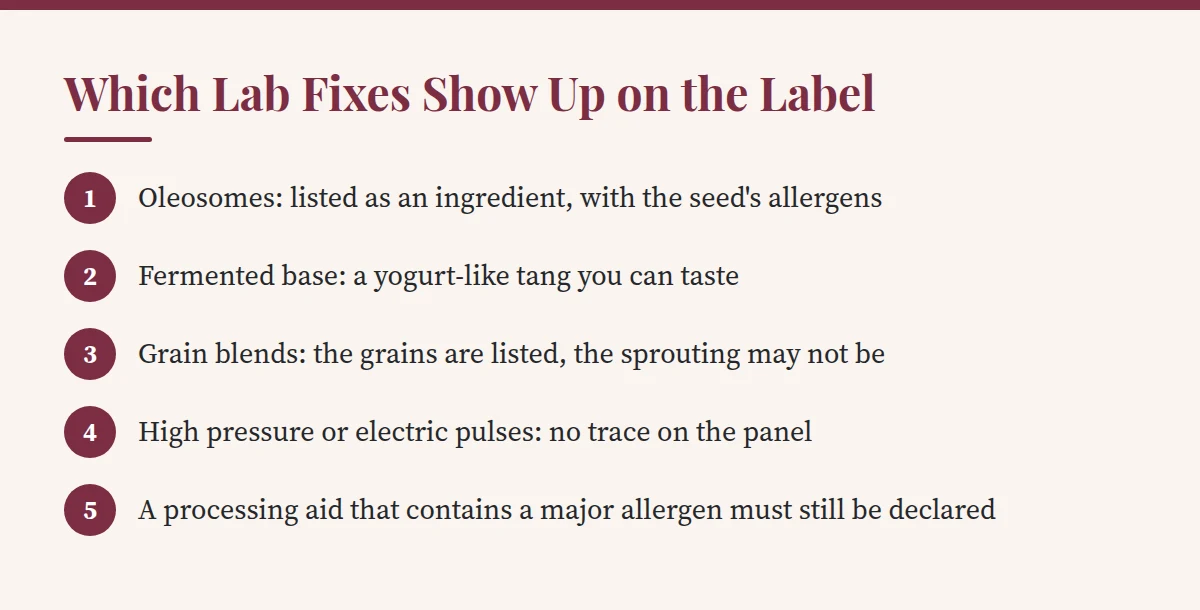
These fixes differ in how visible they are. An oleosome is an ingredient, so it goes in the list and brings its seed’s allergens with it. A fermented base tends to announce itself on the tongue, with a yogurt-like tang. A grain blend lists its grains, but the sprouting and fermenting that did the work happen before anything is weighed into the mix, so the panel may say nothing about them. Gentler processing is invisible. Silva and colleagues describe ultra-high pressure homogenization and pulsed electric fields as technologies under study to improve shelf life, emulsion stability, nutrition and taste without high heat, and none of it leaves a word on the label.
What cannot go missing is an allergen. FDA rules let processing aids stay off the ingredient list, but the agency’s allergen guidance says that exemption does not cover major allergens: if a processing aid is or contains milk, soy or another of the nine major allergens, the label must still name it. An invisible processing step cannot legally hide milk that went in on purpose, though the same guidance treats cross-contact from shared equipment as a separate matter.
The Bottom Line
Of the three ingredient ideas, oleosomes look closest to the freezer case. They have already been churned in lab ice creams, and a scientist from an ice cream maker’s lab has helped study how they behave at air bubbles. Fermentation has the strongest evidence on flavor, but it brings acid with it, so its natural first home is the tangy flavors. Sprouted grain blends are a nutrition story more than a dessert one. And the processing upgrades, if they arrive, will show up only in the taste. Whatever reaches the shelf, the rules for reading the tub stay the same: the seed decides the allergen, and the panel, not the pitch on the front, tells you what is inside.
Further reading (sources)
- Paul and colleagues, reviewing plant milk analogs and what holds back their acceptance
- Tangyu and colleagues on fermenting plant milks for better flavor and nutrition
- Silva and colleagues with the processing steps behind plant milks, including non-thermal methods
- Nikiforidis for how oleosomes are built and why they are so stable
- Li and colleagues on papain-treated soybean oleosomes that make soy milk creamier
- Zaaboul and colleagues, testing peanut oil bodies as the fat in ice cream
- Aliyari and colleagues comparing oleosomes and milk fat globules at an air bubble surface
- Majsiak and colleagues for a short review of oleosins as food allergens
- Kaur, Gray and Barringer on two-stage fermentation that strips off-odors from plant proteins
- Zipori and colleagues with lactic acid bacteria and yeasts fermenting pea protein
- Wang and colleagues on a sprouted soy and fermented rice milk in simulated digestion
- U.S. Food and Drug Administration in its allergen labeling guidance on incidental additives and processing aids (question D.8)