Dairy-Free Ice Cream in Canada: The Scoop Shop Guide to Toronto, Montreal, Winnipeg, and Niagara
Published on September 11, 2026

Canada had a very good summer for plant-based frozen dessert. Toronto absorbed a wave of new gelaterias and scoop shops, Montreal creameries kept widening their vegan cases, Winnipeg dairy bars built out oat milk programs, and regional guides from Niagara to the Kawarthas started listing dairy-free options as a matter of course rather than a footnote. If you are dairy-free and either live here or are driving through, the availability problem is largely solved.
The verification problem is not. If you learned to read labels and ask counter questions in the United States, some of your instincts go wrong the moment you cross the border. The words on a Canadian menu board carry different legal weight, the priority allergen list is not the same list, and the single ingredient this whole category runs on sits in a regulatory gap that has no US equivalent.
”Ice Cream” Is a Legal Term in Canada
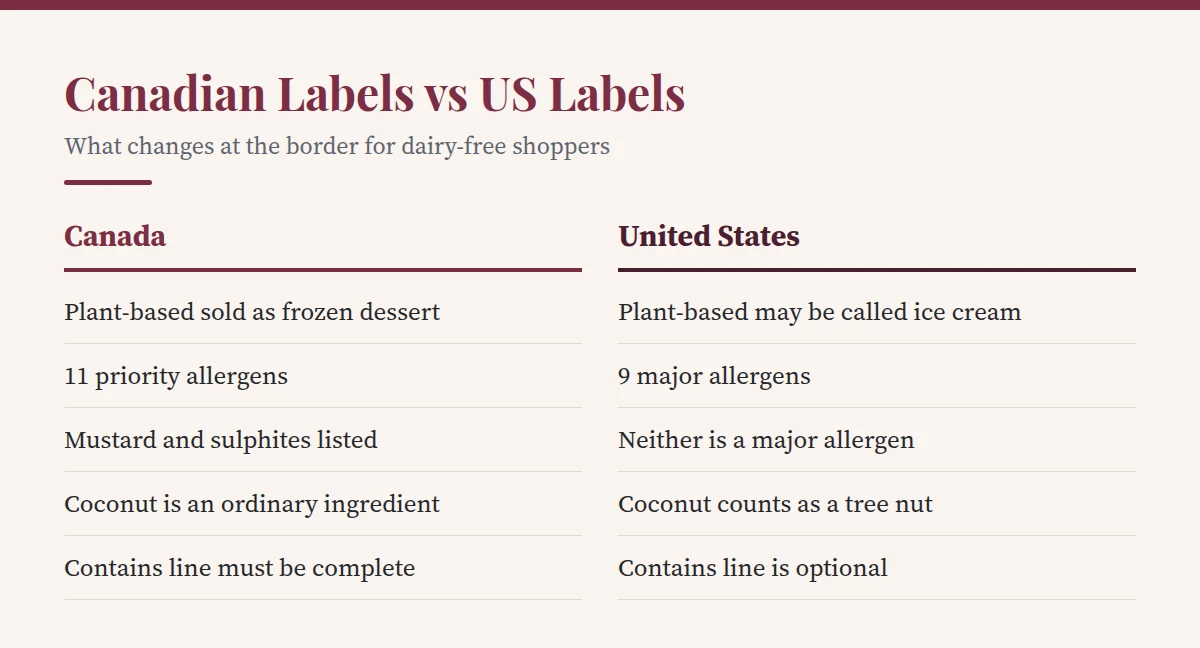
In the US, a plant-based pint can call itself ice cream and most brands do. Canada is stricter. Ice cream is a standardized dairy food here, and the standard sets a floor of roughly 10 percent milk fat and 36 percent solids. A coconut or oat product cannot meet that, so it cannot be sold as ice cream at all. What you see instead is “frozen dessert”, “non-dairy frozen dessert”, or a base-specific name like “oat frozen dessert”.
That cuts in your favour more often than not. On a Canadian package, the plain words “ice cream” are a dairy signal with regulatory teeth behind them, which is not true south of the border.
The trap is one word over. The Canadian Food Inspection Agency defines sherbet as “the frozen food, other than ice cream, light ice cream, ice milk or frozen dairy dessert, that is made from a milk product”. Canadian sherbet contains dairy by definition. Sorbet is not a standardized food and is normally water based. The two sit side by side on menu boards across Ontario and Quebec, one letter apart, on opposite sides of the line that matters to you.
Toronto: A Boom With Uneven Disclosure
Toronto’s 2026 opening wave was large enough that local food press ran it as its own story: Cono Gelato in Little Italy, Cremma Gelato coming to Mirvish Village, Cherry on Top at Dundas and Ossington, Disco Ice Cream reopening on Ossington, Brokn Milk across from Christie Pits. Most of that wave is dairy-first.
The dairy-free lane runs through a smaller set of addresses:
- Honey’s (1448 Dundas St. W. and 1026 Queen St. E.) is described as solely plant-based, which makes it the lowest-stress option in the city. Frosty & Fries, Rainbow Creamsicle, Diet Coke Float, Neapolitan.
- Cloudberry on the Danforth is, in its own framing, dairy-free on purpose rather than by accommodation, running fruit soft serve in cherry, watermelon, mango, and dragonfruit.
- Bang Bang (93A Ossington Ave.), Death in Venice (1418 Dundas St. W.), Brett’s (1007 Kingston Rd.), and Mizzica (307 Queen St. W. and 2375 Yonge St.) are all dual counters with real plant-based selections: sour passionfruit sorbet, coconut and pandan, avocado lime sorbet, limone.
One caution about the roundups themselves. Toronto’s vegan scoop lists name flavours enthusiastically and name bases almost never, so you are usually walking in blind on whether a scoop is coconut, oat, cashew, or soy. If that distinction matters to you, and for a second allergy it does, the base question has to be asked at the counter.
A related mislabel worth flagging: Kela in midtown opened as frozen Greek yogurt made with Ontario kefir. The health framing reads plant-adjacent. It is dairy.
Montreal: The City That Tells You the Base
Montreal is the most transparent market in the country on this, and its creameries have been at it long enough to have opinions about which base suits which flavour.
- Hoche Glacé (2225 Ave Bennett, Hochelaga-Maisonneuve) specializes in vegan and gluten-free, including vegan ice cream cakes.
- Crèmerie SWIRL (230 Rue Rachel Est) builds on coconut milk and turns real fruit into sorbets, with a twist of both in one cone as the house order.
- Meu Meu (4458 Rue Saint-Denis) churns its vegan scoops on DAM oat milk and organic cane sugar, with no dyes, stabilizers, or artificial flavourings. That is an unusually specific disclosure, and it also tells you the texture will run leaner than a coconut scoop.
- Le Patio (836 Ave du Mont-Royal Est) has been a Plateau institution since 1971 and now pours tofu-based scoops, an oat milk chocolate twist, sorbets made only with Quebec fruit, and a vegan chocolate shell from its in-house chocolatier.
- Dalla Rose (4609 Rue Notre-Dame Ouest, Saint-Henri) works in coconut: coconut cacao, a coconut chocolate brownie twist, plus lemon, orange, and Quebec apple and strawberry sorbets.
- Ca Lem (several locations, NDG at 6926 Rue Sherbrooke Ouest), Les Givrés (2730 Rue Masson), and Iconoglace (three counters, including 1419 Rue Clark) round out the list. Les Givrés packs vegan flavours in 100 ml, 500 ml, and 4 L sizes.
The spread of bases across one city is the useful lesson here. Tofu, oat, and coconut behave differently in a freezer and taste different under the same flavouring, which is why the same shop will run a coconut base for chocolate and a fruit sorbet for citrus. My guide to plant milk bases covers what each one does to fat, freeze, and mouthfeel, and if a shop’s oat scoop convinces you, the same conversion logic works at home.
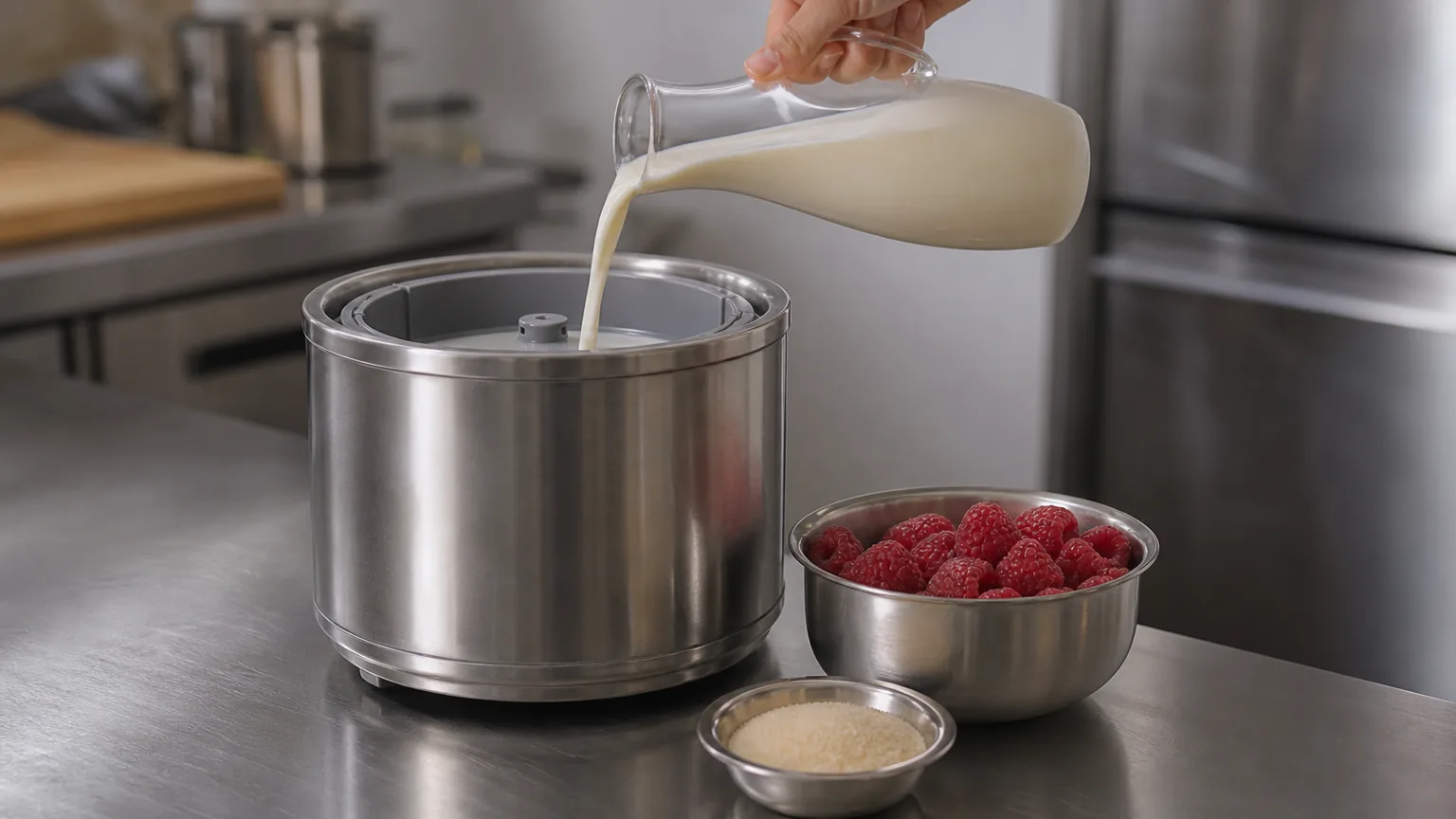
Iconoglace deserves one asterisk: it runs seasonal soft serve in vegan versions. Soft serve is a machine question rather than a tub question, so ask whether the plant-based mix has its own barrel and spout.
Winnipeg and the Prairies
Winnipeg’s frozen dessert scene is deeper than outsiders expect, and it opens early, with the classic stands sliding their shutters up as soon as late March.
Sub Zero (290 Jamison Ave.) is the clearest example of base separation. It claims Manitoba’s largest ice cream menu, makes its plant-based product from Canadian oats while Canadian dairy is the base for everything else, and offers vegan versions of almost everything on a menu that includes more than 80 parfaits. That clean separation of base by product line is exactly what you want to hear.
Chaeban (390 Osborne St.) carries five dairy-free flavours. It is also a good illustration of why “vegan available” is not the end of the conversation: the shop’s signature Abir Al Sham is built on a Syrian recipe with ricotta, toasted pistachios, and cashews. A nut-forward shop solves milk and solves nothing else, which is the same warning that applies to all-vegan shops generally and is worth reading alongside the multi-allergy reality of shared counters.
Licks Ice-Cream Patio (20 Britannica Rd.) runs strawberry banana and raspberry mango soft serve in vegan versions. Note that the same two flavours also exist as dairy ice cream and as frozen yogurt on the same machine bank, so name the vegan version explicitly rather than the flavour.
Two Winnipeg items that look dairy-free and are not: the bingsu at Snow and Moon is shaved from crystallized milk flakes rather than water ice, and the khoya in Shake N Rolls’ rolled desserts is reduced milk solids.
Niagara, the Kawarthas, and Cottage Country
Regional Ontario guides now flag dairy-free as standard practice. Around Niagara, Italian Ice Cream (5458 Victoria Ave., Niagara Falls) keeps water-based gelato alongside milk-based, Gelato Village (1417 Pelham St., Fonthill) runs raspberry, pineapple, and mango, Chocolates Etc. (100 Welland Ave., St. Catharines) does lemon, mango, and dark chocolate, and Cool Licks (642 King St., Welland) keeps a select vegan lineup inside a 30-plus flavour board.
Two Niagara stops list lactose-free vanilla or chocolate: Canalside Cones, scooping Kawartha Dairy, and CreekSides Ice Cream Parlour. Those are dairy products with the lactose removed, safe for lactose intolerance and unsafe for a milk allergy, and the lactose-free versus dairy-free distinction is the single most common confusion at a Canadian counter.

In the Kawarthas, the supply chain is worth knowing. Central Smith Creamery (739 Lindsay Rd., Selwyn) is Canada’s oldest independently owned dairy, scoops 36 flavours daily including vegan and sugar-free, and sells through its own distribution network rather than grocery. So the vegan flavours turn up at shacks and general stores across the region, including Reclaimed Garden Co. (4791 Highway 28, Burleigh Falls), which scoops 12 rotating Central Smith flavours plus vegan and non-dairy sorbets. One producer, many counters, and a cross-contact protocol that varies at every one of them.
The Allergen List Is Not the One You Know
Canada names 11 priority allergens: eggs, milk, mustard, peanuts, crustaceans and molluscs, fish, sesame seeds, soy, sulphites, tree nuts, and wheat and triticale. Against the US list of nine, Canada adds mustard, sulphites, molluscs, and triticale. The tree nut category is a closed list of nine species (almonds, Brazil nuts, cashews, hazelnuts, macadamia nuts, pecans, pine nuts, pistachios, walnuts) and each must be declared by name.
Look at what is missing from that list. Coconut. CFIA’s position is explicit: a product containing coconut may declare “does not contain tree nuts or peanuts”, and coconut “must be declared in the list of ingredients as per general labelling requirements”. In other words, Canada treats coconut as an ordinary ingredient. The US FDA counts it as a tree nut.
For a category where coconut cream is the default fat, that gap has teeth. A Canadian frozen dessert will not carry a bolded “Contains: coconut”, will not carry a precautionary coconut warning, and a coconut mix-up does not trigger priority allergen recall machinery. You read the full ingredient list or you guess. If coconut is your problem rather than your solution, the coconut-free options are worth mapping in advance.
Three more rules that differ in your favour:
- A “Contains” statement must be complete. CFIA requires that Contains statements “include all priority allergens, even if they are already included in the list of ingredients”. A partial Contains line is a non-compliant label, not a stylistic choice. In the US the statement is optional to begin with.
- “Allergen-free” is not an allowed claim. CFIA considers a bare “allergen-free” or “no allergens” claim too broad to be acceptable. Claims have to name the allergen.
- “May contain” is still voluntary. Cross-contamination statements may be declared when, despite reasonable measures, an allergen is unintentionally present. No statement does not mean no risk.
Reading a Label in French
Mandatory label information appears in both official languages, which means in Quebec you will often read the French panel first. The vocabulary is worth five minutes.
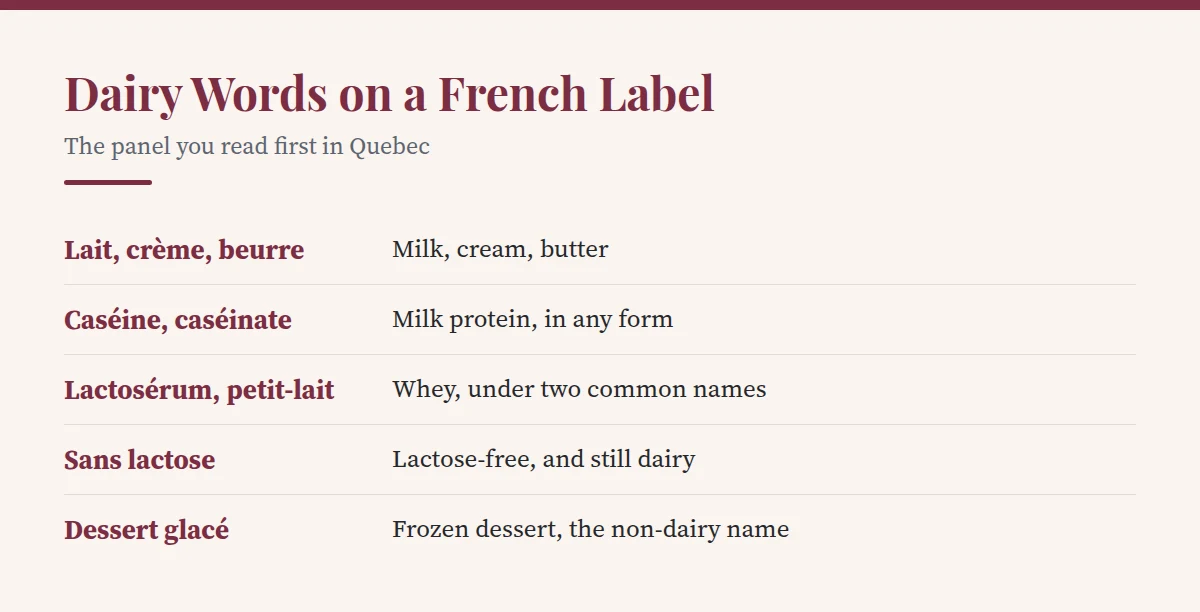
Beyond the card: poudre de lait is milk powder, matière grasse du lait is milk fat, solides du lait is milk solids, and à base de plantes or d’origine végétale both mean plant-based. The two header lines to find are Contient and Peut contenir.
The Canadian Counter Script
- Ask what the base is, not whether it is vegan. Coconut, oat, tofu, cashew, and water-based sorbet all pass a vegan test and answer different questions.
- Treat sherbet as dairy and sorbet as probably not. Then confirm, because menu boards are written by staff, not regulators.
- Name the vegan version, not the flavour, anywhere the same flavour exists in dairy, frozen yogurt, and plant-based on one machine bank.
- Ask for a clean scoop from the drawer. The dipper well keeps a scoop from gumming up. It does not sanitize it.
- For soft serve, ask about the barrel and the spout, not the mix.
- Read the full ingredient list for coconut, because the Contains line will not carry it.
Canada is now a genuinely easy country to eat dairy-free frozen dessert in. It is just not the same country you learned the rules in, and the two places that bite are the ones where a Canadian word means something more specific than the English suggests. Learn sherbet, learn coconut, and the rest of the map opens up.
Further reading (sources)
- Canadian Food Inspection Agency on what has to appear when a label declares allergens
- Canadian Food Inspection Agency for the eleven priority allergens and where they must be declared
- NOW Toronto on the Toronto shops scooping vegan this summer
- blogTO covering the city’s sudden influx of ice cream and gelato shops
- Tastet for where the vegan scoops are in Montreal
- Winnipeg Free Press with a tour of the city’s frozen dessert counters
- The Spec on the thirteen Niagara stops worth a detour
- kawarthaNOW for ice cream made in the Kawarthas, vegan options included