Stabilizers and Emulsifiers in Dairy-Free Ice Cream: A Practical Reference for Gums, Lecithins, and Plant Proteins
Published on May 26, 2026
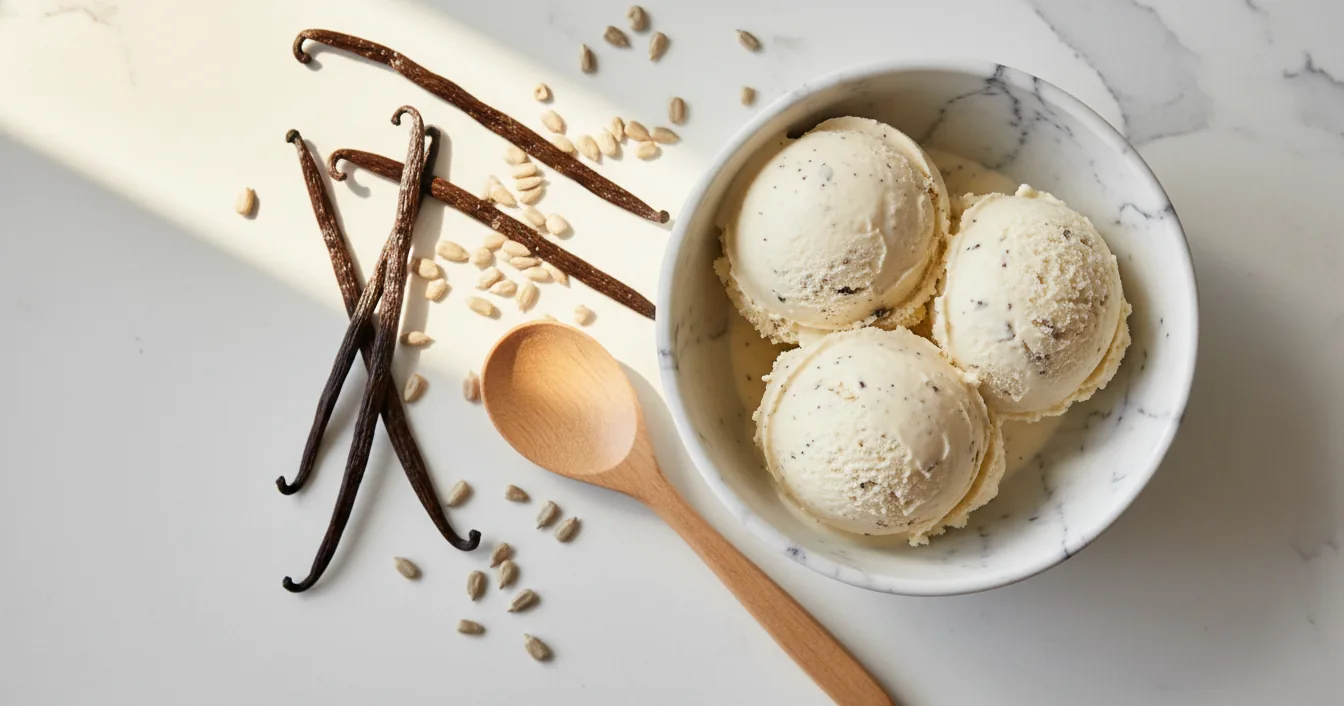
The reason a dairy-free pint scoops the way it does is rarely the oat or coconut milk on the front label. The smoothness, the slow melt, the way a spoonful releases on the tongue without turning to slush, is the work of two small ingredient classes most shoppers ignore: stabilizers and emulsifiers. In dairy ice cream those jobs are partly handled by milk fat and casein. Take those out and something else has to step in. Here is a plain-English reference to the gums, lecithins, and plant proteins doing that work in 2026, and how to read for them on the back of the carton.
Stabilizers Versus Emulsifiers: Two Different Jobs
The two get listed together on a panel and even blended in commercial pre-mixes, but they answer different problems.
Stabilizers are mostly polysaccharides. They bind free water, thicken the unfrozen liquid phase, and slow the migration of water molecules between ice crystals. The practical effect is fewer big, gritty crystals after the first freeze, better resistance to freeze-thaw cycling between the truck and your home freezer, and a slower puddle on the plate.
Emulsifiers are surface-active molecules. They sit at the boundary between fat droplets and the watery base, lowering interfacial tension so the fat stays evenly dispersed during whipping and freezing. In dairy ice cream, casein and whey proteins do most of that work for free. In a plant base they have to be added in.
A well-built non-dairy formulation usually carries one or two stabilizers and one emulsifier. Lean on that mental model when you read a panel: you are looking for one item from each toolbox, not a long ingredient list.
The Gum Roster
The seven names below cover the great majority of what shows up on a non-dairy pint.
- Guar gum is a seed gum from the guar bean. It hydrates in cold water, thickens fast, and is the workhorse of the category. Mild on flavor, easy to source. Used too heavily it can turn a base ropey or slick.
- Locust bean gum (also called carob bean gum) is the silky one. It needs heat to hydrate fully and does not thicken much on its own, but it synergizes beautifully with carrageenan and xanthan, producing a creamier mouthfeel than guar alone.
- Xanthan gum is microbial. It is a powerful thickener at very low doses, which is exactly the problem in ice cream: more than a pinch leaves a faintly slimy texture. More common in sorbet and sherbet than in cream-style non-dairy pints.
- Tara gum is the quietly rising option. Like guar and locust bean it is a galactomannan, sitting between the two in galactose ratio, which gives it some of locust bean’s smoothness without needing as much heat. Several mid-market plant pints have switched to tara for label cleanness.
- Gellan gum is a microbial polysaccharide that builds a fragile, brittle gel. Low-acyl gellan is mostly used in beverages, but high-acyl gellan can lend body to a soft-set frozen dessert, especially in coconut bases.
- Carrageenan is extracted from red seaweed. It binds plant proteins and stabilizes the foam structure better than any other single ingredient on this list. It has been controversial in the consumer press, though the FDA, EFSA, and JECFA continue to approve food-grade kappa-carrageenan and iota-carrageenan for frozen desserts. Shoppers who want to avoid it have plenty of carrageenan-free pints now.
- Gum arabic (acacia gum) acts more as a film-former and emulsifier than a pure thickener. A 2025 study on coconut-milk ice cream with soursop puree found that adding gum arabic at 1 to 1.5 percent raised overrun (the amount of whipped-in air) and meaningfully slowed melting, with the lowest melt rates landing around 0.09 grams per minute.
You will frequently see two or three of these stacked. A common combination is guar plus locust bean plus carrageenan, the same trio that has run through dairy ice cream for decades. Pre-blended “ice cream stabilizer” mixes for home churners are usually built around exactly that.
Emulsifiers: From Lecithins to Plant Proteins
Lecithin is the workhorse emulsifier in the non-dairy aisle. It is a class of phospholipids that, like casein, naturally orient themselves between fat and water. The two main sources for plant pints are sunflower lecithin (extracted from sunflower seeds, soy-free, increasingly the default) and soy lecithin (older, cheaper, very effective, a labeled allergen).
Both are typically used at well under one percent of the mix. If you scan the panel and see lecithin listed near the end, that is exactly where it should be.
The newer story is that plant proteins themselves can serve as emulsifiers, doing both the protein job and the surface-active job that casein handles in dairy. A 2023 review in Comprehensive Reviews in Food Science and Food Safety mapped how plant proteins, including modified wheat fractions, stabilize air-water interfaces, with explicit application to ice cream foam structure. The mechanistic point worth carrying: when a formulator uses pea or soy isolate at a serious level, they are partially replacing the lecithin, not just padding the nutrition panel.
What the Research Says About Plant Proteins in Practice
A 2024 study in Food Science and Nutrition compared dairy-free frozen desserts made with brown rice, pea, and soy protein against a dairy control. The plant-protein desserts all melted dramatically more slowly than the dairy reference: 0.29, 0.19, and 0.12 percent per minute for brown rice, soy, and pea respectively, against 1.95 percent per minute for the milk-protein ice cream. Pea protein gave the best melt resistance and the firmest texture (26.37 newtons of hardness). Brown rice protein gave the highest overrun at 47.5 percent and the softest scoop, but also the lowest sensory acceptance of the three. Soy landed in the middle on most measures, and on consumer scores.
That is the trade-off space in one paragraph. Pea is a great structural choice (firm, slow-melting, neutral) but sometimes carries an off-note. Soy is the most balanced. Brown rice is light and fluffy but can taste cereal-grain-adjacent if a formulator does not mask it.
A separate 2024 paper in the Journal of Texture Studies compared cashew-plus-pea and coconut-plus-pea formulas against dairy plus whey, and confirmed that the plant blends sit at higher cohesiveness and adhesiveness, with lower slipperiness on the spoon, than dairy. That difference, even when “minor” on paper, is exactly what shows up on the tongue as “this scoops a bit differently.”
Sunflower-Seed Oil Bodies: The Cleanest-Label Emulsifier
A 2026 Foods paper looked at a more elegant emulsifier route entirely. Instead of adding lecithin, the authors extracted oleosomes (also called oil bodies) from raw sunflower seed kernels and used them directly in a sugar-free plant ice cream built on sunflower oil, tahini, and date paste. Oleosomes are the natural fat-storage organelles of the seed: a triglyceride core wrapped in a phospholipid-and-protein skin. They arrive pre-emulsified by nature.

At 24 percent oleosome content, the formulation showed improved emulsion stability, better melt resistance, and a softer, less adhesive texture, all without any added synthetic emulsifier. The cleanest-label version of a non-dairy pint may not need lecithin at all, just the seed’s own oil bodies. Expect to see this language (“oil bodies,” “oleosomes,” sometimes “seed cream”) appearing on the front of premium pints within a year or two.
A Label-Reading Lens
Next time a non-dairy pint is in your hand, three quick scans will tell you most of what you need to know.
- The thickener stack. One or two gums (guar, locust bean, tara) means a careful formulation. Three or four with carrageenan included means a more aggressive stabilizer system, often a sign of a freeze-thaw-rough supply chain.
- The emulsifier. Look for sunflower lecithin (clean, allergen-friendly), soy lecithin (effective but a labeled allergen), or, increasingly, no lecithin at all and a plant protein doing the work instead. The newest “oil body” wording signals oleosome use.
- The protein name. Pea isolate and soy isolate in the first half of the ingredient list flag a structurally serious formulation that will probably scoop firm and melt slowly. Brown rice protein signals a lighter, fluffier scoop.
Most of this is invisible from the front of the carton, which is why the 60-second freezer-case routine for label-reading is the right habit to build. Once you know what each ingredient is doing, the healthier-than-dairy question gets a lot easier to answer: a pint heavy on pea protein is a different nutritional animal from a coconut-and-lecithin pint, even when both say “dairy-free” the same way on the front. The vegan-versus-dairy-free distinction cuts another way through the same shelf. None of these surface labels alone tells you how the pint scoops. The stabilizer and emulsifier line, read carefully, gets you closer.
Further reading (sources)
- Food Science and Nutrition on how brown rice, pea, and soy proteins compare in dairy-free frozen desserts
- Foods with sunflower seed oleosomes as natural emulsifiers in a sugar-free plant-based ice cream
- Journal of Texture Studies for the sensory profile of cashew-pea and coconut-pea frozen desserts against dairy
- Food Science and Nutrition on gum arabic and soursop puree in coconut milk ice cream
- Comprehensive Reviews in Food Science and Food Safety for wheat protein behavior at air-water interfaces, with ice-cream applications
- The Journal of Nutrition reviewing protein supplementation strategies in ice cream