Is It Lactose, a Milk Allergy, or Something Else? What Each Test Can Actually Tell You
Published on September 18, 2026

“Dairy doesn’t agree with me” is one sentence doing the work of at least four different conditions, and the differences are not academic. They change which pint in the freezer case is a problem, whether the “may contain milk” line on the back matters to you at all, and whether the answer is total avoidance or simply a smaller portion. People arrive at that sentence from very different directions, and the tests they get offered answer very different questions. Here is what each one can settle, and where each one stops.
Four Different Things People Mean
Lactose maldigestion is a sugar problem. Lactase, the enzyme that splits lactose into glucose and galactose in the small intestine, is switched down in most humans after weaning. Roughly 70 percent of the world’s adults have limited lactase expression, with wide variation by region (Facioni and colleagues, 2020). Undigested lactose travels on to the colon, where bacteria ferment it, and the gas and fluid that follow produce the familiar bloating, cramping, and diarrhoea. The review in Gut by Misselwitz and colleagues separates three terms that get used interchangeably: lactase deficiency is the missing enzyme, lactose malabsorption is the failure to absorb the sugar, and lactose intolerance is only the last of these, the one where symptoms actually appear after a dose.
IgE-mediated cow’s milk allergy is a protein problem. The immune system builds IgE antibodies against casein or whey and reacts within minutes: hives, vomiting, wheezing, and in the worst case anaphylaxis. The dose can be tiny, which is the crucial difference from lactose.
Non-IgE cow’s milk protein allergy is also an immune reaction to the same proteins, but it runs through a different mechanism, arrives hours or days later, and shows up mostly in the gut. Jensen, Fiocchi and colleagues mapped these routes for the World Allergy Organization, and the practical consequence is that the antibody every allergy panel looks for is simply not involved.
Something that is not about dairy. Misselwitz and colleagues make the point bluntly: independent of how well someone digests lactose, people with visceral hypersensitivity linked to anxiety or irritable bowel syndrome are more likely to report intolerance. Lactose is only one of several poorly absorbed carbohydrates that cause symptoms by the same fermentation mechanism, so a dairy-shaped symptom can have a non-dairy cause. Konturek and colleagues list breath testing as a routine step in the IBS workup precisely to rule carbohydrate intolerance in or out rather than assume it.
The Hydrogen Breath Test Proves Malabsorption, Not That It Is Your Problem
This is the test most people get. You drink a measured dose of lactose, then breathe into a collection container every 30 minutes for a few hours while the hydrogen in your breath is measured. If you are not absorbing the lactose, colonic bacteria ferment it and the hydrogen shows up on your breath.

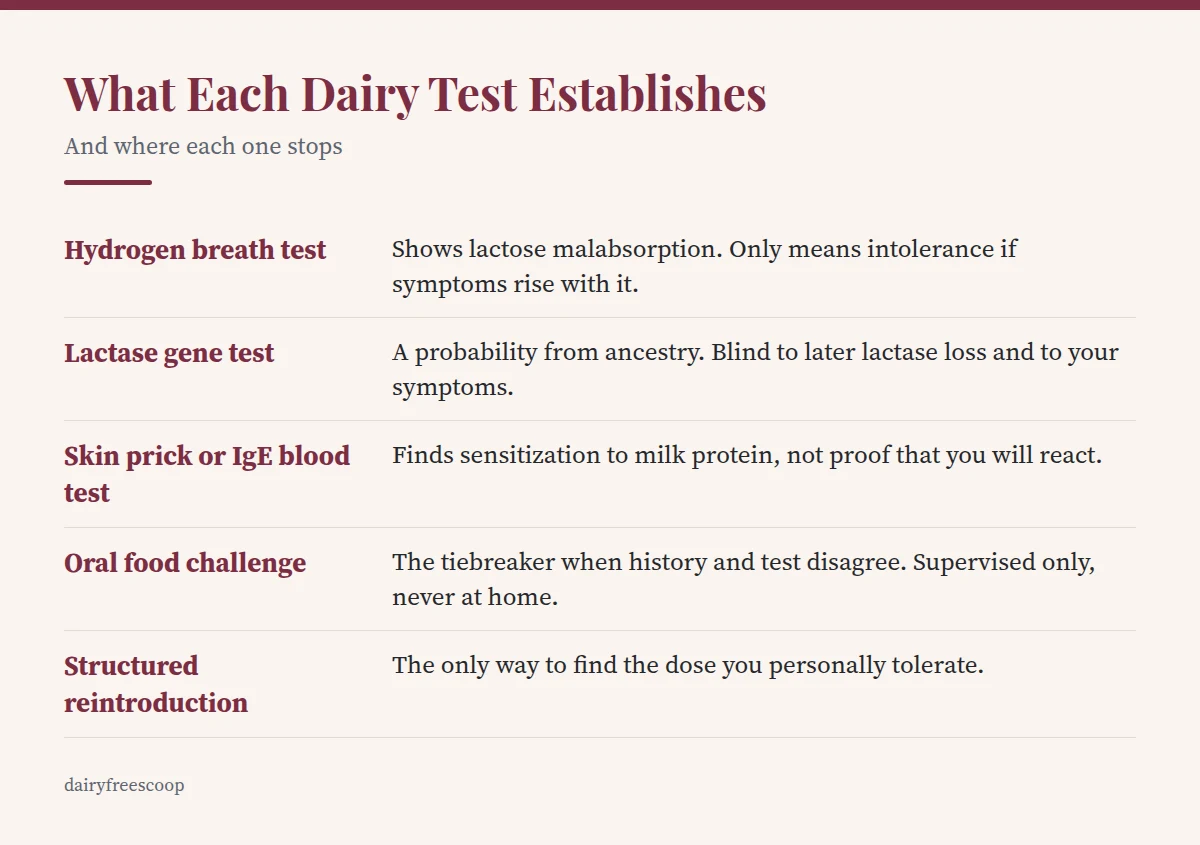
Read the NIDDK’s description of the test carefully and you find the part that gets lost in summary: a doctor may diagnose lactose intolerance when both the breath hydrogen rises and the symptoms get worse during the test. The gas curve on its own establishes malabsorption. It is the symptoms alongside it that make the diagnosis. Plenty of people malabsorb lactose and feel nothing.
Three limits are worth knowing before you put much weight on the result. The test dose is usually far larger than a dessert portion delivers, so a positive tells you what a large challenge does rather than what a scoop does. A minority of people ferment to methane rather than hydrogen and can read falsely negative. And lactase can be knocked down temporarily by infection or by any condition that damages the lining of the small bowel, which is what the literature calls secondary lactase deficiency. A positive result during a bad gut year is not necessarily a life sentence.
The Genetic Test Gives You a Probability, Not a Diagnosis
Consumer genetics has made lactase persistence testing cheap, and it is genuinely interesting. Misselwitz and colleagues describe the mechanism in adults of European descent as a single C to T change at the LCT -13910 locus on chromosome 2. Carry the persistence variant and you were likely to keep making lactase into adulthood.

Notice how narrow that claim is. The variant is described for one population’s genetic history, not as “the lactose gene” for everyone, so a panel built around it is a blunter instrument in people whose ancestry lies elsewhere. It says nothing about secondary lactase deficiency, because a gene cannot see damage to the bowel that happened last year. And it cannot tell you whether malabsorption produces symptoms in you, which is the only question you actually care about. Pratelli and colleagues, reviewing the omics tools now being aimed at this problem, argue for combining genotype with measured response and gut microbiome data rather than reading the genotype alone. A gene result is a useful prior. It is not a diagnosis.
Skin Prick and IgE Blood Tests: Sensitization Is Not Allergy
For suspected milk allergy, an allergist has a skin prick test (a drop of milk protein pricked into the skin, read at 15 to 30 minutes for a red itchy bump) and a blood test measuring milk-specific IgE. Both are looking for the same thing from different angles.
Both are also extremely sensitive, and MedlinePlus is unusually direct about the consequence: these tests can show signs of an allergy when there is not one, which is why they are ordered only after someone has had symptoms rather than used as a screen. A positive result means your immune system has made IgE against milk protein. That is sensitization. Whether eating milk actually makes you react is a separate question, and it is the reason a good allergist takes a careful history first and uses the test to confirm or challenge that story, not to replace it.
When the history and the test disagree, the tiebreaker is a supervised oral food challenge: increasing amounts of the food eaten under observation, with treatment on hand. It is the most informative test available and the only one that answers the real-world question directly. It is also the one thing on this list that should never be improvised at home.
Non-IgE Reactions Have No Lab Test At All
Delayed, gut-based reactions to milk protein, including the infant proctocolitis and enteropathy pictures, do not run through IgE. Skin prick and specific IgE panels come back negative, and that negative is not reassurance. There is no antibody for the panel to find.
Diagnosis here is a supervised elimination followed by a planned reintroduction, which makes the folk advice of “just cut out dairy and see” closer to a genuine diagnostic than it sounds, with one condition: the reintroduction has to actually happen. An elimination with no challenge at the end proves nothing, because symptoms that come and go on their own will look like a cure. Di Costanzo and Berni Canani warn that the gut symptoms of lactose intolerance can resemble cow’s milk allergy closely enough to get mislabelled as one, and the two are managed differently.
What a Reintroduction Settles That No Lab Can

For lactose, the real question is never “can I have dairy” but “how much, with what, and how often”. Shaukat and colleagues reviewed 36 randomised trials for the Annals of Internal Medicine and found moderate-quality evidence that 12 to 15 grams of lactose, about one cup of milk, is well tolerated by most adults with malabsorption. A structured reintroduction finds your own number. No breath test or genotype will.
Getting this wrong is not a harmless error in either direction. Santos and colleagues note that complete exclusion of dairy is usually unnecessary for lactose intolerance and carries a real cost, since milk is a major calcium source and blanket avoidance can push people toward osteopenia and osteoporosis. The American Academy of Pediatrics, in its committee review of lactose intolerance in children, likewise frames the goal as assessment rather than removal. If you have gone dairy-free for a reason that does not survive testing, what the research says about dairy-free nutrition is worth a read before you make it permanent.
What the Answer Changes at the Freezer Case
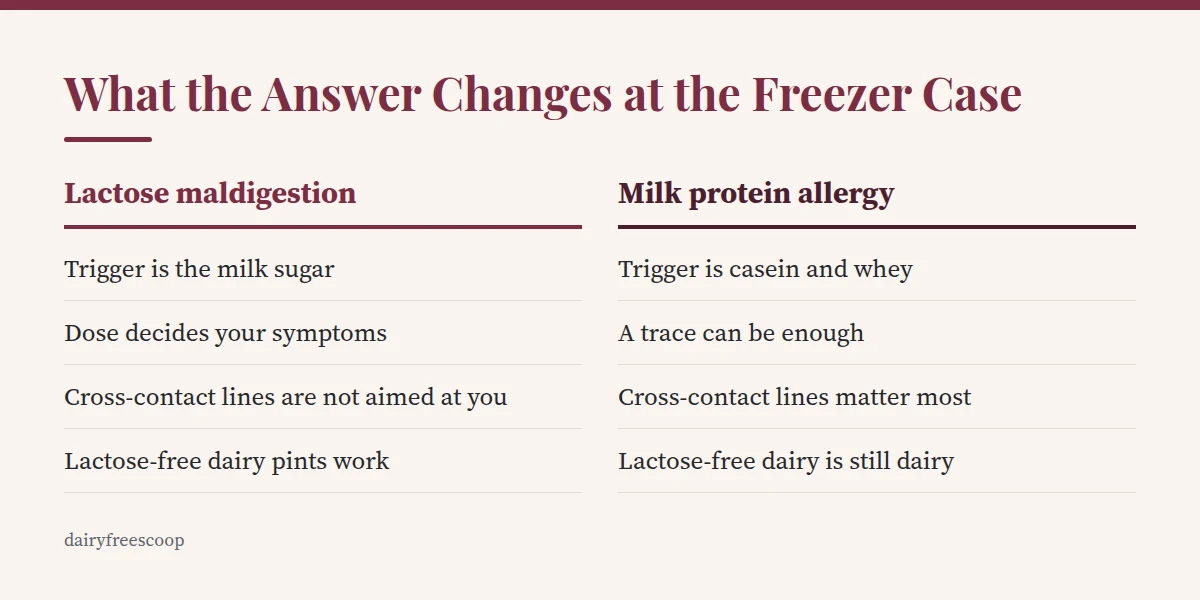
If it is lactose maldigestion, milk protein is not your enemy. Cross-contact statements, shared-equipment warnings, and “may contain milk” lines are aimed at allergic shoppers, and a protein trace is not a lactose dose. Lactose-free dairy ice cream was built for you, and so is every plant-based pint, which is exactly the distinction I unpack in lactose-free versus dairy-free ice cream. Your variable is portion size, not purity.
If it is IgE milk allergy, protein is everything and the precautionary line becomes the most important text on the tub. “Vegan” describes a recipe, not a factory, which is how a vegan-labelled product ended up recalled for undeclared milk. Lactose-free dairy is off the table entirely, because the lactase enzyme removes the sugar and leaves the casein and whey untouched. For confirmed cow’s milk allergy, the World Allergy Organization’s DRACMA update (Venter and colleagues) builds management around individualised avoidance, label reading, appropriate substitutes, and monitored growth and nutrition, and specifically advises against swapping in other mammalian milks such as goat or sheep because they cross-react.
If it is a non-IgE milk protein reaction, the trigger is still protein, so ingredient lists matter, but how strictly to treat precautionary labelling is a judgement call to make with your clinician rather than a fixed rule. Protein-forward plant bases are useful here, and soy is the one that comes closest to dairy on protein.
If nothing tests positive, going dairy-free may simply not fix it, and it is worth looking at other fermentable carbohydrates and at the gut-brain factors before rebuilding your whole diet around a food that was never the culprit.
The Bottom Line
No single test answers “is dairy the problem”. A breath test finds malabsorption and needs your symptoms standing next to it to mean anything. A gene test gives you a probability from one population’s history. An IgE panel finds sensitization, not reaction. Non-IgE reactions have no panel at all. Only a supervised challenge or a structured reintroduction connects a food to your symptoms, and only that answer tells you whether you are shopping for a smaller portion or reading every cross-contact line on the back of the tub. Until you know which of the four you are, the habit that serves everyone is the same one: read the label rather than the front of the pack.
Further reading (sources)
- Misselwitz and colleagues in Gut on how lactase deficiency, malabsorption, and intolerance differ
- NIDDK for how the hydrogen breath test is actually run and read
- MedlinePlus with why food allergy tests return false positives
- Shaukat and colleagues, a systematic review of how much lactose most adults actually tolerate
- Jensen, Fiocchi and colleagues on cow’s milk allergens and the immune mechanisms they trigger
- Venter and colleagues for the WAO DRACMA update on managing confirmed cow’s milk allergy
- Di Costanzo and Berni Canani on why lactose intolerance gets mislabelled as milk allergy
- Pratelli and colleagues reviewing what genetic and omics testing can and cannot add
- Santos and colleagues on the bone cost of excluding dairy unnecessarily
- Facioni and colleagues for how widespread limited lactase expression really is
- Heyman and the AAP Committee on Nutrition on assessing lactose intolerance in children
- Konturek and colleagues with how stress and the gut-brain axis produce the same symptoms