Dairy-Free Ice Cream With Kidney Stones or CKD: Which Plant Base Carries the Least Risk
Published on September 22, 2026
Almost everything written for people with kidney stones or chronic kidney disease is a list of things to stop eating. Cut the sodium, cut the oxalate, watch the potassium, watch the phosphorus. What almost nobody writes is the other half: given all that, what can you actually have for dessert. And if you have landed on dairy-free frozen desserts because you were told to ease off dairy, there is a detail worth knowing before you get attached to a flavour. Dairy-free is not a kidney category. Some plant bases are gentler on a stone-forming kidney than cow’s milk ever was. At least one is measurably worse.
The Minerals Are Not One Problem, They Are Three
The first thing to settle is which of these actually applies to you, because stone prevention and CKD management pull in different directions and the advice gets mixed together constantly.
Oxalate matters if you form calcium oxalate stones, the most common type. It binds calcium, and when that happens in urine rather than in the gut you get crystals. Potassium matters in later-stage CKD, when the kidneys stop clearing it efficiently. The National Institute of Diabetes and Digestive and Kidney Diseases puts the risk on both sides: having too little or too much potassium in your blood can cause heart and muscle problems, which is why the target is a number from your own team rather than “less”. Phosphorus matters in CKD too, and for a different reason. The National Kidney Foundation explains that when it builds up, the body pulls calcium out of bone to compensate, and high phosphorus with high calcium leads to deposits in blood vessels, lungs, eyes and heart.
A stone former with normal kidney function generally does not need to think about potassium at all. Someone on dialysis is thinking hard about potassium and phosphorus and rarely about oxalate. Sorting out which list is yours is the whole game, and it is a conversation for a renal dietitian rather than a website.
The Base Ranking, Measured
The useful thing about this question is that somebody actually measured it. Borin and colleagues, publishing in the Journal of Renal Nutrition, took popular brands of plant milk and ran the oxalate by ion chromatography with mass spectrometry, then pulled sodium, calcium and potassium off the labels. It is the closest thing to a direct answer anyone has published, and the numbers are not intuitive.
Almond came out highest in oxalate, followed by cashew, hazelnut and soy. Coconut and flax registered undetectable oxalate. Oat turned out to be the closest match to dairy milk across the board, with moderate calcium, potassium and sodium alongside low oxalate. Their conclusion was that oat, macadamia, rice and soy compare favourably with dairy milk on stone risk factors, while almond and cashew carry more of them. For chronic kidney disease specifically they singled out coconut, because it is low in potassium, sodium and oxalate at once.
Two honest caveats. The team measured drinks, not frozen desserts, and a pint is not a carton. And they say plainly that further study is needed to establish what any of this does to urine chemistry, which is the outcome that actually matters. Treat the ranking as the best available guide to the raw material, not as a clinical result.
Why Almond and Cashew Scoops Deserve a Portion Limit
Nuts are near the top of every oxalate list a stone clinic hands out. NIDDK names nuts and nut products first among the foods to limit for calcium oxalate stones, alongside peanuts, rhubarb, spinach and wheat bran.
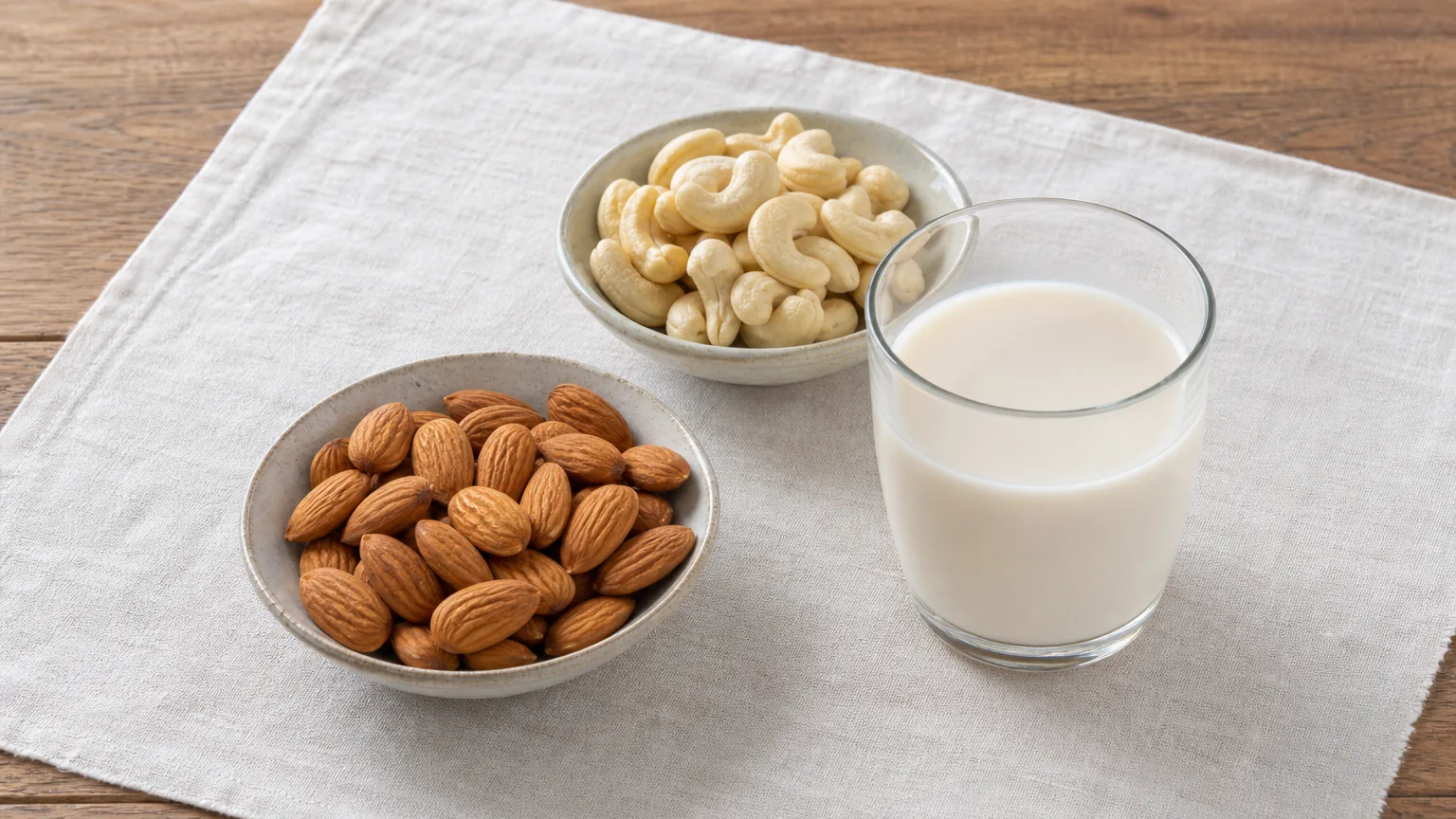
A nut drink is heavily diluted, so a glass of almond milk is nothing like a handful of almonds. The problem is that frozen desserts do not work that way. A creamy almond or cashew scoop is usually built from nut paste or nut butter rather than strained nut drink, because that is where the fat and body come from. The base is more concentrated than the carton the oxalate figures came from, not less. Nobody has published the oxalate content of commercial dairy-free pints, so the honest position is that a cashew pint is the one base where the direction of the error runs against you.
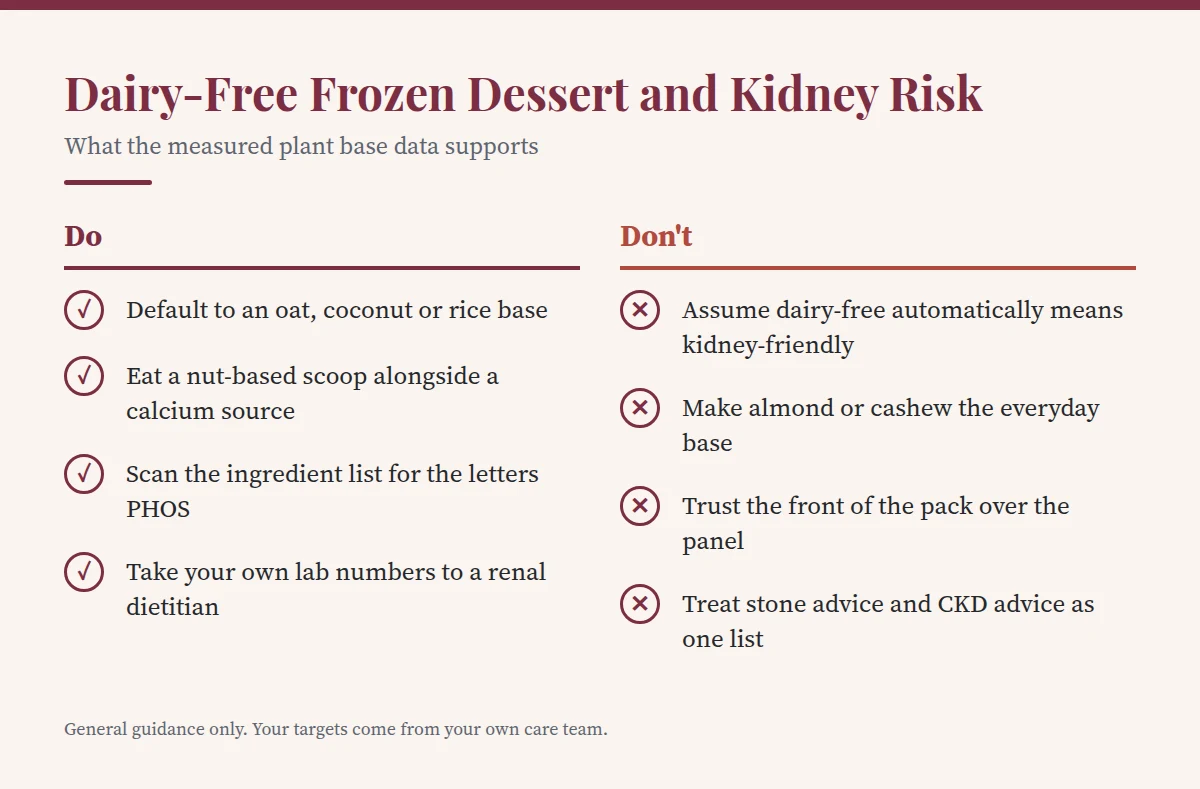
That is not a ban. Almond and cashew make some of the best frozen desserts in the case, and a stone history is a reason for portion discipline rather than abstinence. It does mean that if you are eating a nut-based dessert several nights a week, the base is worth swapping rather than the serving size. My guide to the plant milks behind dairy-free ice cream covers what oat and coconut give up in exchange, which is mostly protein.
Calcium Is the Ally, Not the Enemy
This is the point that surprises people, and it is the single most useful thing in this article.
NIDDK states it directly: even though calcium sounds like it would be the cause of calcium stones, it is not, and in the right amounts calcium can block other substances in the digestive tract that may cause stones. Read where that happens. The digestive tract. Calcium and oxalate bind to each other, and you want them finding each other in your gut, where the pair leaves in stool, rather than in your kidney.
The practical consequence follows from the mechanism. Calcium only does that job if it is present at the same time as the oxalate. A cashew scoop eaten alone at ten at night delivers oxalate with nothing to bind it. The same scoop after a meal containing a calcium source is a different proposition.
NIDDK adds a refinement worth noting for anyone who is dairy-free anyway: it may be best to get calcium from low-oxalate, plant-based sources such as calcium-fortified juices, cereals, breads, some vegetables and some beans.
Which puts fortification in an interesting light. A calcium-fortified plant base is doing something genuinely useful for a stone former, and the calcium content of plant drinks varies enormously. Borin’s group found calcium highest in macadamia, then soy, almond, rice and dairy, and lowest in cashew, hazelnut and coconut.
Fortification Is Where CKD and Stones Disagree
Start with the good news. Walther and colleagues, analysing 27 plant drinks alongside cow’s milk for Frontiers in Nutrition, found milk carried more calcium and more phosphorus than most of the plant alternatives did. On native mineral load, a plant base generally starts ahead for anyone watching phosphorus.
Then the two conditions come apart, because the same fortification that helps a stone former can be exactly the wrong thing in chronic kidney disease.
Plant bases are commonly fortified and stabilised with mineral salts, and a good number of those salts are phosphates. The National Kidney Foundation lists dicalcium phosphate among the additives to watch, and the reason additives matter more than the phosphorus in food is absorption. Phosphorus in plants is largely bound up as phytate, and Buades Fuster and colleagues, writing in Nefrologia, set out why that form is poorly available to humans. Added phosphate is not bound to anything. As the Kidney Foundation puts it, phosphorus from food additives is completely absorbed. St-Jules and colleagues made the case in Diabetes Spectrum that avoiding those additives is one of the more effective levers a CKD patient has, precisely because of that gap.
So a plant base can be low in native phosphorus and still deliver a meaningful load through what was added to it. The same logic applies to potassium salts used as stabilisers.
Reading the Panel, and What the Panel Will Not Tell You
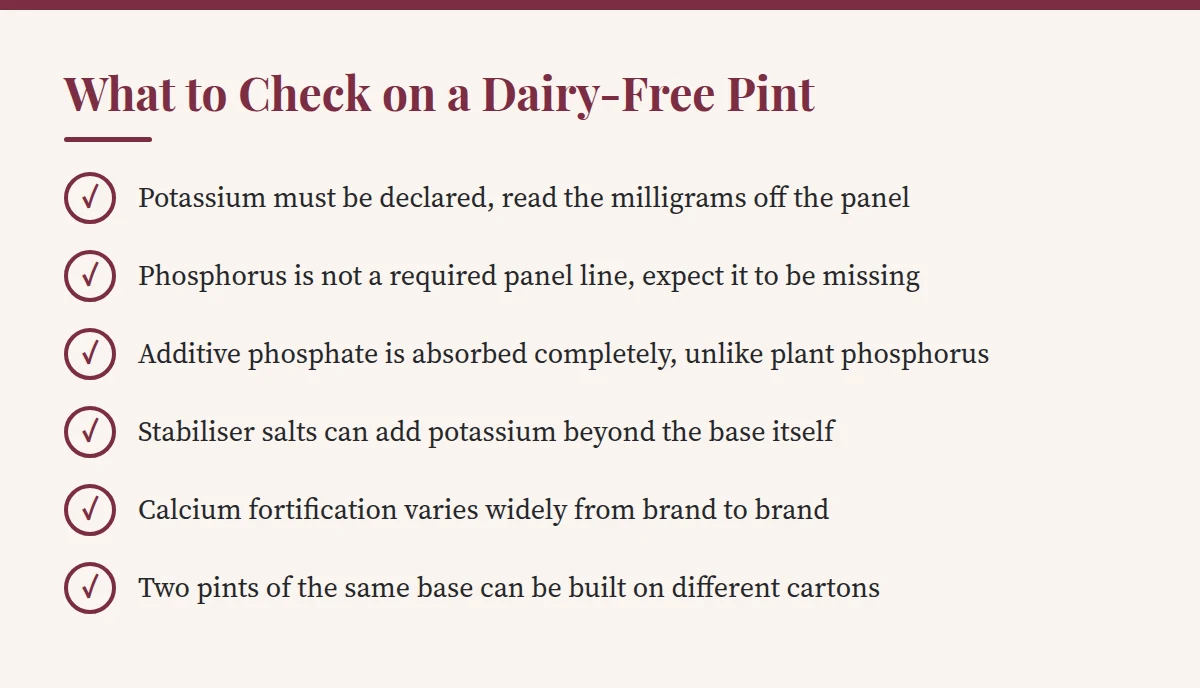
Here is the trap. Federal nutrition labelling rules require a panel to declare vitamin D, calcium, iron and potassium. Phosphorus is not on that mandatory list. So you can read potassium straight off the label, and for phosphorus you have to go to the ingredient list and hunt.
The Kidney Foundation’s shortcut is the best one going: scan the ingredients for the letters PHOS. That catches dicalcium phosphate, disodium phosphate, phosphoric acid, sodium hexametaphosphate, trisodium phosphate, sodium tripolyphosphate and tetrasodium pyrophosphate in one pass.
Assume nothing from the front of the pack. Johnson and colleagues, assessing 219 plant-based milk products from 21 brands for the Journal of the Academy of Nutrition and Dietetics, found high variability in every nutrient they looked at, within product types as well as between them, with roughly 70% fortified with both calcium and vitamin D. Pérez-Rodríguez and colleagues, working through 136 products on labelling data alone, found only a third calcium-fortified and 23% with added vitamin D. Two oat pints sitting side by side can be built on completely different cartons. Nor does the fortification in a carton necessarily survive into the frozen dessert made from it, a gap I go into in which plant bases actually feed a small child. The general discipline of reading past the claim to the panel is the same one I set out in how to read a dairy-free ice cream label, and the sugar-free class action is a reminder of what front-of-pack wording is worth.
The Sorbet Option
If all of this feels like a lot of arithmetic for a dessert, there is a shortcut that sidesteps most of it. A true sorbet has no plant base at all. Fruit, sugar, water, and nothing to carry oxalate, phosphate additives or fortification salts into the bowl.
That is close to ideal for a stone former. For advanced CKD it moves the question rather than answering it, because fruit is where potassium lives, and how much of it you can have is a number from your own blood work. Formats vary more than most shoppers realise, and the field guide to dairy-free frozen dessert types lays out which ones are built on a plant base and which are not.
The Bottom Line
If you form calcium oxalate stones, oat is the safest default and coconut and rice are close behind, with almond and cashew worth keeping to a controlled portion and eaten with food rather than alone. If you are managing CKD, coconut has the best profile on paper for being low in potassium, sodium and oxalate together, and the ingredient list matters more than the base name because added phosphate is absorbed completely while the phosphorus native to plants largely is not.
Above all, do not let a dairy-free label do your thinking. Ferraro and colleagues, reviewing dietary patterns and stone risk in Nutrients, make the wider point that plant-based eating is not uniformly protective and the composition of the diet decides the outcome. The same is true one pint at a time. Turn the tub over, read the potassium off the panel, scan the ingredients for PHOS, and take the specific numbers to the dietitian who has your labs.
Further reading (sources)
- Borin and colleagues measured oxalate, sodium, calcium and potassium across popular plant milk brands for the Journal of Renal Nutrition
- NIDDK on what to eat and avoid for calcium oxalate stones, including why dietary calcium helps
- NIDDK for how potassium, sodium and protein fit a chronic kidney disease diet
- National Kidney Foundation with the PHOS trick for spotting phosphate additives on an ingredient list
- St-Jules and colleagues in Diabetes Spectrum on why avoiding phosphate additives works better than cutting phosphorus-rich foods
- Buades Fuster and colleagues in Nefrologia for why phytate-bound plant phosphorus is poorly absorbed
- Johnson and colleagues surveyed the nutrient content of 219 plant milk products sold in the US
- Pérez-Rodríguez and colleagues assessed how little fortification plant beverage labels actually declare
- Ferraro and colleagues reviewed how dietary patterns including vegan diets change stone risk in Nutrients
- Walther and colleagues compared the mineral content of 27 plant drinks against cow’s milk
- Code of Federal Regulations sets which vitamins and minerals a nutrition panel must declare at 21 CFR 101.9