Eating Dairy-Free Ice Cream Away From Home: Scoop Shops, Soft Serve, and Cross-Contact
Published on August 24, 2026

At home you control everything. You buy the pint, you read the panel, you keep it in your own freezer next to your own food. Away from home you control almost nothing. There is no ingredient list on a scoop, the line behind you is four people deep, and the only source of truth is a seasonal employee who started three weeks ago. That gap is why so many dairy-free eaters quietly stop ordering frozen dessert on the road, and it is a shame, because availability has genuinely improved. Small towns have oat milk scoops now. Theme parks are switching whole machines to plant-based mix. The problem is no longer finding an option; it is knowing which options are actually safe for you.
The useful mental model is not “which flavors are dairy-free.” It is “what kind of counter am I standing at.” Three archetypes cover nearly everything you will meet, and each one carries a different level of risk.
Three Kinds of Counter
The all-vegan shop. The entire building is the control. No milk enters the premises, so there is no shared scoop problem, no dairy residue in the dipper well, no chance the new hire grabbed the wrong tub. Places like Frankie & Jo’s in Seattle, Like No Udder in Providence, Monkeywrench in Salt Lake City, FoMu in Boston, and Kate’s in Portland run this way, and they are the lowest-stress option by a wide margin. This category is also growing outward rather than just upward: the Charlotte vegan shop Seemingly Overzealous expanded into suburban Davidson in 2026, which is the kind of move that used to only happen in dense city cores. One caution, though. An all-vegan shop solves milk and egg. It does not solve cashews, coconut, or soy, and plenty of these shops are nut-heavy by design. If you manage more than one allergy, the building being vegan changes nothing about your other questions, and my multi-allergy guide covers where those hide.
The dual counter. This is most shops. Dairy tubs and plant-based tubs sit side by side in the same freezer well, get served with the same scoops, and share the same toppings station. The product is fine. The process is where the risk lives.
The dairy-first stand with a rotating slot. A traditional stand that keeps one or two non-dairy items on hand, often a sorbet, sometimes a branded oat milk line. Availability here is real but volatile, and the flavor you drove for may have sold out on Sunday.

The Dipper Well Is Not a Sanitizer
At a hard-serve counter, the single biggest hazard is not the tub. It is the scoop.
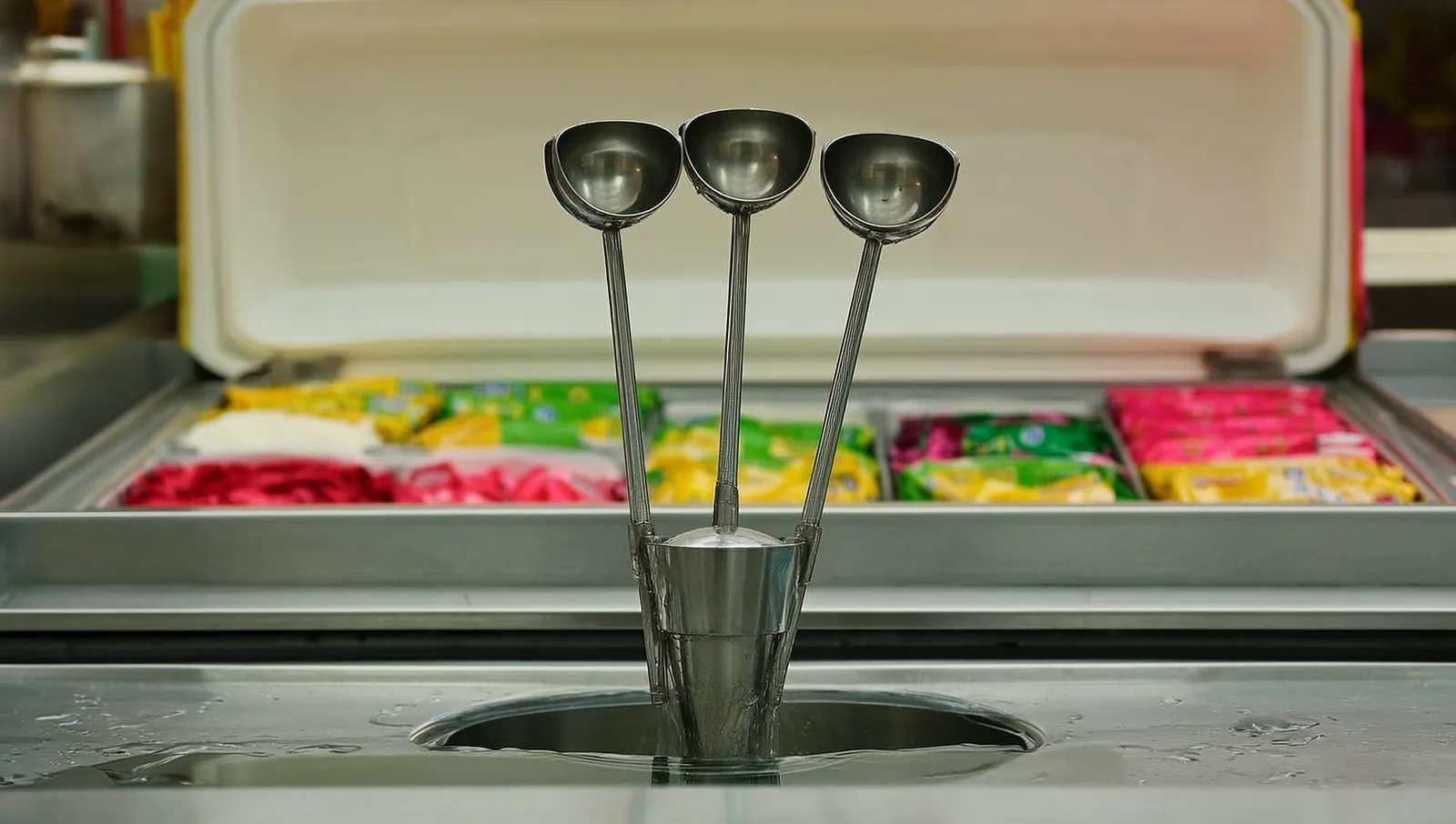
Most shops park their scoops in a dipper well, that small basin of running or standing water beside the freezer. It exists to keep the scoop from gumming up between servings, and it does that job well. What it does not do is sanitize. Water at ambient temperature that has been holding a dairy-coated scoop all afternoon is not a clean-room step, and dipping a scoop from dairy vanilla into sorbet transfers milk protein no matter how good the swirl looks. This is not a theoretical worry. A published case report describes a milk-allergic child who went into anaphylaxis after eating a sorbet labeled pareve that had been produced on shared equipment, and a shared scoop is the same mechanism at a smaller scale.
The fix is one sentence and it works almost everywhere: ask for a clean scoop from the drawer, not the well, and a fresh tub if one is available. Most shops will do it without blinking. The ones that push back have told you something useful.
Soft Serve and the Shared Spout
Soft serve is a different animal, because you are not dealing with a tub you can swap. You are dealing with a machine.
Liquid mix sits in a hopper, gets drawn into a refrigerated freezing barrel, and comes out through a spout and a lever. A dairy-free mix in that machine still travels through a barrel and a spout that ran dairy earlier, and those components are cleaned on a schedule (often nightly), not between customers. So the only question that matters is architecture, and there are three answers:
- A dedicated machine. The plant-based mix has its own unit. This is the clean answer, and shops that have invested in one are usually happy to say so.
- A dedicated barrel on a twin unit. Better than nothing, but twin-barrel machines often share a single dispensing nozzle assembly or a common drip tray. Ask specifically whether the spout is shared.
- One machine that switched mix. Increasingly common, and potentially the best outcome of all. Some operators have moved their entire soft serve program to a plant-based mix so there is a single product for every customer. That is reportedly what happened at Legoland, where staff pointed a customer to a Flora Professional plant-based mix as the park-wide default. Worth knowing about, worth verifying yourself, because at the time that story ran the park had not confirmed a company-wide switch publicly. One employee’s account of one carton is a lead, not a policy.
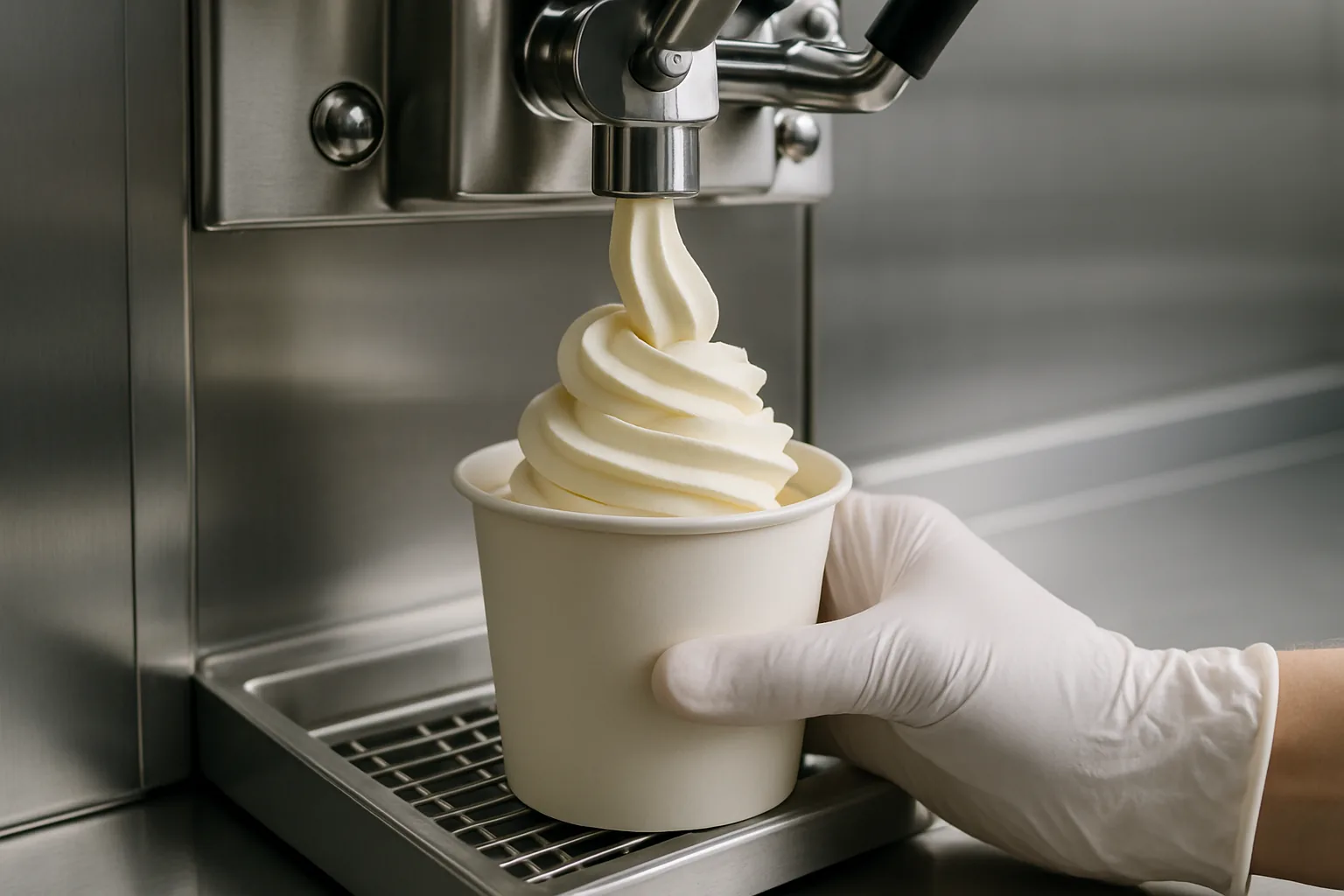
Rotating dairy-free soft serve is spreading through independent stands too. Softie Delite in Livermore Falls, Maine has been running non-dairy flavors like mango and key lime pie on rotation. Encouraging, and still worth the barrel question.
How to Read a Scoop Trail or City Roundup
Curated lists are how most people find these places now. PETA launched a Pennsylvania “Nice Cream Trail” spotlighting vegan frozen desserts across the state. VegNews maintains a 48-shop national roundup. Local outlets publish regional lists every June, like the Niagara guide that flags which gelaterias keep water-based sorbetto alongside the milk-based case.
Use them for discovery. Do not use them for allergen clearance. Almost all of these lists are compiled from a vegan perspective, where the test is “does the recipe contain animal products.” That is an ingredient question. Cross-contact is a process question, and a shop can pass the first test and fail the second. Lists also go stale fast: seasonal stands change flavors weekly and shops close. Treat any roundup as a call-ahead list rather than a guarantee.
One roundup-specific trap: at a gelateria, “water-based” or sorbetto is usually your dairy-free lane, but it is scooped from the same case with the same paddles. And if you are ordering a sorbet course at a restaurant rather than a shop, check whether it is spiked, since wine and spirits turn up in sorbet more often than menus admit.
Small Towns Are Not the Dead Zone They Were
The most encouraging shift is geographic. A 2026 survey found dairy-free scoops at stand after stand in western Maine towns most people have never heard of: Oatmazing oat milk flavors at Sweet Scoops in Jay, a rotating fruit sorbet at the Bethel Sugar Shack, vegan coconut milk ice cream at Pine Tree Frosty in Rangeley, vegan vanilla and mango sorbet at the Farmer’s Daughter in Oquossoc, raspberry sorbet at Wilson Stream in Wilton.
Buried in that same survey is the trap that catches people constantly. Several stands stock Hood Lactaid cups, and a stand carrying Lactaid is not a stand carrying dairy-free. Lactose-free products are real dairy treated with the lactase enzyme, so the casein and whey are fully intact and completely unsafe for a milk allergy. If you only remember one distinction from this article, make it that one.
The Away-From-Home Script
Chain menus deserve their own treatment, and I cover the national players flavor by flavor in the 2026 chain guide. What follows is the part that travels with you anywhere:
- Call before you drive. Seasonal stands rotate weekly and sell out. Two minutes on the phone saves a wasted trip with a disappointed kid in the back seat.
- Say the word allergy. A stated allergy triggers a protocol. A stated preference usually triggers nothing.
- Ask about architecture, not just ingredients. Separate machine or separate barrel? Shared spout? Clean scoop from the drawer?
- Ask to see the packaging. The operator has the tub or the mix carton in back, and that carton has the allergen statement your scoop does not.
- Go early. Fresh tubs, recently cleaned equipment, and staff who are not slammed all improve your odds.
- Default to a cup. Cones are a common hidden source of milk, wheat, and soy, and the waffle cone almost always contains dairy.
- Bring a backup for events. Theme parks, fairs, and birthday parties combine high volume with high staff turnover, which is the worst possible combination. A packed novelty in a cooler bag ends the negotiation.
Sorbet remains the near-universal fallback, and knowing the difference between formats helps you spot the safe lane on an unfamiliar menu board.
None of this needs to be grim. The trend is genuinely good, the shops are multiplying, and most operators want to get it right. But the verification still sits with you, every visit, every location. Ask the three questions, take the clean scoop, and the treat stays a treat.
Further reading (sources)
- Sun Journal on dairy-free scoops turning up at small western Maine stands
- VegNews for a national roundup of all-vegan scoop shops
- VegNews with where the best dairy-free soft serve is being poured
- Plant Based News asking whether a theme park really switched its soft serve to plant-based by default
- Pittsburgh Post-Gazette covering PETA’s Pennsylvania vegan frozen dessert trail
- Axios Charlotte reporting an all-vegan ice cream shop expanding into the suburbs
- Cambridge Times listing which Niagara gelaterias keep a water-based case
- Annals of Allergy documenting anaphylaxis from a pareve-labeled sorbet made on shared equipment