How to Convert Any Ice Cream Recipe to Dairy-Free: Cream, Condensed Milk, and Evaporated Milk
Published on September 9, 2026
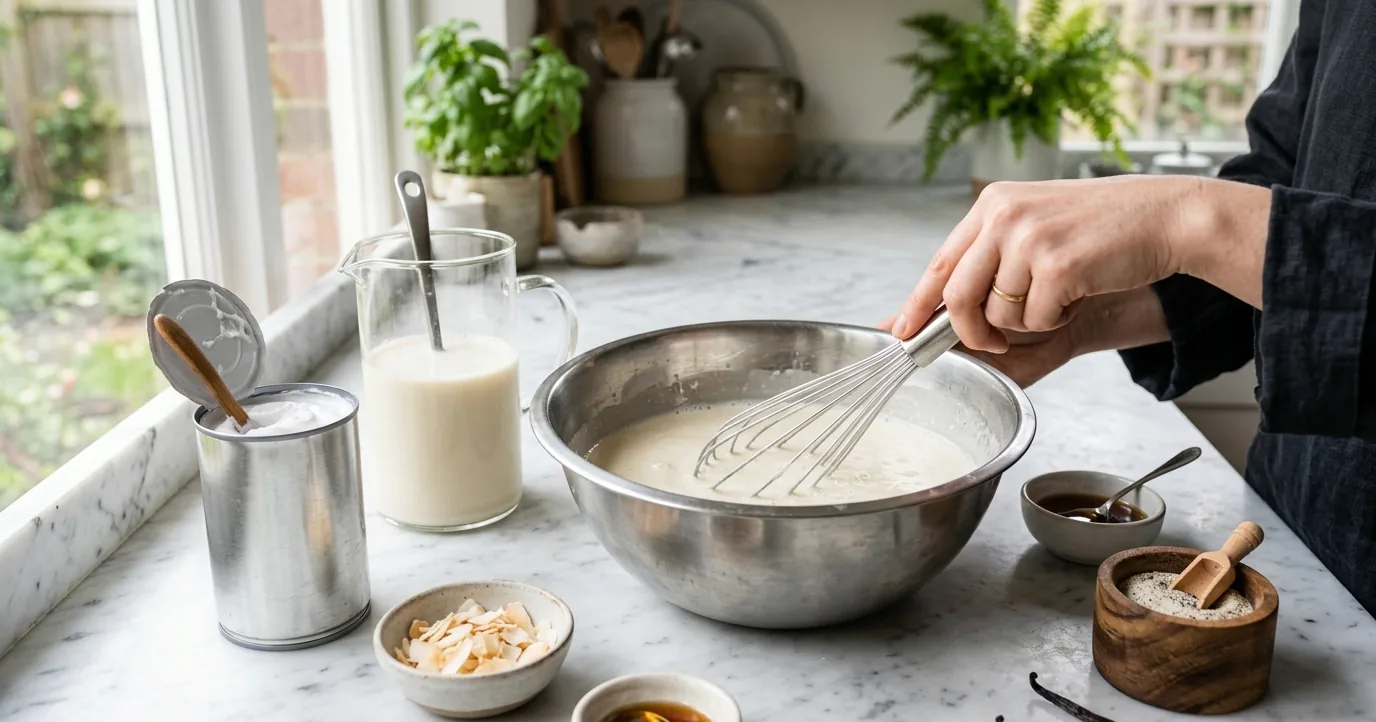
Almost every dairy substitution chart on the internet was written for baking. Swap almond milk for whole milk in a muffin and you get a muffin. Swap it into an ice cream base and you get a block of sweetened ice you have to chip at with a spoon.
The difference is simple. Baking drives water off. Freezing locks it in place. A cake batter only asks a substitute for roughly the right liquid and roughly the right fat, and it forgives both. A churn asks for the right fat and the right total solids, because every gram of water you fail to bind becomes a crystal you can feel on your tongue. That is why a swap can be flawless in a batter and useless in a freezer, and why the generic charts keep letting people down. Here is what to actually do with a conventional recipe, ingredient by ingredient.
Why a Frozen Swap Is Not a Baking Swap
Dairy is doing four jobs at once in an ice cream base, and a substitute has to cover all four.
The University of Guelph’s ice cream technology reference puts a standard mix at 10 to 16 percent fat and 9 to 12 percent milk solids-not-fat, the fraction carrying protein, lactose, and minerals. On a dry basis that solids fraction runs roughly 38 percent protein, 54 percent lactose, and 8 percent ash. Fat gives richness and slows the melt. Protein binds water and holds the air you churn in. Lactose is a sugar, so it lowers the freezing point and keeps the mix soft. Even at a typical serving temperature of -16°C, only about 72 percent of the water in ice cream is frozen, and that unfrozen fraction is the entire reason a scoop yields to a spoon.
Pour in an unsweetened almond milk and you have replaced all four of those jobs with water. That is the failure mode in one sentence, and it explains nearly every icy dairy-free batch anyone has ever made.
So judge every swap below on two questions. Does it bring the fat? Does it bring the solids?
Heavy Cream: The Swap That Decides Everything
Heavy cream runs about 36 percent fat. Nothing plant-based off the shelf matches that number, so this is the swap that sets the ceiling for the whole recipe.
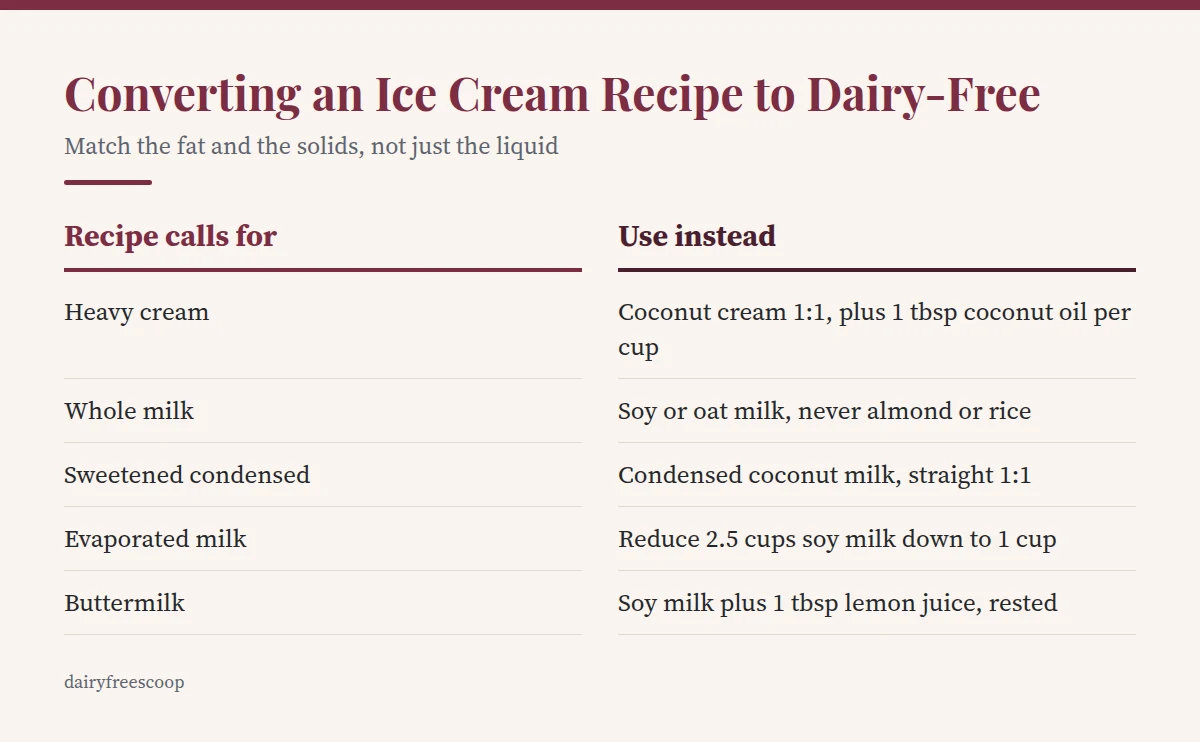
Coconut cream, 1:1. Chill a can of full-fat coconut milk for an hour, skim the thick layer off the top, and use it cup for cup. This is the standard recommendation and it works, with one thing worth knowing: coconut cream lands around 20 to 25 percent fat, so a straight 1:1 swap arrives roughly a third short. Close the gap with 1 tablespoon of refined coconut oil or melted cocoa butter per cup of cream you replaced.
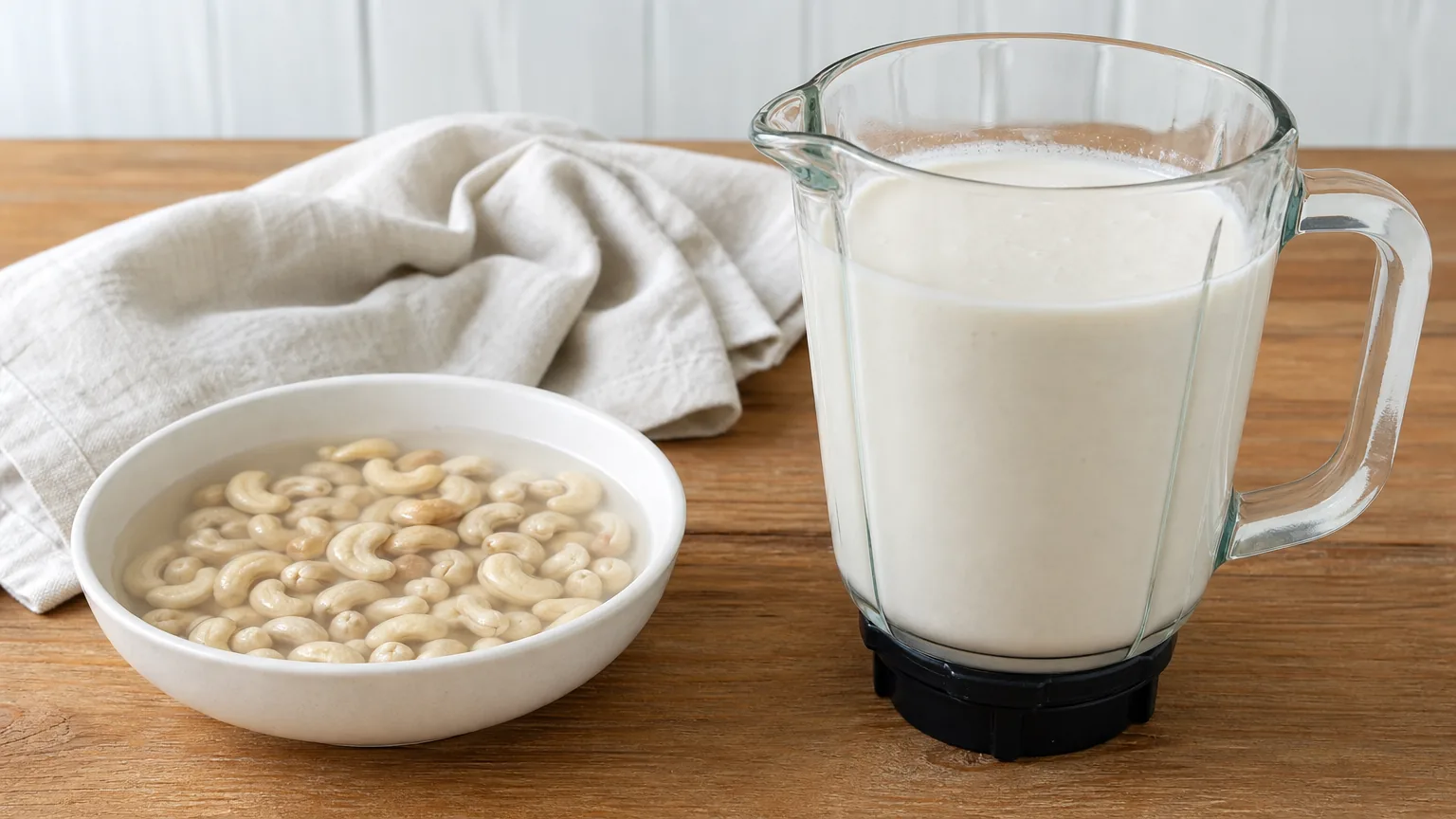
Cashew cream, the texture winner. Soak 1 cup of raw cashews, blend with 3/4 cup of water, and you get the only common swap that brings meaningful fat and real protein in the same pour. It costs more and it carries a tree nut flag, but nothing else replaces both halves of what cream was doing.
Plant milk plus fat. Two thirds cup of soy milk with a third cup of melted vegan butter equals a cup of cream in most recipes. In a frozen base, insist on a fat that is solid at fridge temperature (refined coconut oil, cocoa butter, a vegan butter block) rather than a liquid oil. Olive and canola never crystallize, so instead of giving the base body they coat your tongue with grease.
Silken tofu, 1:1. Excellent advice for a sauce, only half right here. Tofu brings protein and water but almost no fat, so treat it as a solids booster alongside a real fat, never as the cream itself.
Store-bought plant whipping creams are the nearest drop-in, already emulsified and gummed. Read the panel anyway: several products marketed as “non-dairy” creamers still list sodium caseinate, which is a milk protein, and that is one of the classic traps in reading a dairy-free label properly.
One behavioral note that catches people out. Butterfat melts across a wide temperature range, so dairy ice cream softens gradually. Coconut fat melts over a narrow band close to room temperature, so a coconut base freezes harder and then slumps quickly once it goes. Give it ten minutes on the counter, and do not push the fat much past 18 percent or the texture turns waxy. That same sharp curve is why shops running plant flavors next to dairy ones hold their cabinets differently.
Whole Milk and Half-and-Half: Where Protein Decides It
Whole milk is only 3.25 percent fat, so people assume it is the easy swap. It is not, because it is also carrying 8.5 percent solids and about 3.3 grams of protein per cup, and the protein is what stops ice crystals from growing.
Soy is the honest 1:1. Around 3 grams of protein per cup, the only mainstream plant milk in the same league as dairy. Use it wherever a recipe says whole milk.
Oat punches above its protein. Barely 1 gram per cup, yet oat performs far better in a churn than that suggests, because the enzyme treatment that makes oat milk sweet leaves maltose and dextrins behind. Those are dissolved solids, and dissolved solids bind water and depress the freezing point exactly as lactose did. Reach for a barista blend, which has added oil.
Pea protein milks carry around 8 grams per cup, more than dairy, and they are the quiet weapon for anyone avoiding both nuts and soy.
Almond and rice are the ones that fail. Roughly a gram of protein, next to no fat, and in rice’s case essentially sugar water. They are why so many first attempts come out gritty. The full base by base comparison covers what each one is good at, and frozen structure is not on almond’s list.
For half-and-half, which sits around 10 to 12 percent fat, mix one part coconut cream with one part unsweetened soy or oat milk and use it 1:1.
Sweetened Condensed Milk: The Easiest Conversion Here
Condensed milk is roughly 45 percent sugar and over 70 percent total solids, and in a no-churn recipe those two numbers are its entire job. Both are easy to replace, which makes this the most forgiving swap on the list.
Canned sweetened condensed coconut milk substitutes 1:1 and is now stocked in most large supermarkets, with oat versions appearing alongside it. Cream of coconut also goes in 1:1, though it is sweeter and unmistakably tropical, so save it for a flavor that wants that. To make your own, simmer two cans of full-fat coconut milk with about half a cup of sugar until it reduces to roughly a third of its volume.
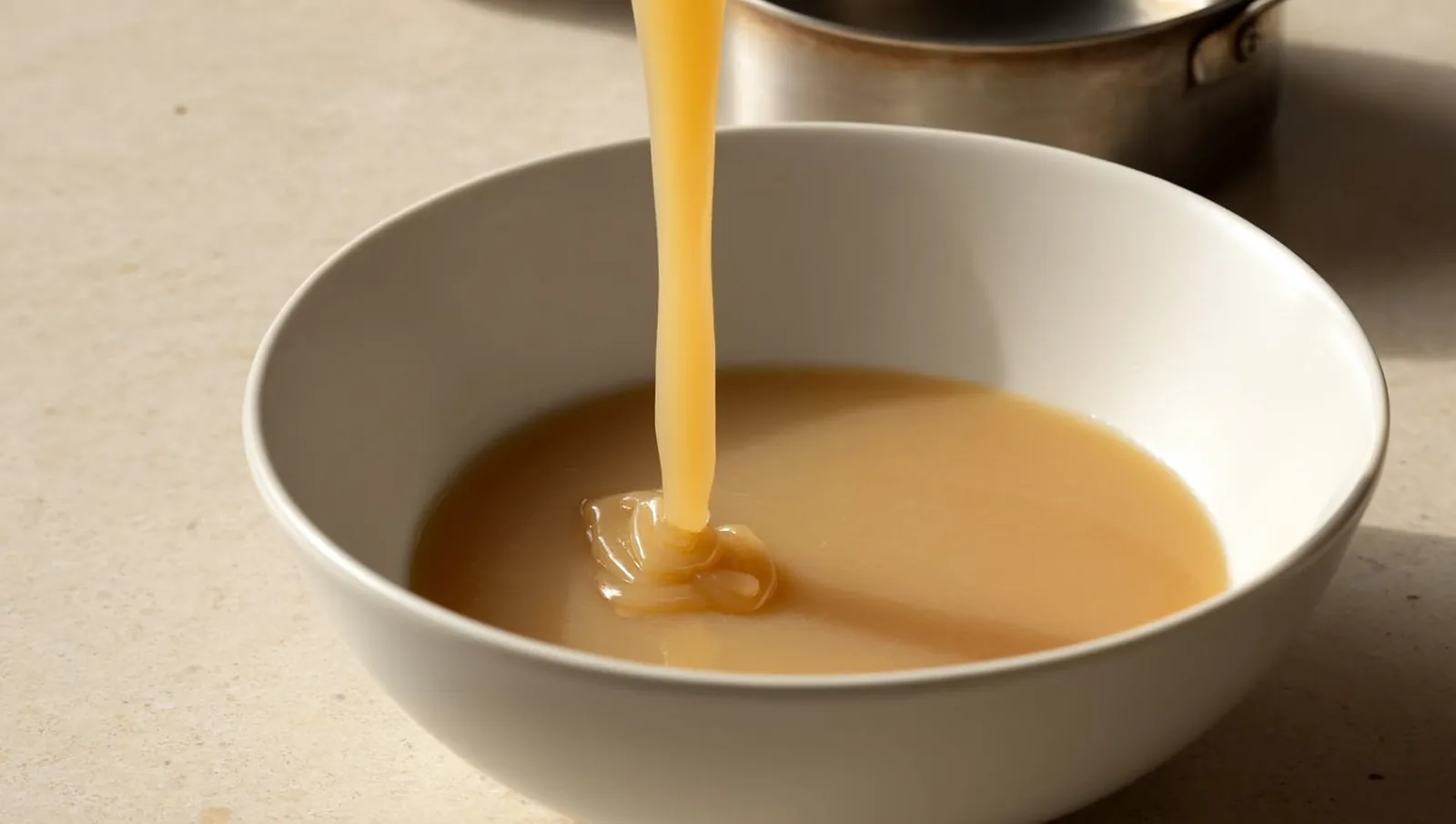
What does not work is reaching for maple syrup or agave at 1:1. You get the sweetness and none of the solids or fat, and a no-churn base built that way stays slack and never sets. If you want the flavor, cap it at about a quarter of the volume and make up the rest with coconut cream. The sweetener reference covers how each one moves the freezing point.
Evaporated Milk: The Hardest One
Evaporated milk is whole milk with around 60 percent of its water removed and no sugar added, which leaves roughly 25 percent total solids and a heavily concentrated dose of protein. That protein is the point, and it is what makes this swap genuinely difficult rather than merely fiddly.
The quick version: let a can of full-fat coconut milk settle for half an hour and use the thin liquid underneath 1:1. Light canned coconut milk works straight from the can, and one can gives you about 1 3/4 cups. Both bring body but no protein, so add 2 tablespoons of plant milk powder or a tablespoon of cashew butter per cup to put the water-binding back.
The version that actually tastes right: reduce it yourself. Simmer 2 1/2 cups of unsweetened soy milk down to 1 cup over medium-low heat, stirring. Soy is the one plant milk that concentrates protein as the water leaves, so it behaves closest to the original. Plant milks scorch faster than dairy, so keep it below a boil and keep the spoon moving.
Buttermilk: Only Soy Behaves
Buttermilk is about 1 percent fat with a pH near 4.5, so in a frozen dessert it is there for tang, not for richness. The standard swap is a cup of plant milk with a tablespoon of lemon juice or vinegar, rested five minutes.
The catch is that only soy genuinely curdles, because the acid coagulates soy protein the way it coagulates casein. Do this with oat or almond and you get the sourness with none of the thickening, which is fine in a pancake and disappointing in a sherbet. For a richer result, thin cultured coconut or cashew yogurt with water to pouring consistency. That gives you fat, protein, and live-culture tang in a single ingredient.
Swaps That Work in Baking and Fail in the Freezer
- Almond or rice milk for whole milk. Fine in a quick bread, gravel in a churn.
- Applesauce or mashed banana for fat. They hold moisture in a cake and freeze into fruity ice in a base. Banana only works when it is the dessert, as in nice cream, where the fruit’s own cell structure does the job.
- Liquid oil 1:1 for butter. Butter is around 16 percent water and oil is 100 percent fat, so a straight swap overshoots and leaves a greasy film.
- Aquafaba for eggs. A superb aerator, so it carries a semifreddo where whipped air does the structural work. It brings no fat and almost no solids, so it cannot stand in for yolks in a churned custard, where lecithin is emulsifying rather than foaming.
- Cornstarch slurry for cream. Thickens beautifully hot, then weeps on freezing and thawing. Tapioca and arrowroot hold up far better through a freeze.
Two Adjustments Every Converted Recipe Needs
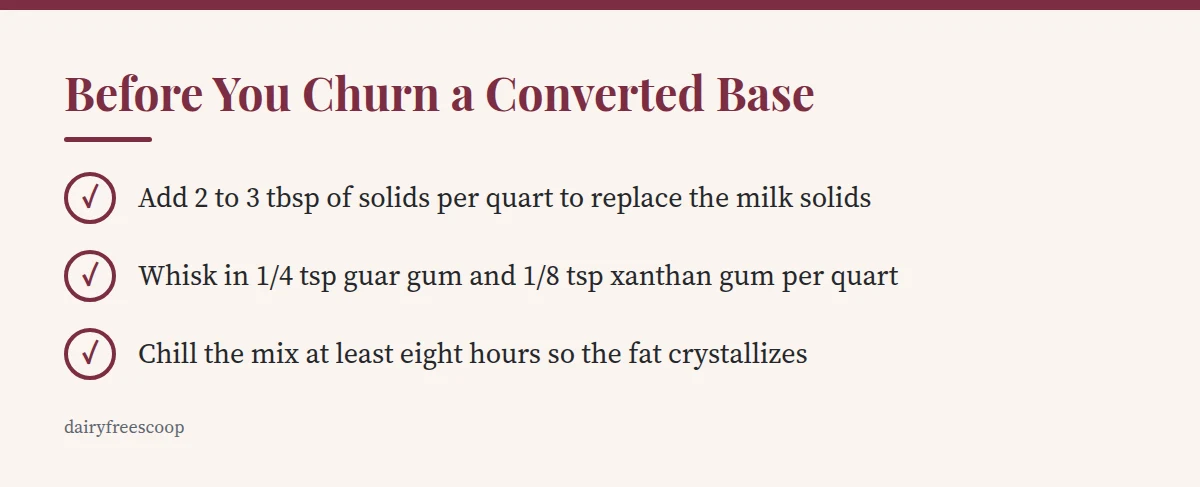
Put the solids back. Taking dairy out removes 9 to 12 percent milk solids-not-fat, and no plant milk restores that on its own. Add 2 to 3 tablespoons per quart of plant milk powder, cashew butter, cooked-in oat flour, or unflavored pea protein. A tablespoon or two of tapioca syrup or glucose does the freezing-point half of the job without making the base sweeter.
Add a stabilizer. Casein is a natural emulsifier and plant bases have no equivalent, which is why converted recipes separate or turn coarse on the second day. About 1/4 teaspoon of guar gum plus 1/8 teaspoon of xanthan per quart covers it, or use a commercial blend at around 0.25 percent of mix weight. The gums and emulsifiers reference explains what each one is doing.
A Worked Conversion
Take a standard custard base: 2 cups heavy cream, 1 cup whole milk, 3/4 cup sugar, 5 egg yolks. Converted, it becomes:
- 2 cups coconut cream, plus 2 tablespoons refined coconut oil
- 1 cup unsweetened soy milk
- 3/4 cup sugar, plus 2 tablespoons tapioca syrup
- 2 tablespoons cashew butter in place of the yolks
- 1/4 teaspoon guar gum and 1/8 teaspoon xanthan gum
Blend everything hot so the gums hydrate and the fat emulsifies, then chill at least eight hours before churning. Aging matters more here than it did with dairy, because without casein the fat needs that time to crystallize properly.
The Bottom Line
Converting a recipe is not really about finding a dairy-free version of each ingredient. It is about accounting for fat and solids separately, then putting back the roughly 10 percent of milk solids that walked out the door with the dairy. Get those two right and almost any conventional recipe converts cleanly. Skip them and no substitute on the shelf will save the batch.
If you would rather build a base from the ground up than convert one, the homemade master guide covers the whole method from ratios to hardening.
Further reading (sources)
- Go Dairy Free on swapping cream when the recipe will not forgive a thin one
- Go Dairy Free for the condensed, evaporated, and buttermilk conversions in one place
- University of Guelph with what milk solids-not-fat actually contribute to a mix
- University of Guelph with the fat and solids ranges a standard mix is built to hit
- Minimalist Baker on getting a can of coconut milk to whip instead of split
- Minimalist Baker for the soak and blend ratio behind a decent cashew cream