Dairy-Free Ice Cream and Your Gut: A Condition-by-Condition Guide for IBS, GERD, Crohn's, and More
Published on October 10, 2026
When your gut acts up, dairy is usually the first suspect, and the freezer case makes it an easy one to drop. But going dairy-free takes exactly two things out of a frozen dessert, lactose and milk protein, and leaves in everything else your digestive system might object to. A typical plant-based pint carries around 12 grams of fat a serving, and it may also be sweetened with sugar alcohols, made creamy with cashews, topped up with chicory root fiber or studded with wheat cookie pieces. Which of those matters depends on what is actually wrong, so this guide goes condition by condition, drawing on NIH diet guidance and gastroenterology guidelines. Treat it as a map rather than a prescription: your own doctor or dietitian knows your gut.
What Dairy-Free Removes, and What It Leaves In
Lactose is the milk sugar that people short on the lactase enzyme cannot fully digest, and it is one of the FODMAPs, the fermentable carbohydrates behind a lot of IBS bloating. A dairy-free pint removes it. So does a lactose-free one, which is real dairy with the sugar already split, but only dairy-free also removes the casein and whey that matter for a milk allergy. I unpack that difference in lactose-free vs dairy-free ice cream.
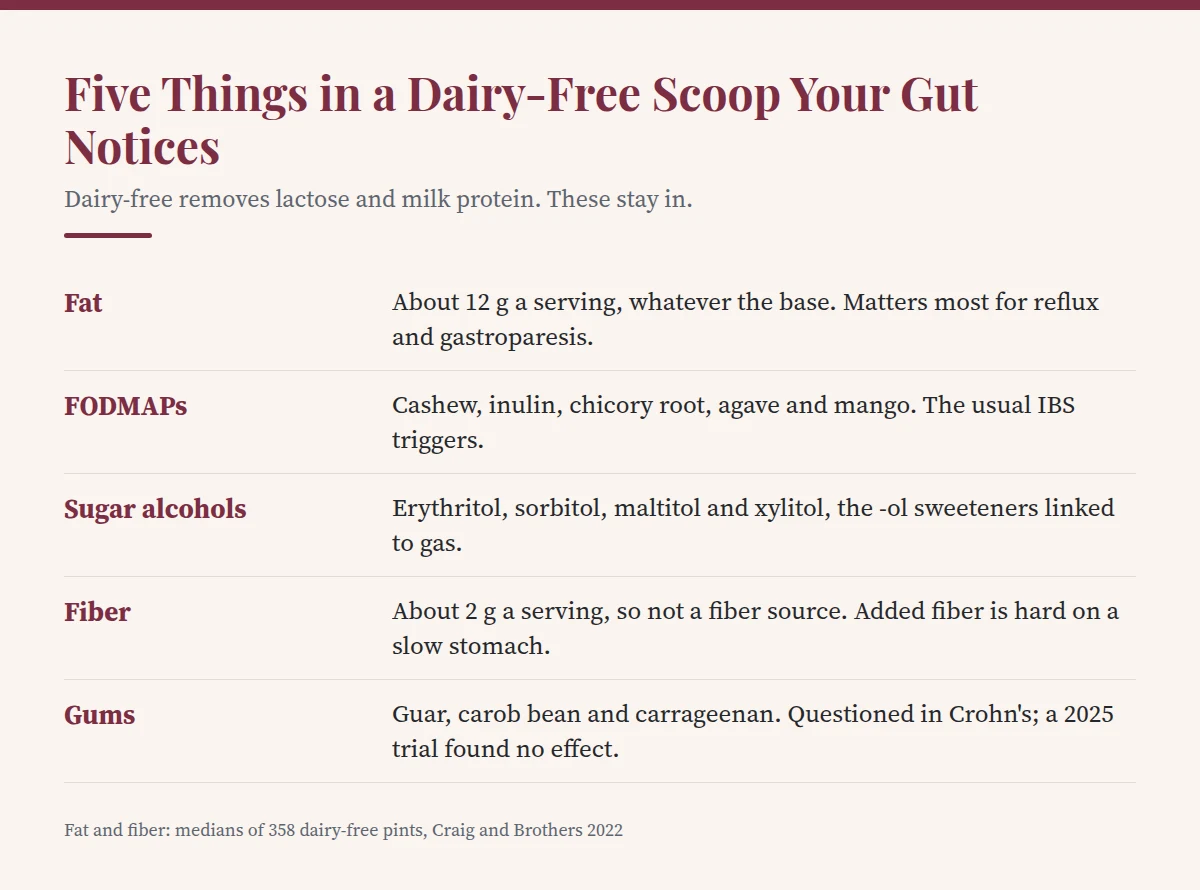
The most detailed picture of what stays in is a survey by Craig and Brothers, who recorded the labels of 358 dairy-free pints sold in US supermarkets in early 2022:
- Fat. The median serving held 12 grams, and the base barely moved it. Coconut, almond and soy pints all sat at 12 grams, oat at 11 and cashew at 13. Only the saturated share changed, from 3 grams in soy pints to 10 in coconut.
- Fermentable fibers. About one pint in five contained inulin or chicory root extract. Counting agave syrup, which the authors group with them as an inulin source, the share rose to roughly 30 percent.
- Sugar alcohols. Thirty pints used erythritol. NIDDK names it, along with sorbitol, mannitol, xylitol and maltitol, among the “-ol” sweeteners that can cause gas.
- Very little fiber. The median was 2 grams a serving.
- Gums. Guar and carob bean gum were the usual stabilizers, with carrageenan in a few.
IBS: Lactose Is Only One FODMAP
The American College of Gastroenterology recommends a limited trial of a low-FODMAP diet for IBS, and NIDDK describes the same idea as a few weeks of cutting hard-to-digest carbohydrates to see whether symptoms ease. It is a trial measured in weeks, best done with a dietitian, not a permanent list of banned foods.
Lactose is one of those carbohydrates, so swapping to a dairy-free pint can help. It is not the only fix. Monash University, whose team developed the diet, lists lactose-free milk as low-FODMAP and stresses that dairy is not excluded, so lactose-free dairy is an option if milk protein is not your problem. What catches people out is that the dairy-free aisle brings FODMAPs of its own:
- Cashew bases. Monash puts cashews among the high-FODMAP nuts, carrying fructans and GOS. Almond milk and rice milk are low.
- Soy, depending on how it is made. Soy milk made from whole soybeans is high in GOS, while soy milk made from soy protein is low. The ingredient list tells you which you have.
- Inulin and chicory root. Monash warns that even small amounts of these purified fibers add a lot to a food’s FODMAP load, which is why the pint sold on gut health can be the worst one for an IBS gut.
- Fruit and sweeteners. Mango, cherry, peach, apple and watermelon are high in excess fructose or sorbitol, and so are honey and high-fructose corn syrup. Pineapple, orange, kiwifruit and blueberry are low, as are table sugar and maple syrup.
- “No sugar added” pints. Monash notes that low-sugar products often get their sweetness from polyols at high doses. I compare how each sweetener behaves in sweeteners in dairy-free ice cream.
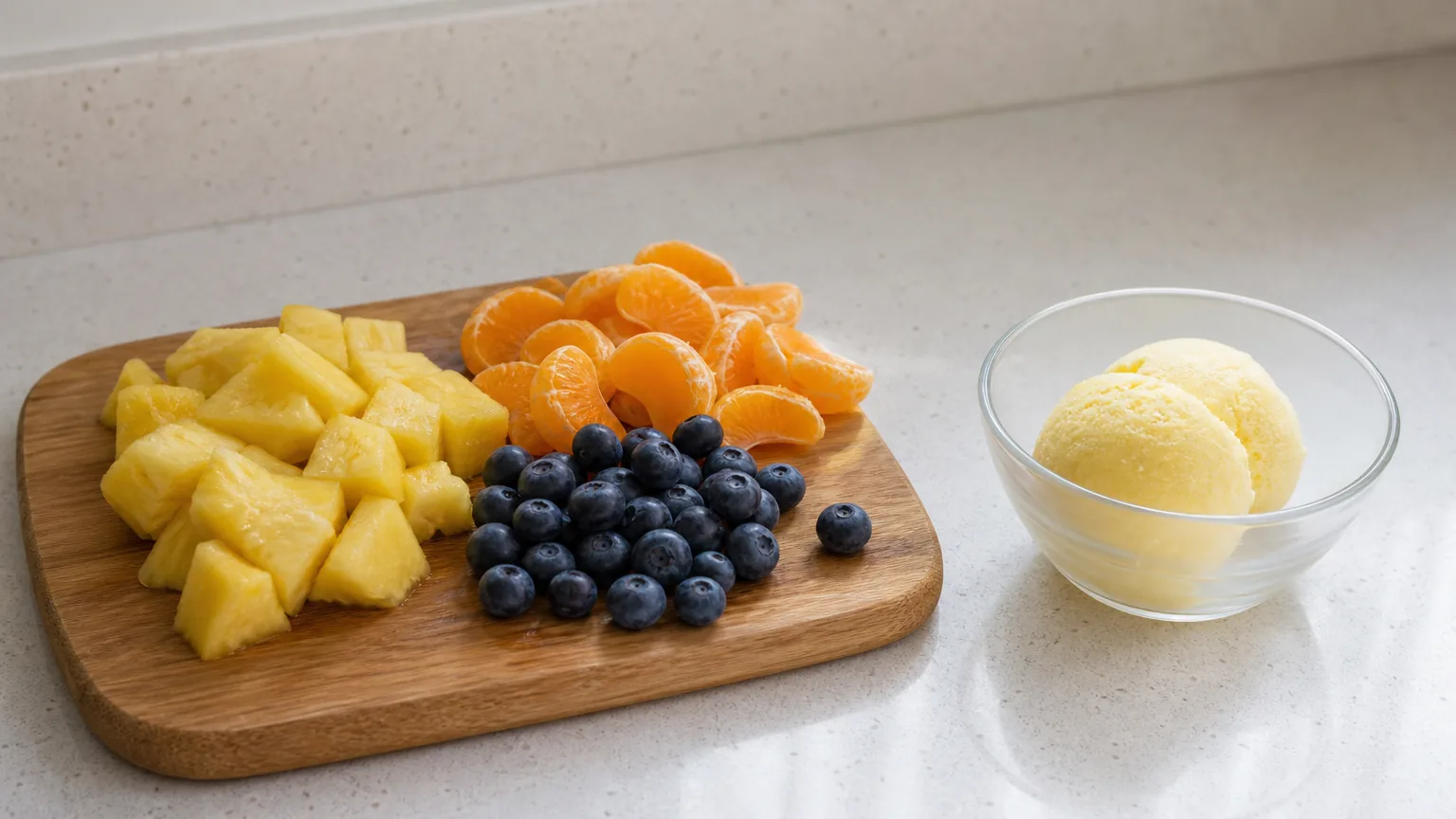
During the elimination phase, the simplest scoop is a plain almond, rice or soy-protein pint sweetened with sugar, or a pineapple, orange or blueberry sorbet. After that, the point is to learn your own limits, not to live on sorbet.
Reflux and GERD: Fat, Flavor, and the Clock
Reflux is where dairy gets blamed most and matters least. The American College of Gastroenterology’s 2022 GERD guideline lists the foods commonly linked to reflux: coffee, chocolate, fizzy drinks, spicy and acidic foods, and foods high in fat. In lab studies, chocolate, peppermint, alcohol and high-fat foods lower the pressure in the muscular valve between the stomach and esophagus. Dairy as such is not on the list. Fat is. The guideline also admits that few studies show avoiding these foods helps, so it treats trigger foods as something to identify for yourself.
The suspects are some of the most popular flavors in the case. Of the 358 pints in Craig and Brothers’ survey, 76 contained chocolate, 29 were mint and 19 coffee. If fat or chocolate is your trigger, a coconut pint will not fix reflux that a dairy pint caused.
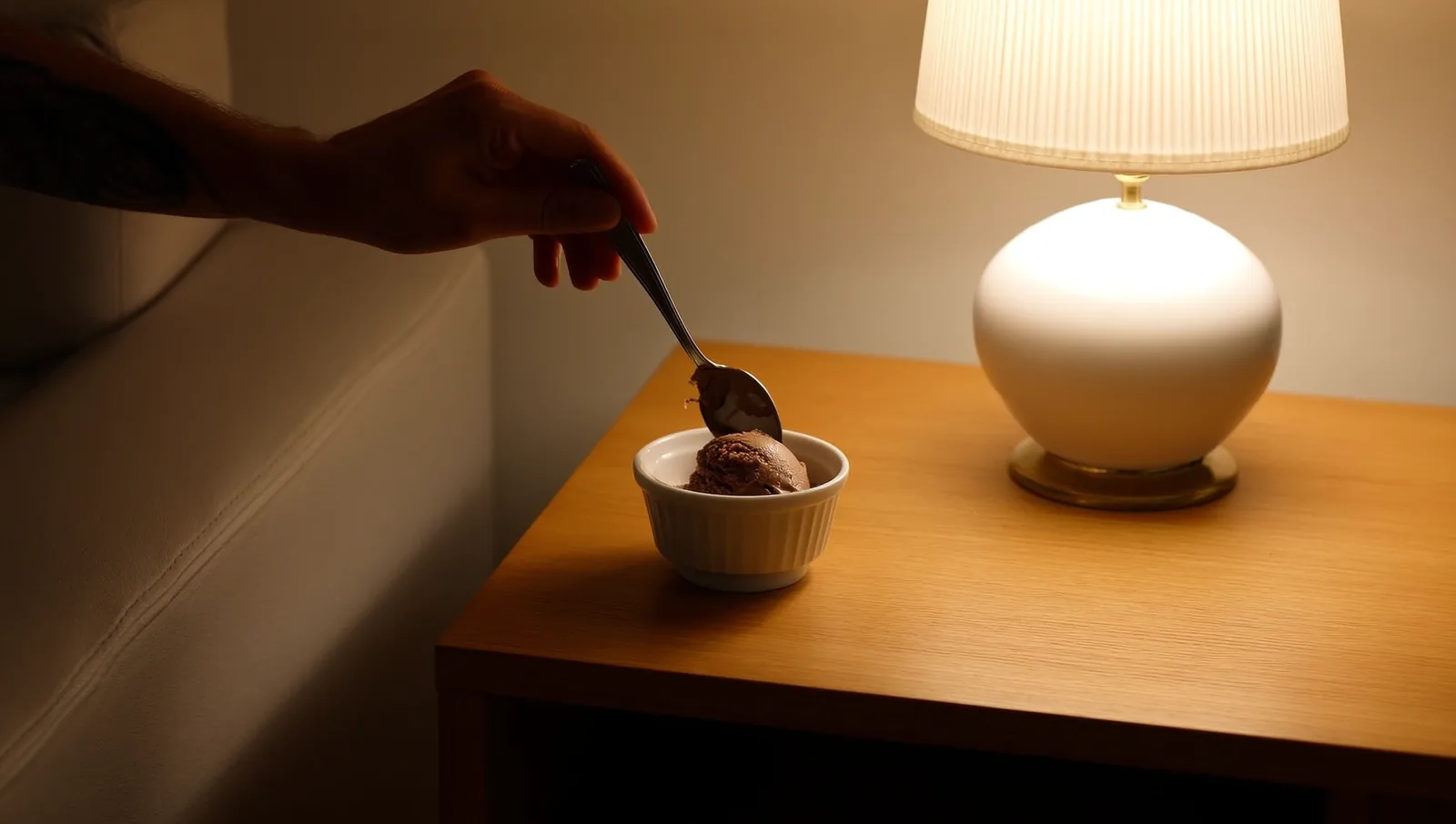
Timing matters as much as the tub. The guideline suggests avoiding meals within two to three hours of bedtime and raising the head of the bed for nighttime symptoms, which makes the bowl on the couch at 10 p.m. the worst version of the habit. A small serving soon after dinner, in vanilla or a fruit flavor if chocolate and mint bother you, is the reflux-friendly order. Sorbet is the lowest-fat format, though a lemon or orange one trades fat for acid, and citrus is on the same list.
Celiac Disease: Two Label Checks, Not One
Celiac disease adds a second check rather than replacing the first. The intestinal damage gluten causes also cuts lactase, which is why dairy often turns on people around diagnosis, and that secondary lactose intolerance can take a year or more on a gluten-free diet to lift. A dairy-free pint handles that half. The gluten risk sits elsewhere: in cookie, brownie and cone pieces, in malt, and in oat bases without a gluten-free claim of their own. A vegan or dairy-free label says nothing about gluten, so look for a gluten-free claim on the finished pint. I go through mix-ins, oats and both sets of label rules in celiac disease and dairy-free ice cream.
Crohn’s Disease: Texture, Fat, and the Emulsifier Question
There is no single Crohn’s diet. The Crohn’s & Colitis Foundation stresses that triggers vary from person to person, and that some cause trouble only during a flare. Its list of common triggers reads like a frozen dessert label, though: high-lactose foods including ice cream, foods high in insoluble fiber such as sunflower seeds and apple skin, and sugar alcohols and artificial sweeteners including sorbitol, mannitol, xylitol and sucralose. Dairy-free takes care of the first. The other two are worth checking on the pint.
Texture matters more if you have stricturing disease, where inflammation has narrowed part of the bowel. The foundation lists raw nuts, popcorn and dried fruit among foods that can cause problems, and suggests adjusting texture, such as nut butter in place of raw nuts and blended fruit in place of tough skins. In dessert terms, that means a smooth scoop or a sorbet over anything with nut pieces, cookie chunks or dried fruit, and a peanut butter swirl over chopped peanuts.
Two newer questions concern what dairy-free pints are made of. The same guide lists coconut oil and palm oil next to dairy fat among foods associated with more inflammation, so swapping a dairy pint for a coconut one does not move you off that list. It also files several additives under emerging evidence, including carrageenan, guar gum, carboxymethylcellulose and polysorbate 80, a worry that rests mostly on animal and lab studies. When Fitzpatrick and colleagues gave 24 adults with active Crohn’s a diet high or low in emulsifiers for four weeks, double-blind, disease activity improved on both with no significant difference, and the authors concluded that advice to avoid emulsifiers in active Crohn’s is not supported. A short ingredient list is a fair experiment if you suspect a gum, not a rule; I explain what each gum does in stabilizers and emulsifiers in dairy-free ice cream. And if frozen desserts help you keep calories up during a flare, most dairy-free pints carry little protein, as I found when looking at high-protein dairy-free ice cream.
Gastroparesis: Small, Smooth, and Low in Fat
With gastroparesis the stomach empties too slowly, and NIDDK’s diet advice is built around easing its job: foods and drinks low in fat and low in fiber, five or six small meals instead of two or three large ones, soft and well-cooked food, and liquids or blended food when solids will not go down. The foods to avoid are high-fat and high-fiber ones, anything hard to chew, fizzy drinks and alcohol.
A frozen dessert melts into a liquid, which works in its favor. In a small crossover study by Homko and colleagues, 12 people with gastroparesis ate four test meals on separate days. Symptoms climbed most after a high-fat solid meal and least after a low-fat liquid one, and nausea more than doubled after the high-fat solid. The American College of Gastroenterology’s 2022 guideline recommends a small-particle diet, citing a review that found small-particle, low-fat diets better tolerated.
So fat is the variable to manage. A serving of a typical plant-based pint, at about 12 grams of fat, is a high-fat liquid. A sorbet or fruit ice is a low-fat one and fits the advice far better, served small and free of nut, cookie and seed pieces. Pints with added chicory root or other fiber work against the low-fiber advice. If you have diabetes, NIDDK notes that your meal plan also has to manage blood glucose, and sorbet is mostly sugar, so the portion belongs in that plan.
Constipation: A Scoop Is Not a Fiber Source
Constipation is the one condition where you may want more from a frozen dessert than it can give. The median pint in Craig and Brothers’ survey held 2 grams of fiber a serving, and some pints add inulin or chicory root to raise that number. That fiber counts, but Monash’s researchers note it can bring gas and bloating for people with IBS, which matters if your constipation comes with IBS.
The British Dietetic Association’s 2025 guidelines, the first comprehensive dietary guidelines for constipation, are refreshingly specific. They found too little evidence to recommend a general high-fiber diet as treatment, but did recommend particular foods and supplements, including psyllium, kiwifruit and rye bread. Their practical advice for kiwifruit is two to three a day for at least four weeks. Kiwi purées into a lovely dairy-free sorbet, but a scoop holds much less fruit than that, so treat it as a top-up rather than the treatment.
There is one situation where going dairy-free is itself the intervention. Iacono and colleagues ran a double-blind crossover trial in 65 children aged 11 months to 6 years whose chronic constipation had not responded to laxatives. On soy milk, 44 of them (68 percent) improved; on cow’s milk, none did, and a blinded challenge with cow’s milk confirmed the result in all 44. Those were children referred to a specialist clinic, not every constipated toddler, so a milk-free trial is something to plan with the child’s doctor. If you do try one, the treats have to be truly free of milk protein. Lactose-free ice cream still contains casein and whey.
Diverticular Disease: Nuts and Seeds Are Back On
For decades, people with diverticulosis were told to avoid nuts, seeds, corn and popcorn to prevent complications, with little evidence behind the advice. Strate and colleagues followed 47,228 men for 18 years and found that eating nuts, corn or popcorn did not raise the risk of diverticulitis or diverticular bleeding, and the men who ate popcorn most often actually had a lower risk of diverticulitis. The American Gastroenterological Association’s 2021 practice update agrees, adding that fruits with small seeds such as strawberries and blueberries are not linked to diverticulitis either. The eating pattern it links to lower risk is high in fiber from fruit, vegetables, whole grains and legumes, and low in red meat and sweets. So a strawberry sorbet or a pint with nuts is fine. It is still a sweet.
A flare of diverticulitis is different. The AGA advises a clear liquid diet during the acute phase of uncomplicated diverticulitis, advancing as symptoms improve. MedlinePlus counts popsicles as clear liquids only if they have no bits of fruit, fruit pulp or yogurt, so a smooth fruit ice pop fits that stage. If your diet then moves through a full liquid stage, MedlinePlus lists plain ice cream, sherbet, and fruit ices and popsicles on it. Sherbet is not dairy-free, though: the federal standard requires 1 to 2 percent milkfat and up to 5 percent milk solids. The dairy-free versions of that stage are sorbet and plain dairy-free ice cream with no mix-ins.
The Bottom Line
Going dairy-free solves one problem well: lactose, plus milk protein if you react to it. Everything else depends on your diagnosis. With IBS, read the label for cashew, inulin, chicory root and the “-ol” sweeteners. With reflux, watch the fat, the chocolate and mint, and the clock. With celiac disease, look for a gluten-free claim on the finished pint. With Crohn’s, put texture first and don’t panic over a gum. With gastroparesis, go small, smooth and low in fat, which usually means sorbet. With constipation, get your fiber elsewhere, and with diverticular disease, stop picking out the strawberry seeds. Recipes and suppliers change, so read the label on every tub, and bring a dietitian in on any diet you plan to follow for longer than a short trial.
Further reading (sources)
- NIDDK on the carbohydrates and “-ol” sweeteners that cause gas, and the low-FODMAP trial for IBS
- NIDDK for what to eat and avoid with gastroparesis
- Craig and Brothers with the nutrition labels of 358 dairy-free pints, from fat to inulin
- Lacy and colleagues on the American College of Gastroenterology’s IBS guideline and its low-FODMAP recommendation
- Monash University, listing which foods are high and low in FODMAPs, from cashews to soy milk
- Monash University on reading labels for inulin, chicory root and polyols
- Katz and colleagues for the American College of Gastroenterology’s GERD guideline, bedtime meals and trigger foods included
- Crohn’s & Colitis Foundation with its IBD eating guide covering triggers, strictures and additives
- Fitzpatrick and colleagues on a double-blind feeding trial of emulsifiers in active Crohn’s disease
- Homko and colleagues on how fat and meal texture change gastroparesis symptoms
- Camilleri and colleagues for the American College of Gastroenterology’s gastroparesis guideline and the small-particle diet
- Dimidi and colleagues with the British Dietetic Association’s guidelines for managing constipation through diet
- Iacono and colleagues on a crossover trial of cow’s milk and chronic constipation in young children
- Strate and colleagues, following nut, corn and popcorn intake and diverticular disease in 47,228 men
- Peery, Shaukat and Strate for the American Gastroenterological Association’s diverticulitis practice update
- MedlinePlus on what counts as a clear liquid diet, popsicles included
- MedlinePlus listing the frozen desserts allowed on a full liquid diet
- Code of Federal Regulations on the milkfat and milk solids required in sherbet, 21 CFR 135.140